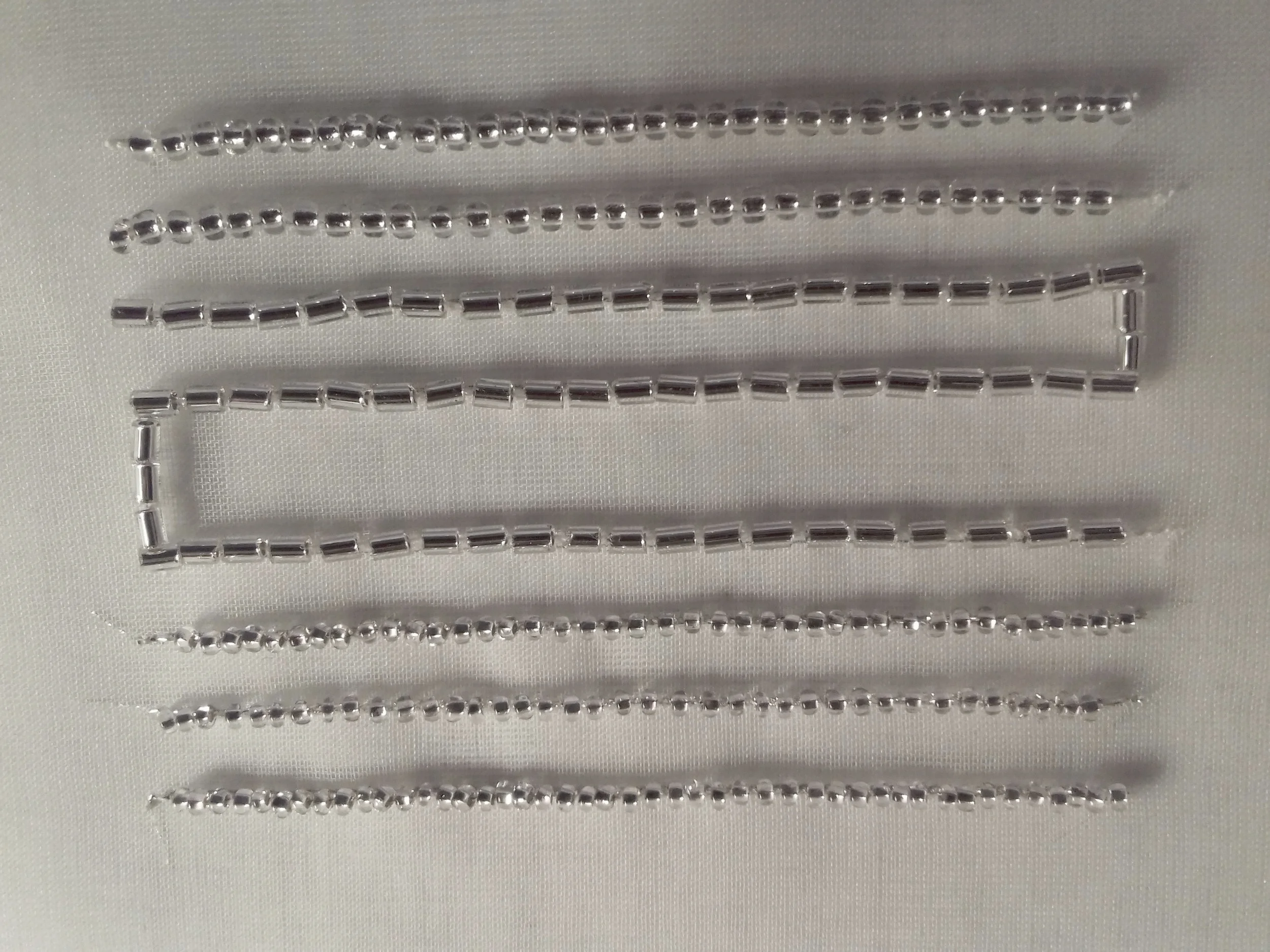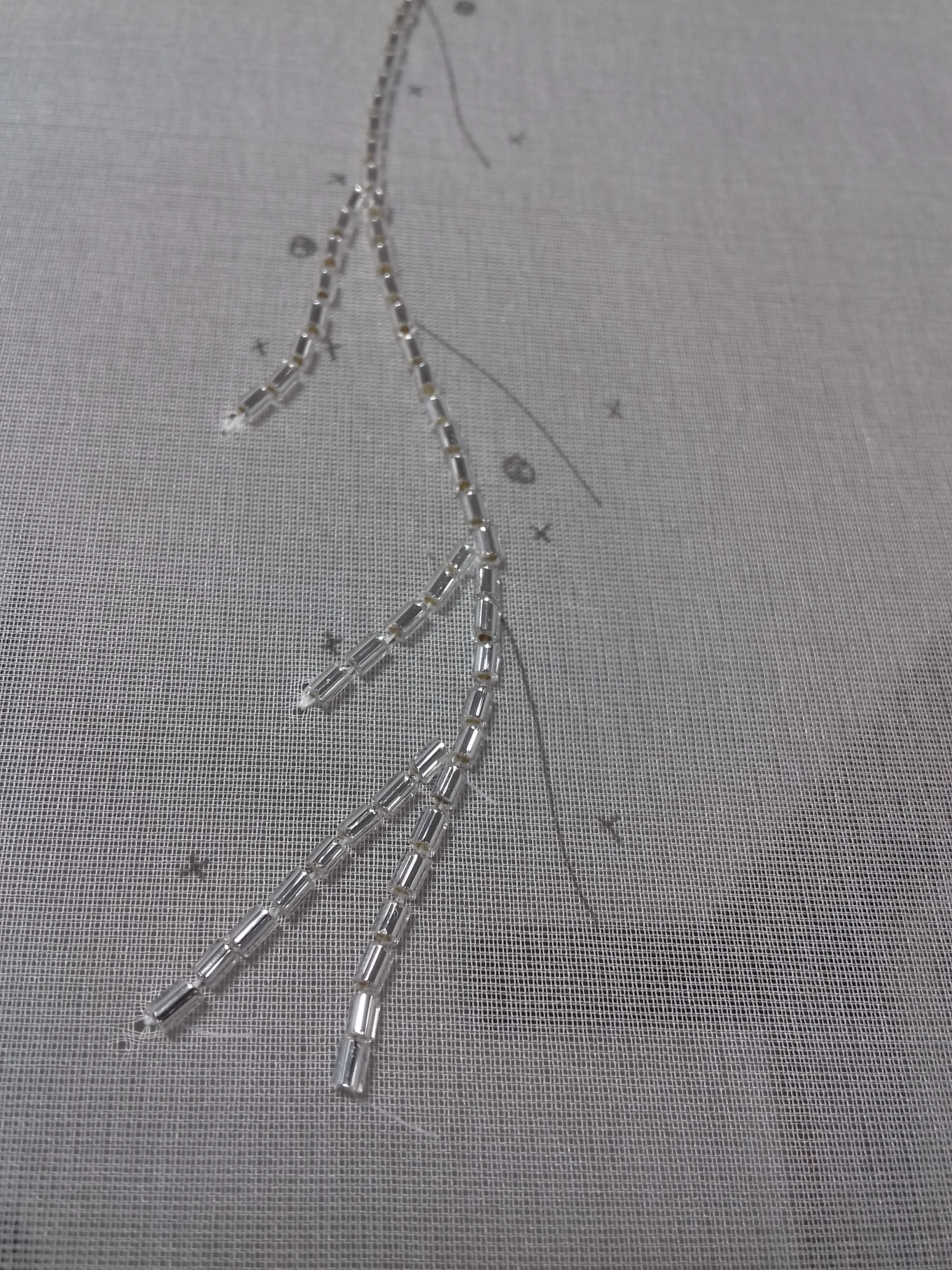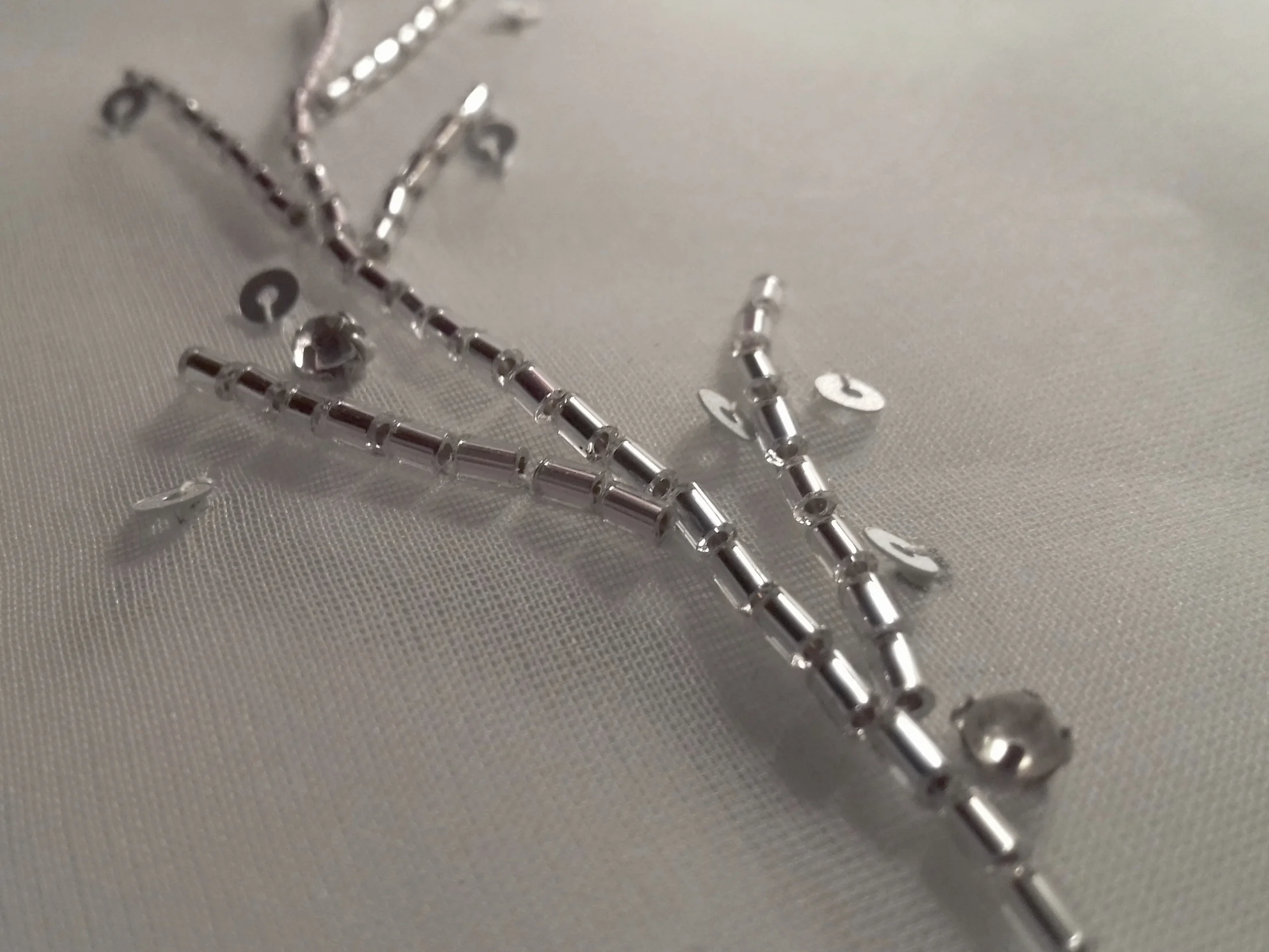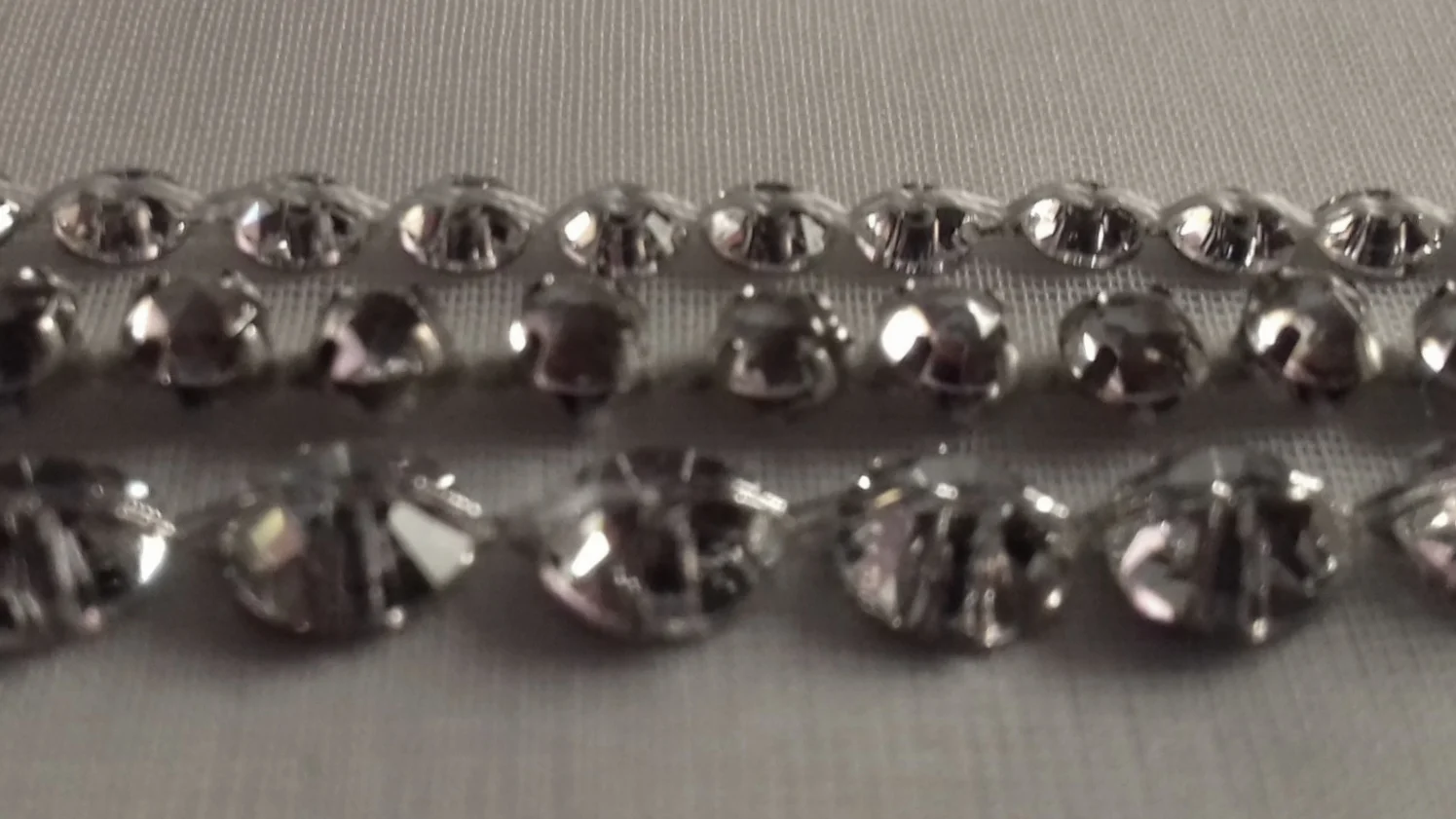
• Portfolio
  • Bordados
  • Research
  • Facilitation & Residencies
  • Blog
  • Contact
    • Curriculum Vitae
Menu

Rebecca Devaney

Street Address
75019, Paris
Phone Number

Your Custom Text Here

Rebecca Devaney

  • Portfolio
  • Bordados
  • Research
  • Facilitation & Residencies
  • Blog
  • Contact
  • About
    • Curriculum Vitae
2016-03-16+10.38.41.jpg

Les Petites Mains à Paris

An illustrated journal describing my time studying Haute Couture embroidery at École Lesage and a few textile adventures along the way in Paris, France...

Les Grands Magasins

March 28, 2018 Rebecca Devaney
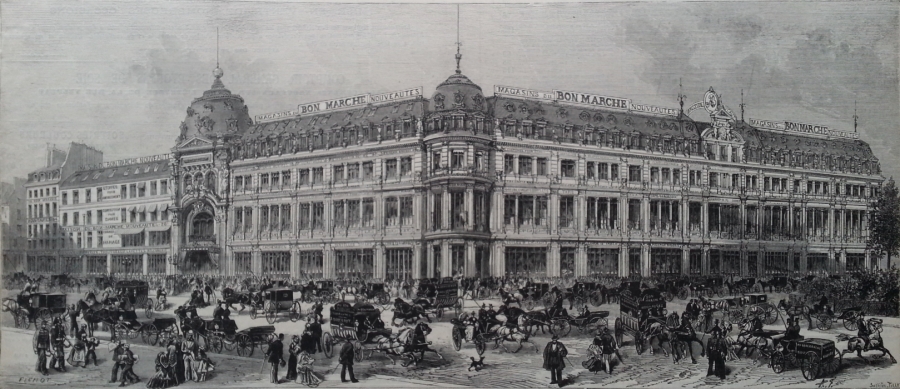
Bon Marche

Paris has been considered the centre of fashion, style and shopping for centuries. And although careening horse-drawn carriages have been replaced by velibs, scooters, seg-ways, skateboards, rollerblades and roller-skates, chic ladies continue to sashay gracefully along the beautiful boulevards today. I had followed in their footsteps by visiting Au Printemps, Le Bon Marché and Galeries Lafayettes but hesitated at the doors of the boutiques along Rue de Fauborg Saint-Honoré and Avenue Montaigne. I gazed in the enticing window displays of Dior, Hermès, Chanel, Louis Vuitton, Yves Saint Laurent, Chloé, Valentino and Nina Ricci. Smiling sheepishly at the men guarding the doors as I soaked up every detail it took me a while to build up the confidence to enter.   
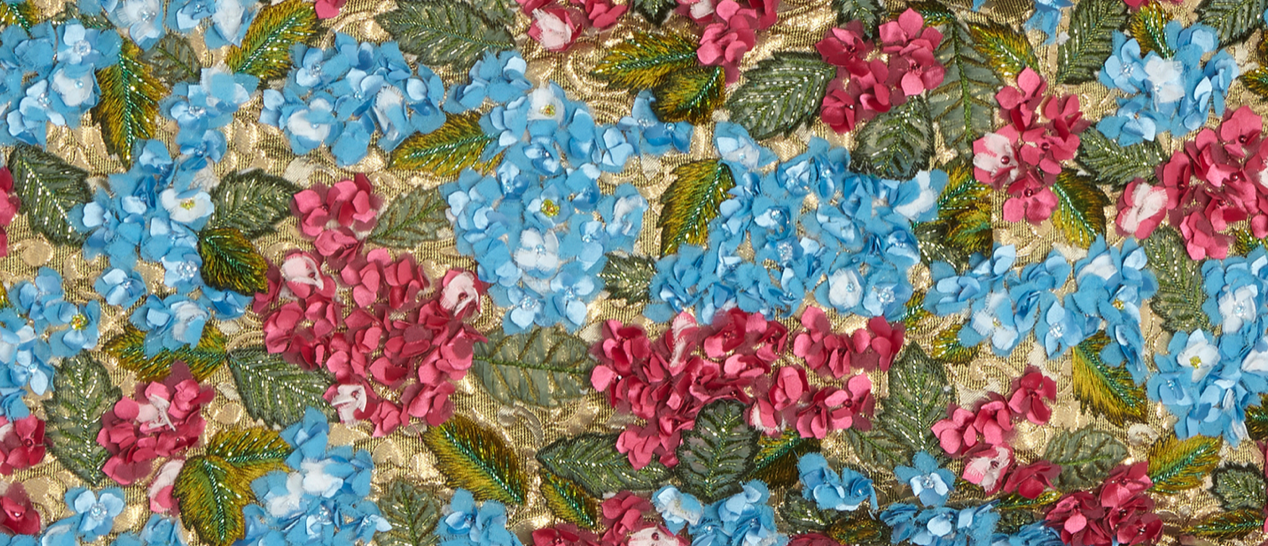
Hortensia D&G

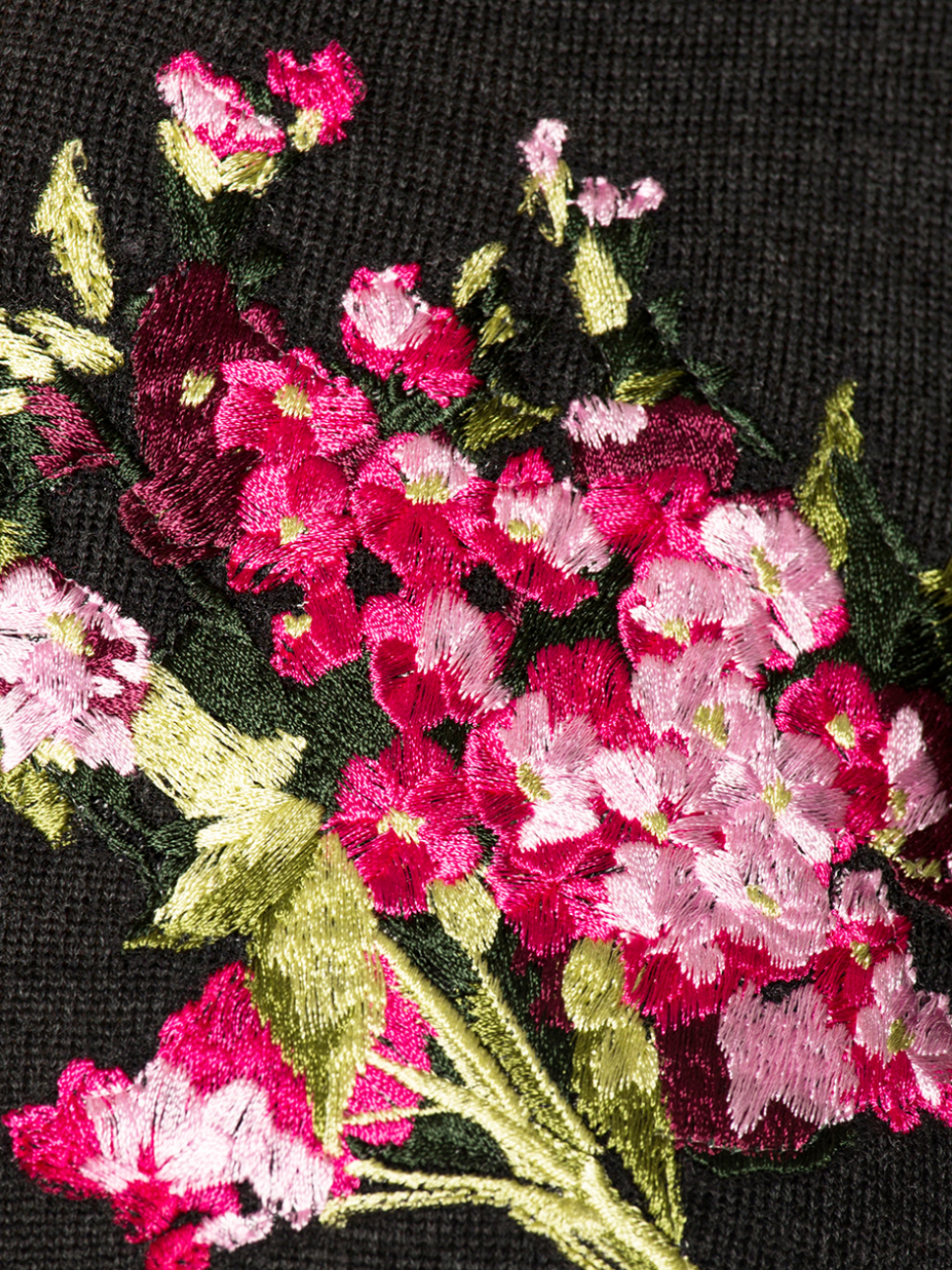
Curiosity got the better of me one day as I gaped at the window display in Dolce & Gabbana. It was a visual feast of sumptuously rich, ornate and colourful embellishment and rather impulsively, I walked purposefully through the doors in the name of embroidery research! Once inside I was met by a welcoming team of staff dressed in elegant uniforms who were all smiling, asking how my day was and how they could help. I couldn't believe I was inside the door! Eventually, I returned their smiles and asked for directions to the ladies section with confidence. A flurry of responses I didn't understand, some knitted brows and before I knew it they had circled around me and I was ushered out the door - back onto the street. 

Standing beside me on the pavement was an elegantly dressed man who gestured for me to follow him. I hesitated, was I in trouble? What had I done wrong? Was I being taken to the Fashion Police? He smiled reassuringly and as he was very handsome I followed despite my inner consternation. With a pronounced chivalry he opened the door of the next boutique, had a quick exchange with someone in the new welcoming troupe,  assured me that I would be taken care of and then said his goodbyes. With no time to gather myself, I turned to the next elegantly dressed, handsome member of staff who was now in charge of my care and smiling down at me, he discreetly explained that people often confuse the Men's boutique with the Women's boutique. The relief swept over me and I finally understood - my crime was short-sightedness!
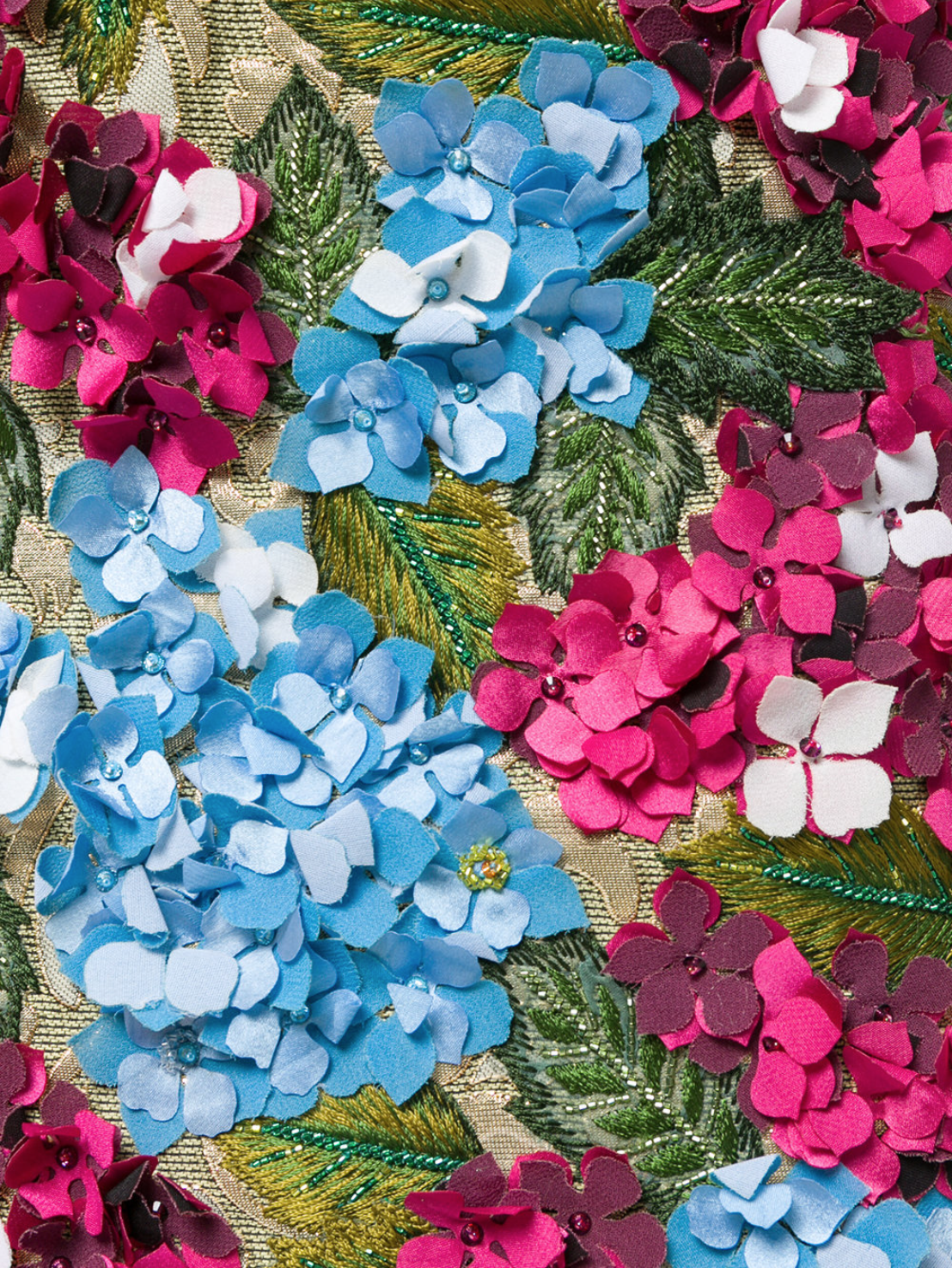
View fullsize Screen Shot 2018-03-18 at 12.17.44.png

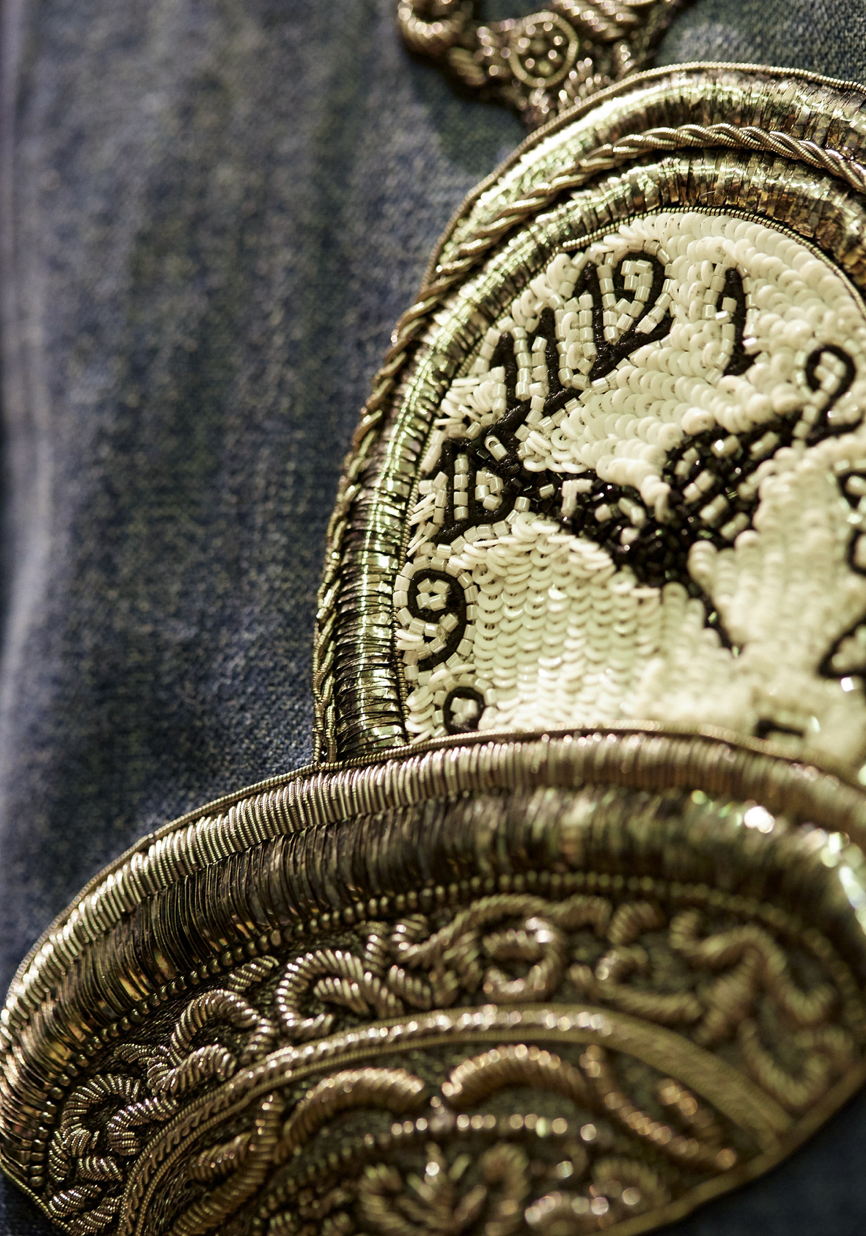
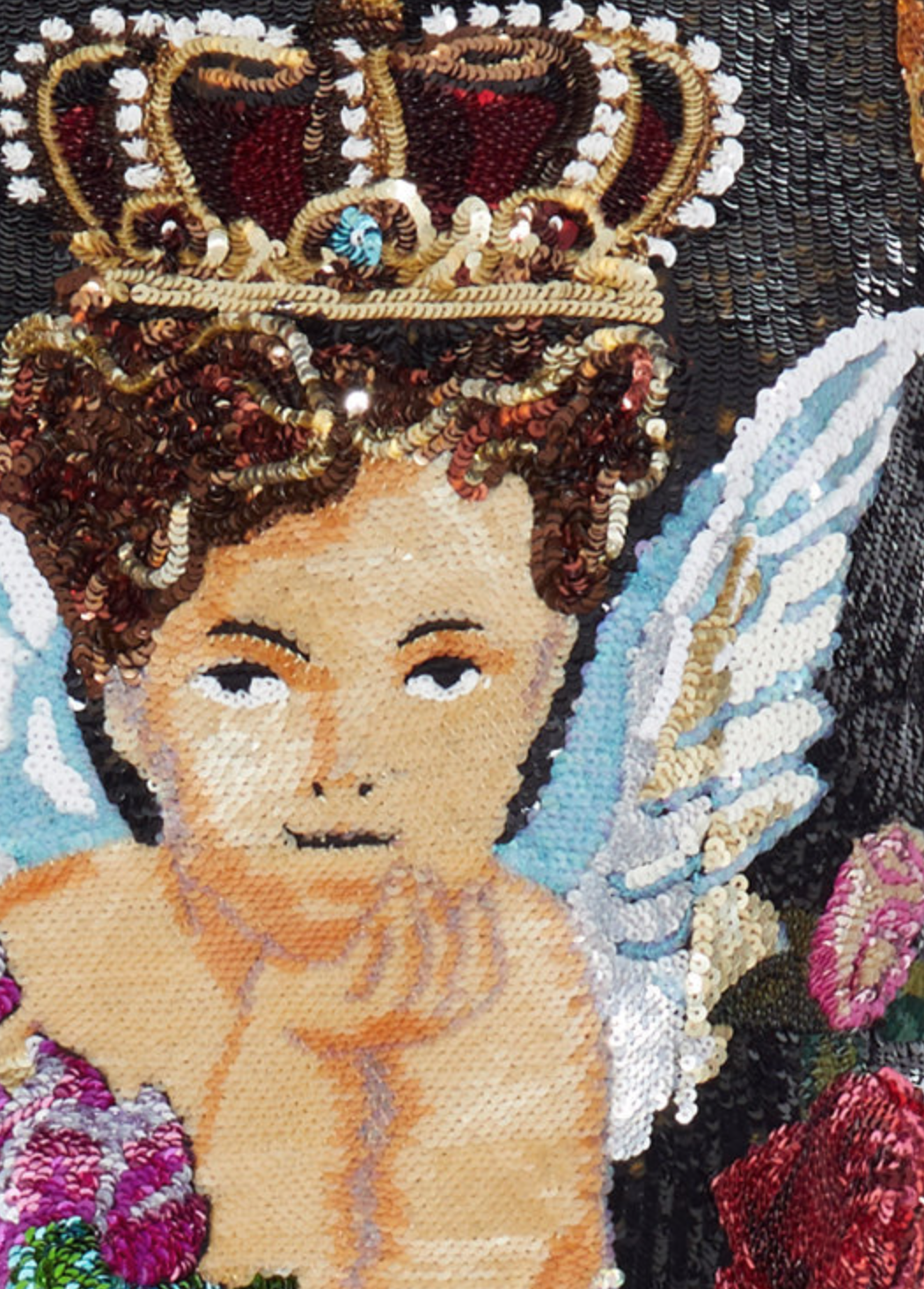
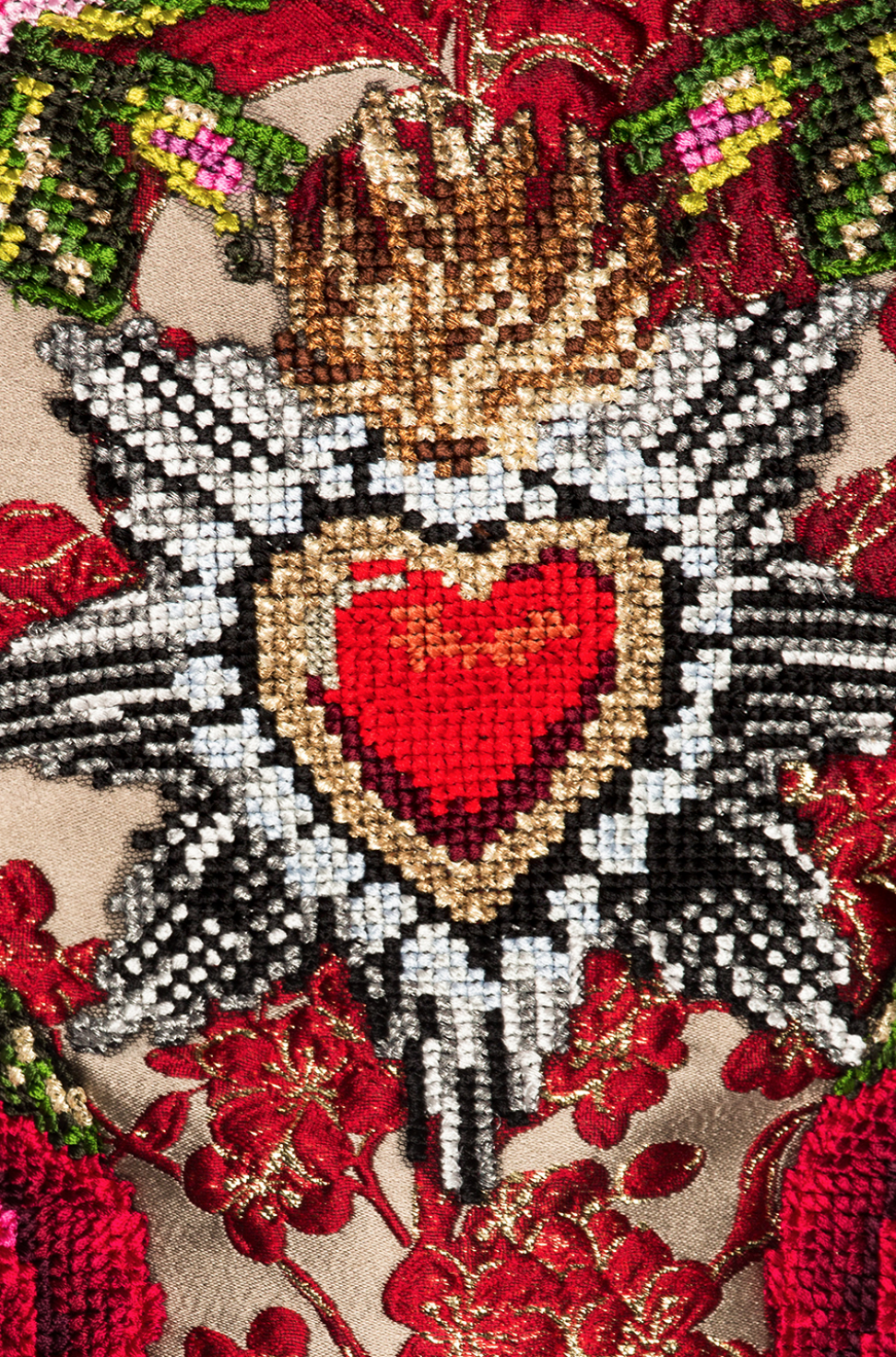
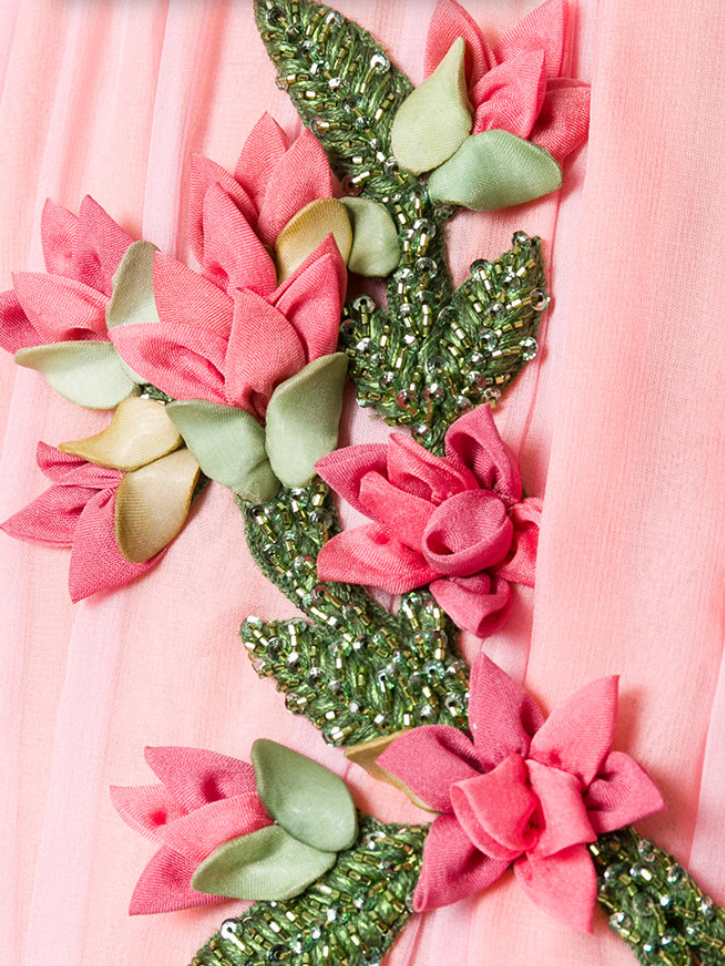
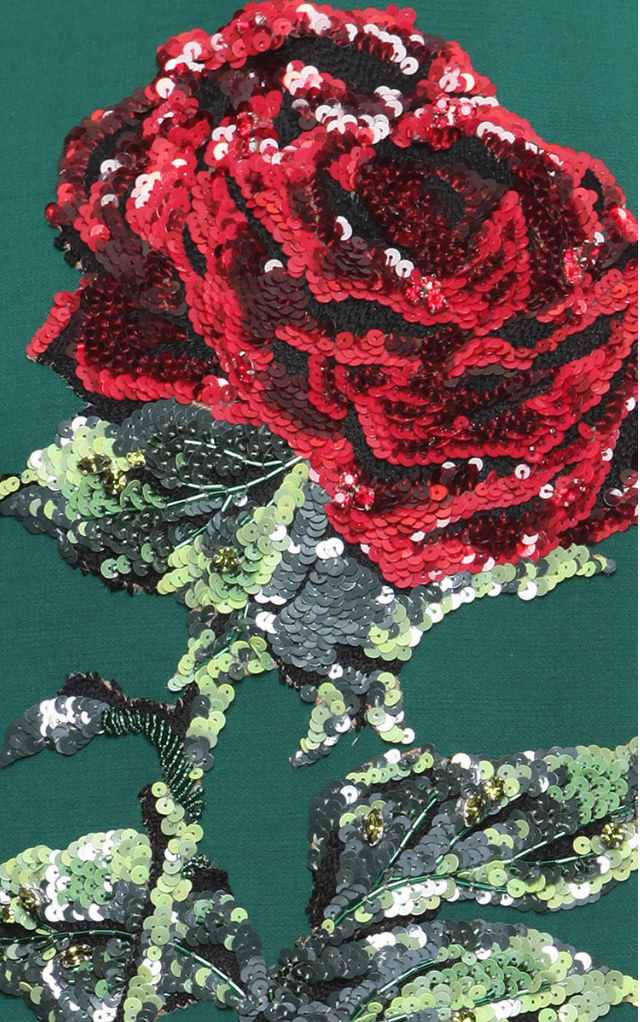
We walked up the beautiful marble staircase and with my newfound innocence I confessed that I was not there to buy anything, that I was a student from École Lesage and that I was there to do embroidery research. His eyebrows flew up to his hairline as we reached the top of the stairs and I held onto the ornate banister, ready to be ejected once again. In that case let me show you something special he smiled...and for the next twenty minutes or so he took me on a tour of the most beautifully embroidered and embellished garments from their collection. He explained the history of the Italian embroidery ateliers, the Sicilian inspiration for the floral, religious and baroque design motifs, the type of materials used from fabrics, to embroidery threads, to sequins and gold finishings. He asked me to wait on the shop floor and returned from the stock room with the pièce de la resistance, a stunning coat with magnificent hand embroidery in cross-stitch needlework, parades of sequins and beads applied with the Lunéville technique, floral embellishment in relief and hand-woven lurex metallic threads. He held it aloft for me to admire and I couldn't stop my hand from reaching out to delicately touch the surface and with that he handed it to me. The weight was incredible and he laughed at my surprise. I thought of the elegant ladies from the 19th century weighted down with their layers of corsets, crinolines, petticoats and finally their embroidered and embellished gowns. 
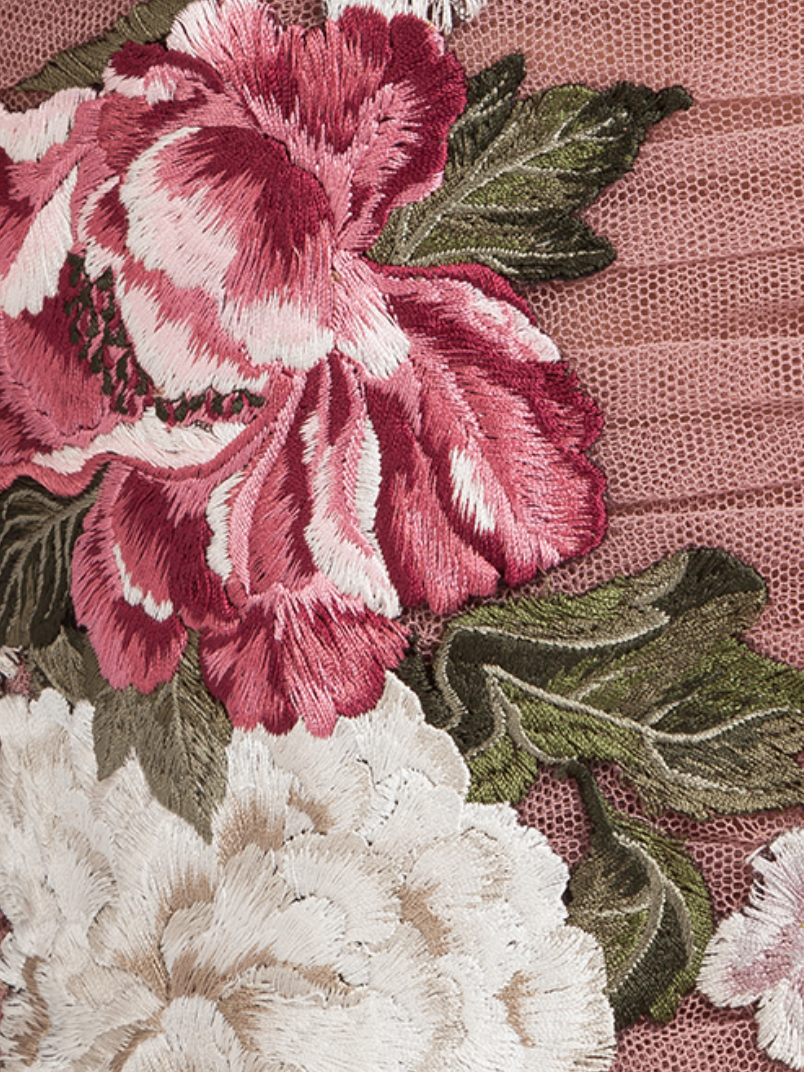
View fullsize Screen Shot 2018-03-18 at 13.34.27.png
View fullsize Screen Shot 2018-03-18 at 13.21.18.png
View fullsize Screen Shot 2018-03-18 at 13.15.12.png
View fullsize Screen Shot 2018-03-18 at 13.04.12.png
View fullsize Screen Shot 2018-03-18 at 12.20.52.png
View fullsize Screen Shot 2018-03-18 at 13.05.37.png
Screen Shot 2018-03-18 at 12.55.38.png

Delighted, I told him that I had learned how to do some of the techniques, applying sequins in a river, graduated sequins, applying beads individually, applying beads in rows, merging rows of beads, applying tube beads, painting with stitches, point-tiré, applying gold metallic ribbon in the come-and-go technique, making 3D pieces, applying 3D pieces and adding volume.

We continued to the handbags and finished with the shoes. It's very hard to embroider onto leather I knowledgeably informed him! Not wanting to take up too much of his time I thanked him and as we descended the marble staircase he said to come back as often as I wished, that there would be more embroidery in the next collection for me to admire!

I skipped out onto the pavement. Previously I had studied this kind of embroidery in books, museums or galleries. I had never actually touched the work of a master embroiderer! Looking at the prices of the clothes I was surprised, by that stage I knew how long it took to apply a row of sequins in a river and on the items I saw there were floods of them! I thought perhaps that I am still quite slow, but with time and practice I would speed up. I was truly inspired and hurried onto the metro, excited to start my homework! 

Textile Tours of Paris

Join Rebecca on a tour of Paris’ charming haberdasheries nestled deep in the winding streets of Le Sentier, the city’s historic textile and fashion district. Enjoy a Sunday morning with Rebecca on a Flea Market Tour as she guides you through the labyrinth alleys of Paris’ oldest marché-aux-puces to uncover hidden treasure troves filled with vintage lace, linen, passementerie, golden threads and gossamer lingerie. To find out more visit Textile Tours of Paris.
Adding a Dramatic Flourish

March 18, 2018 Rebecca Devaney
20171215_112730.jpg
20180308_112441_Richtone(HDR).jpg

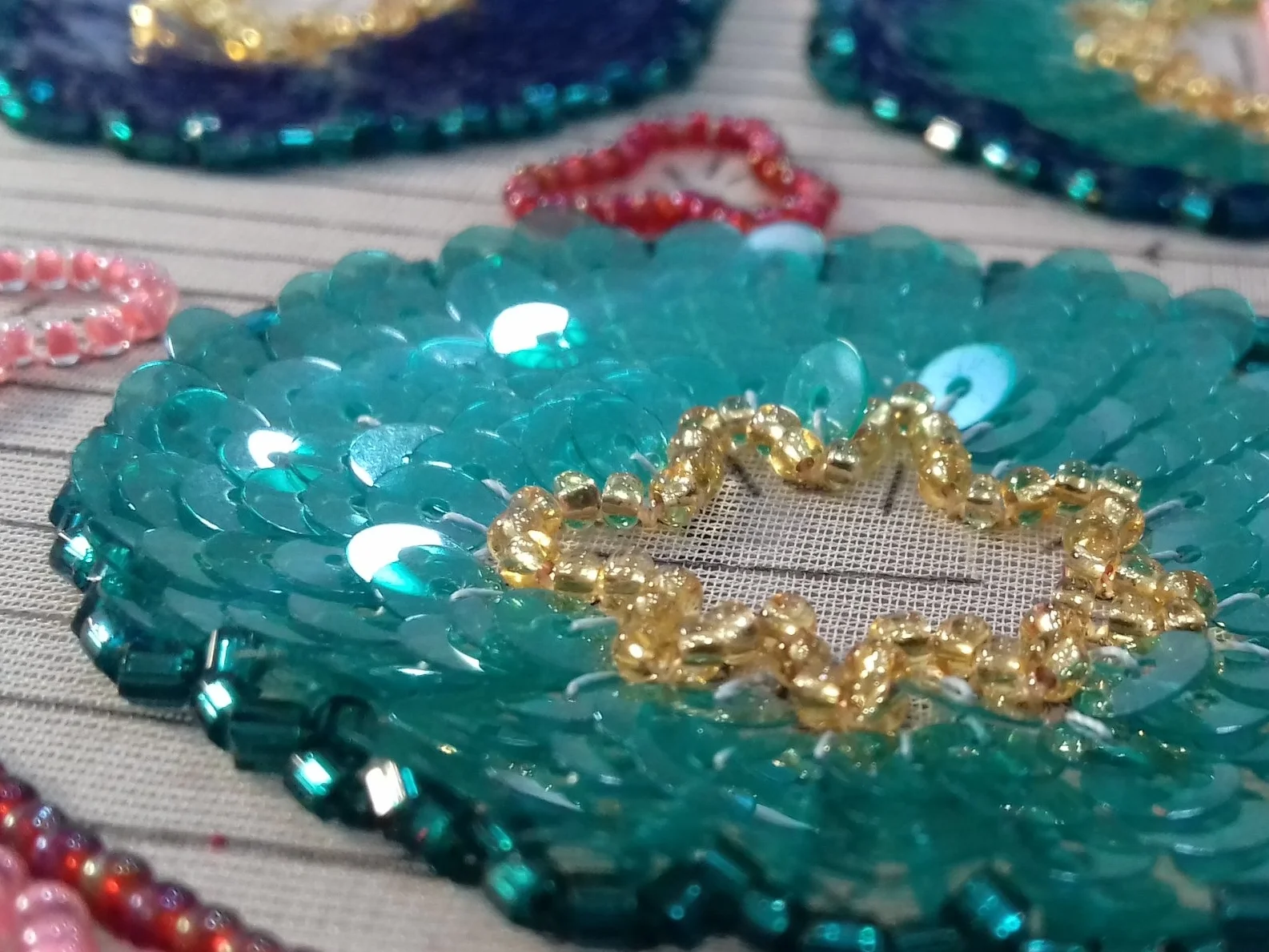
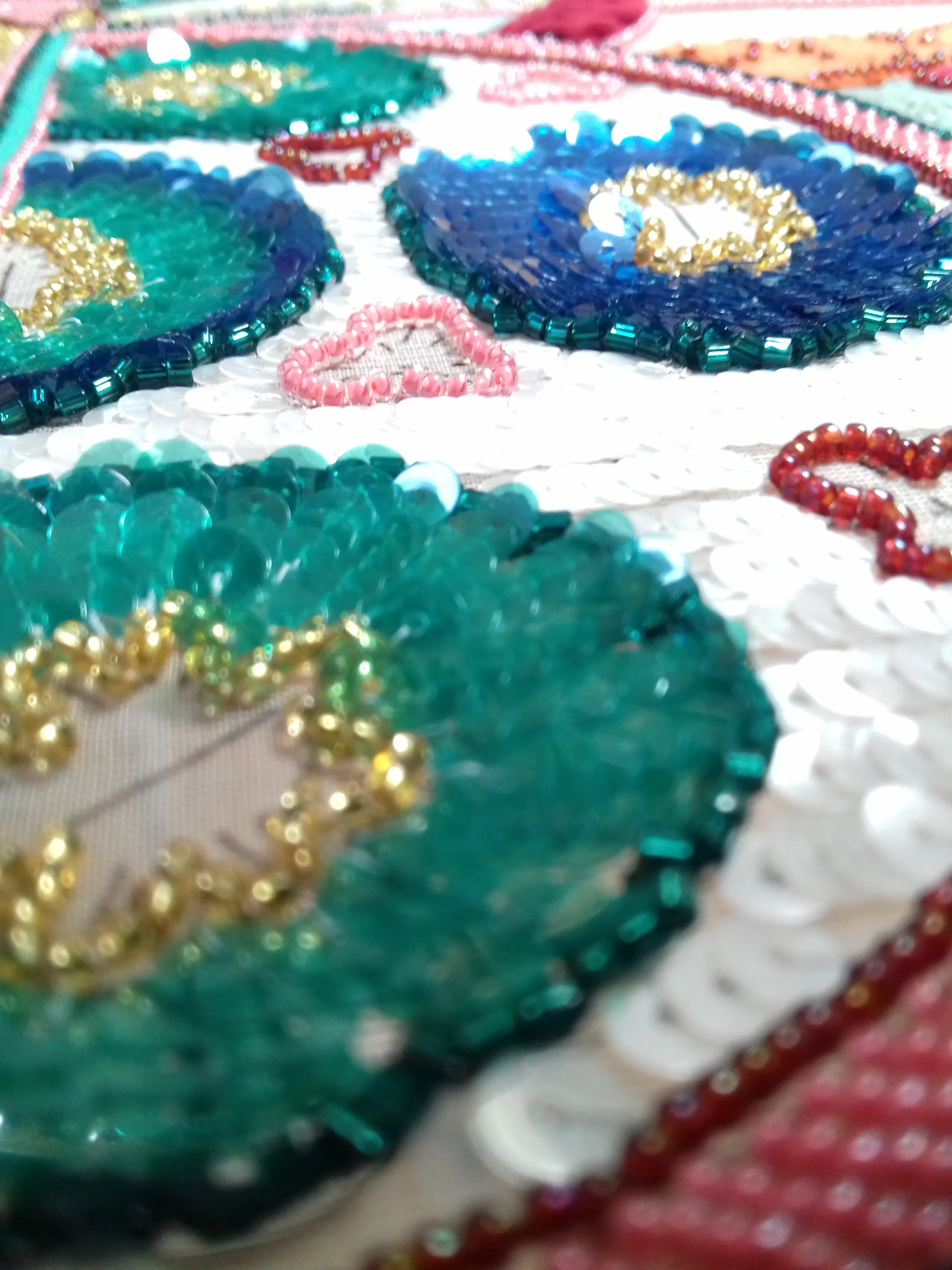
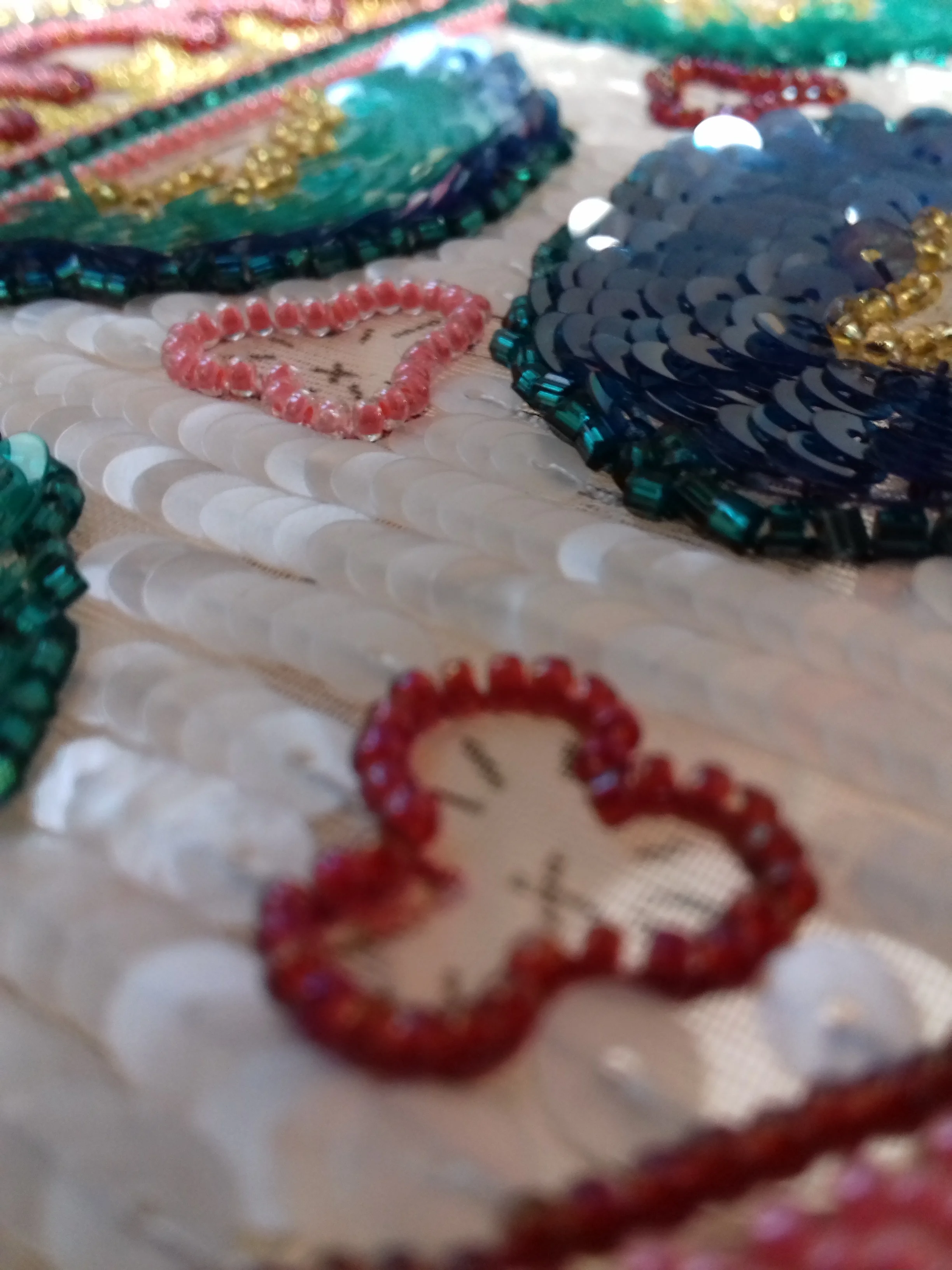
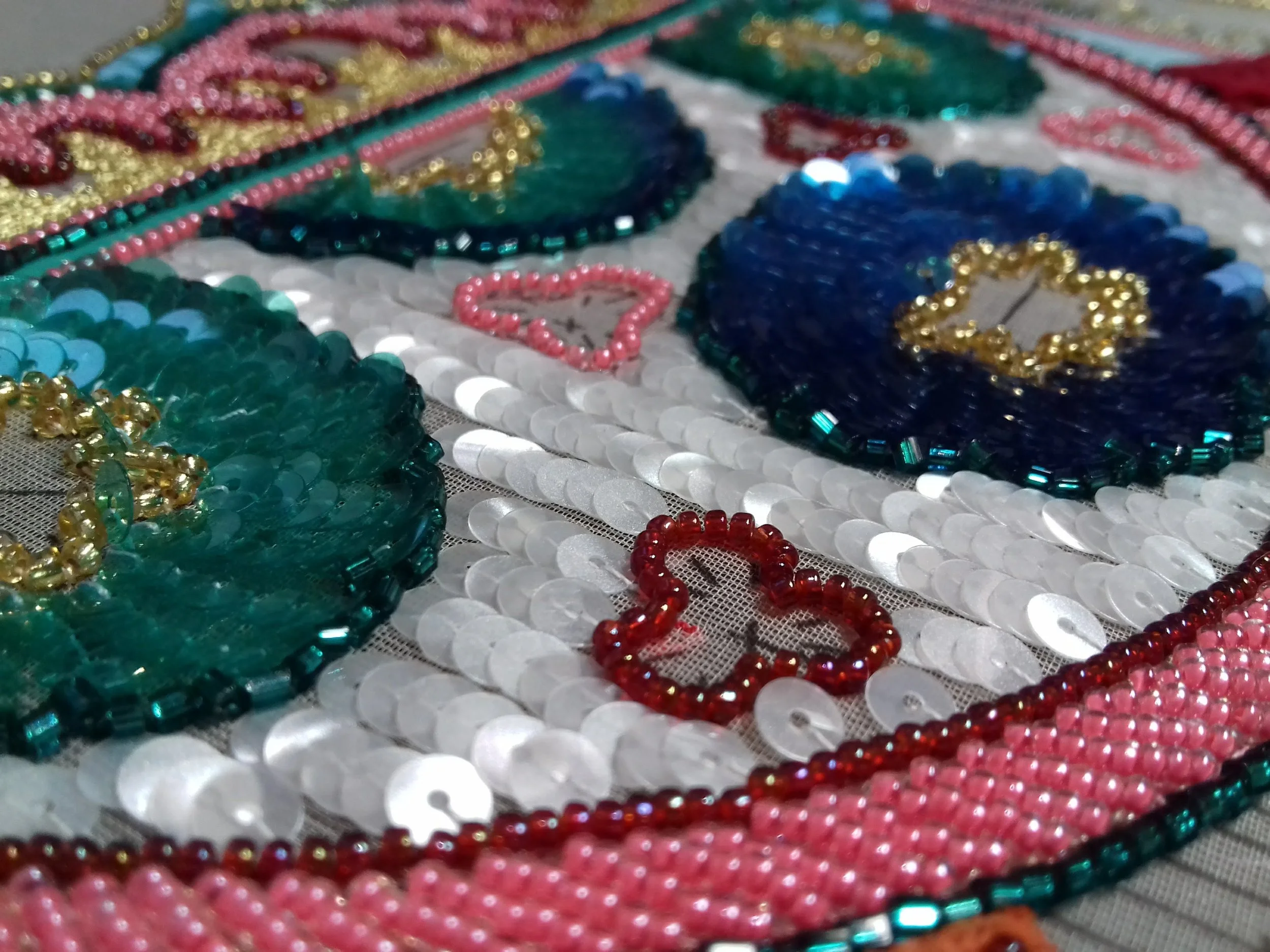
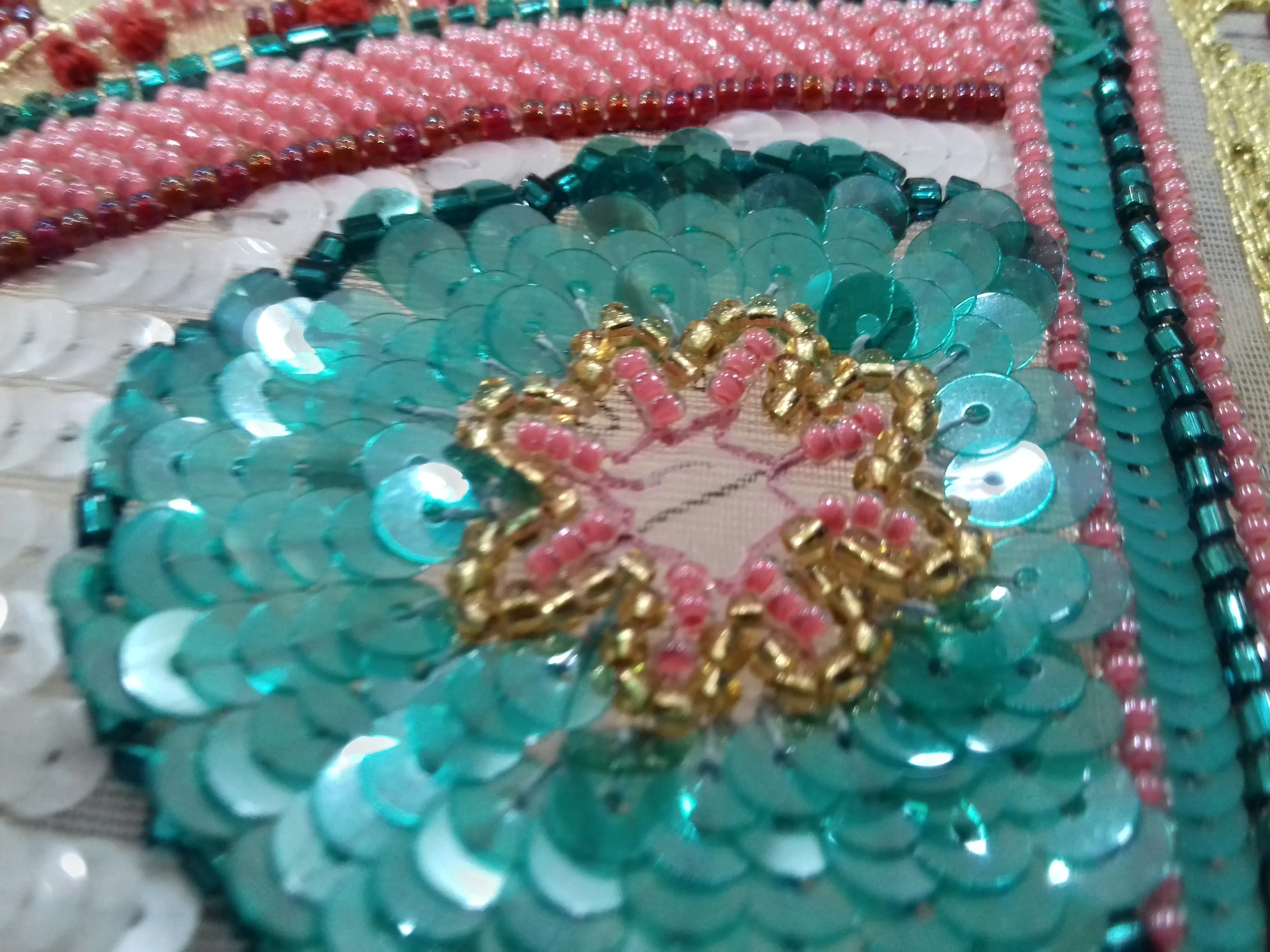
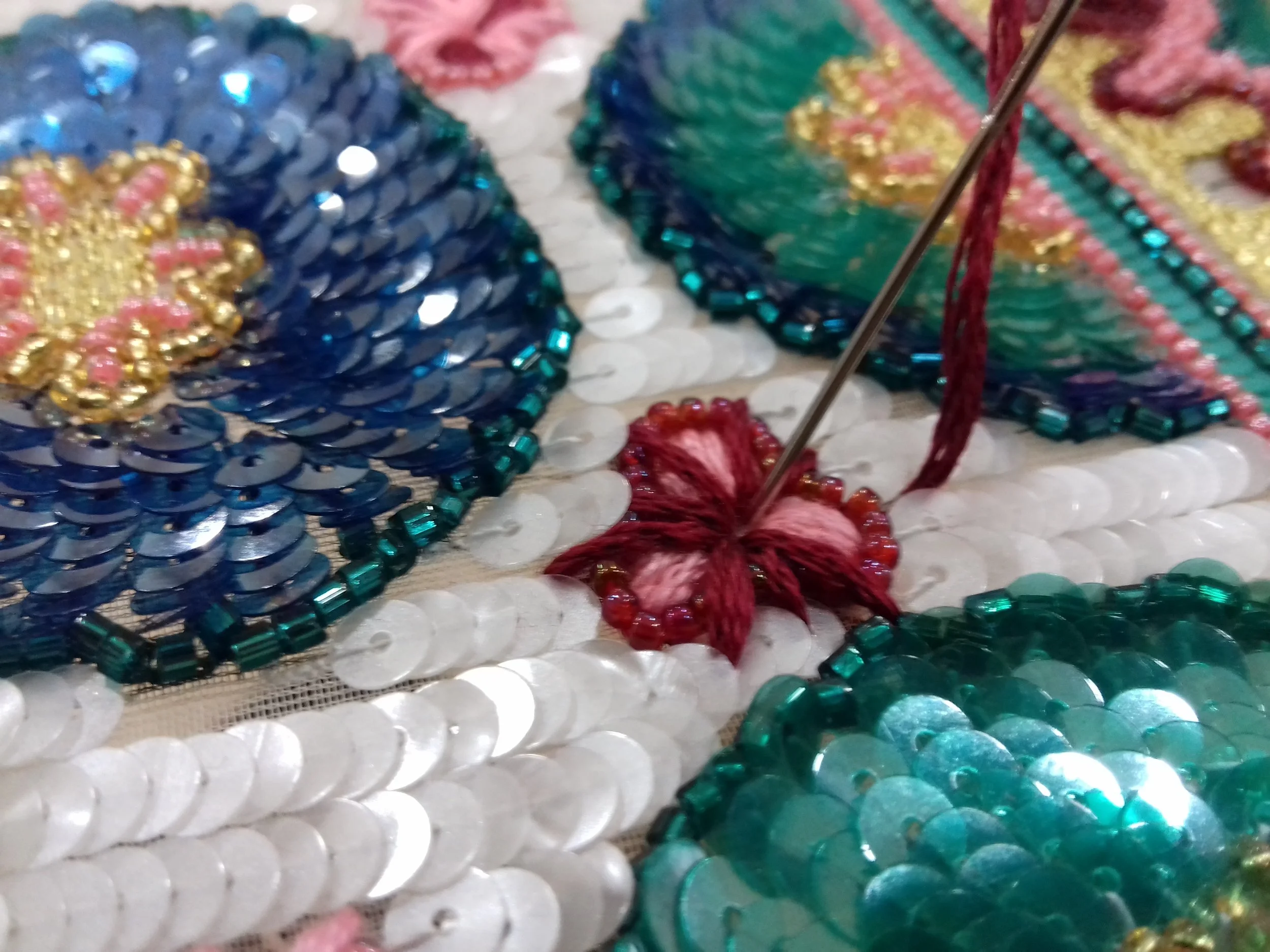
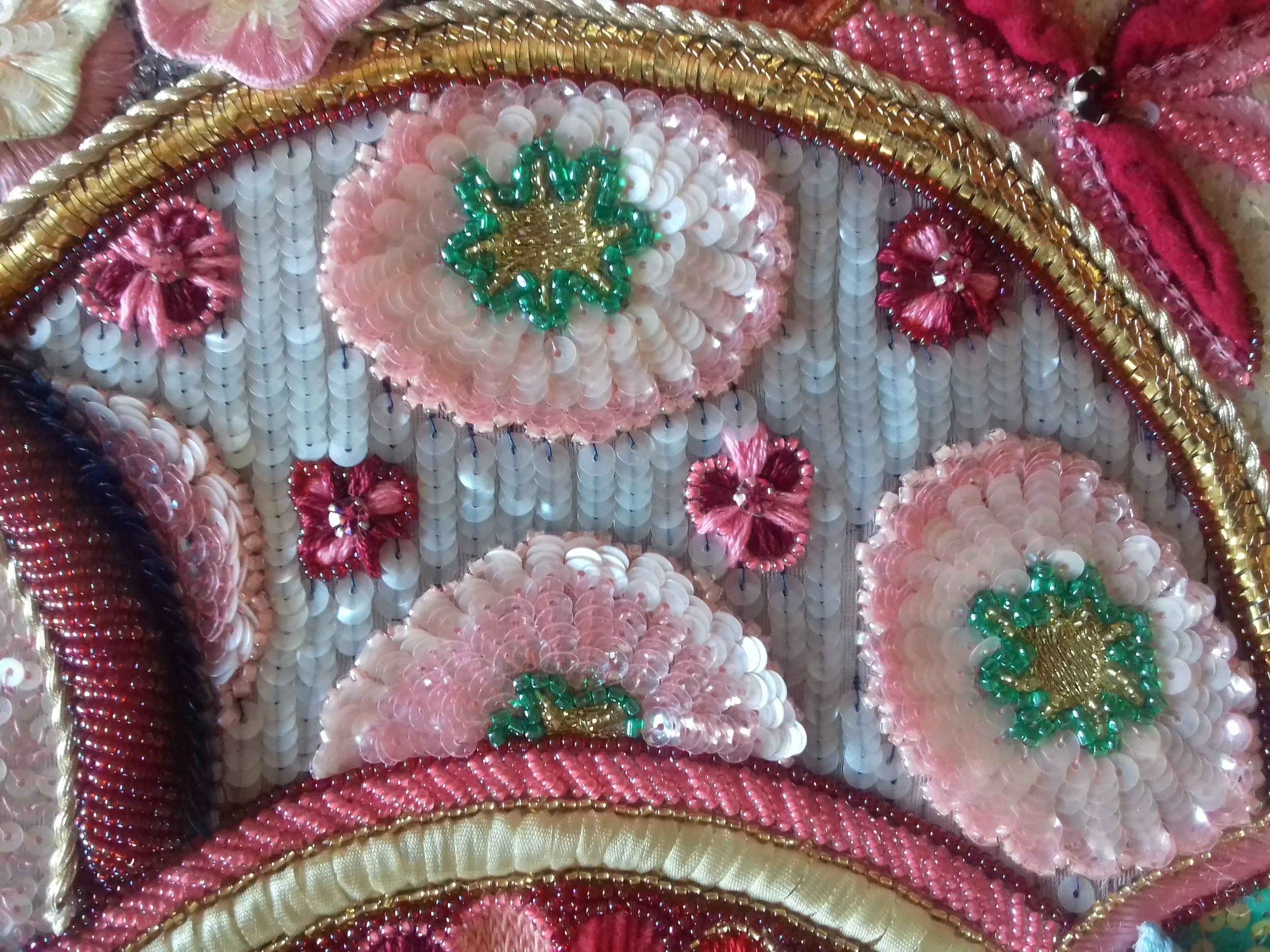
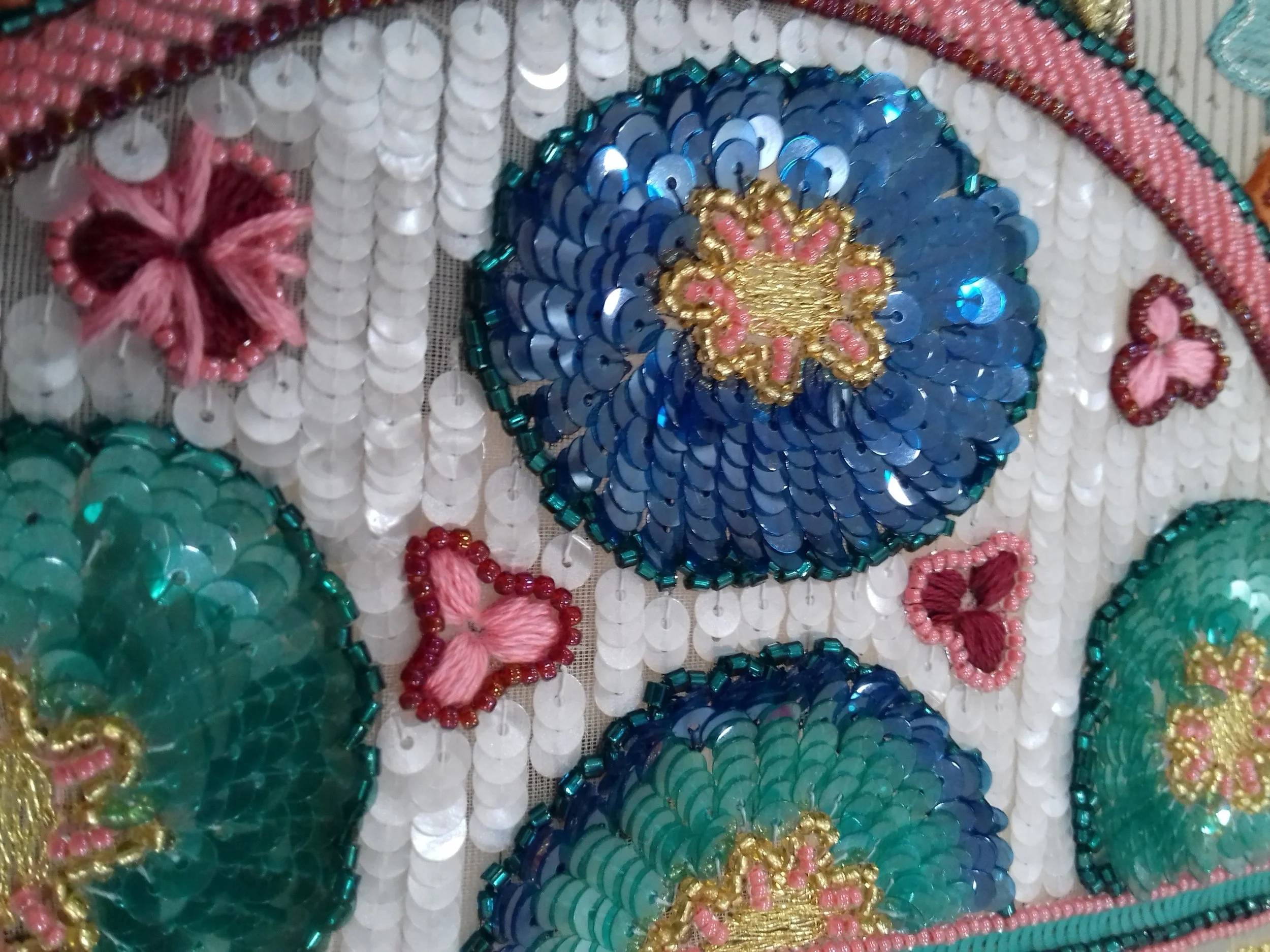
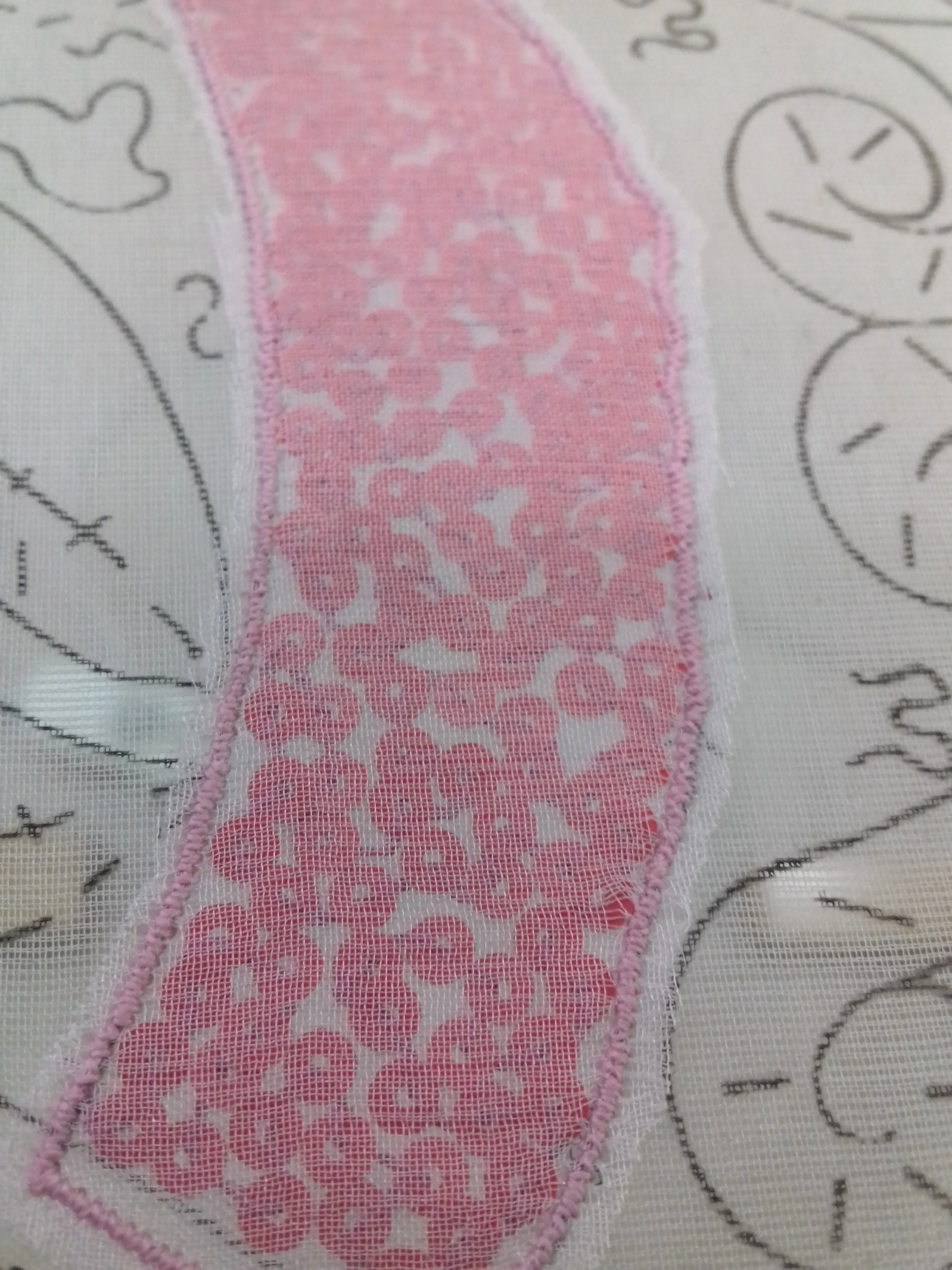
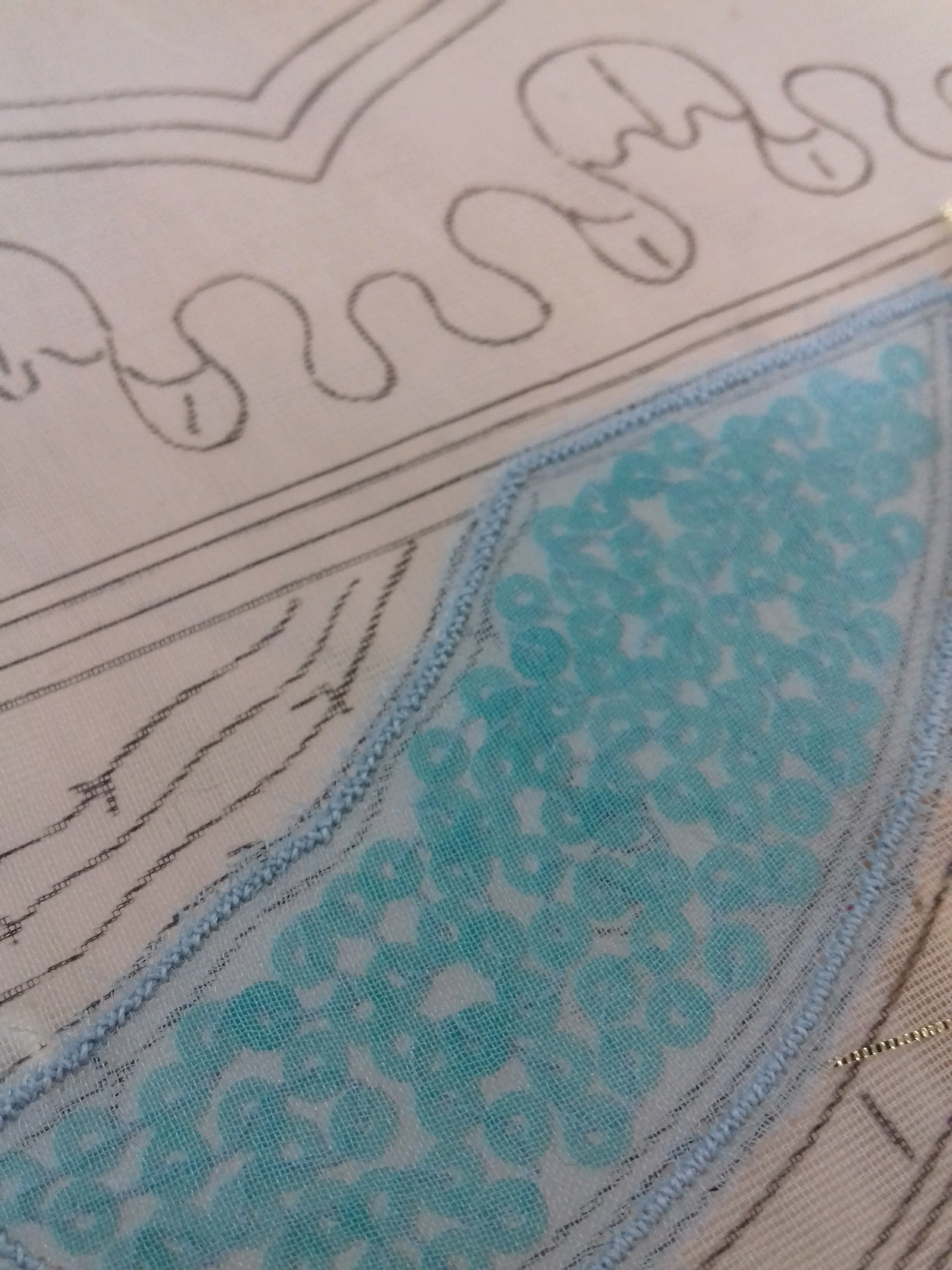
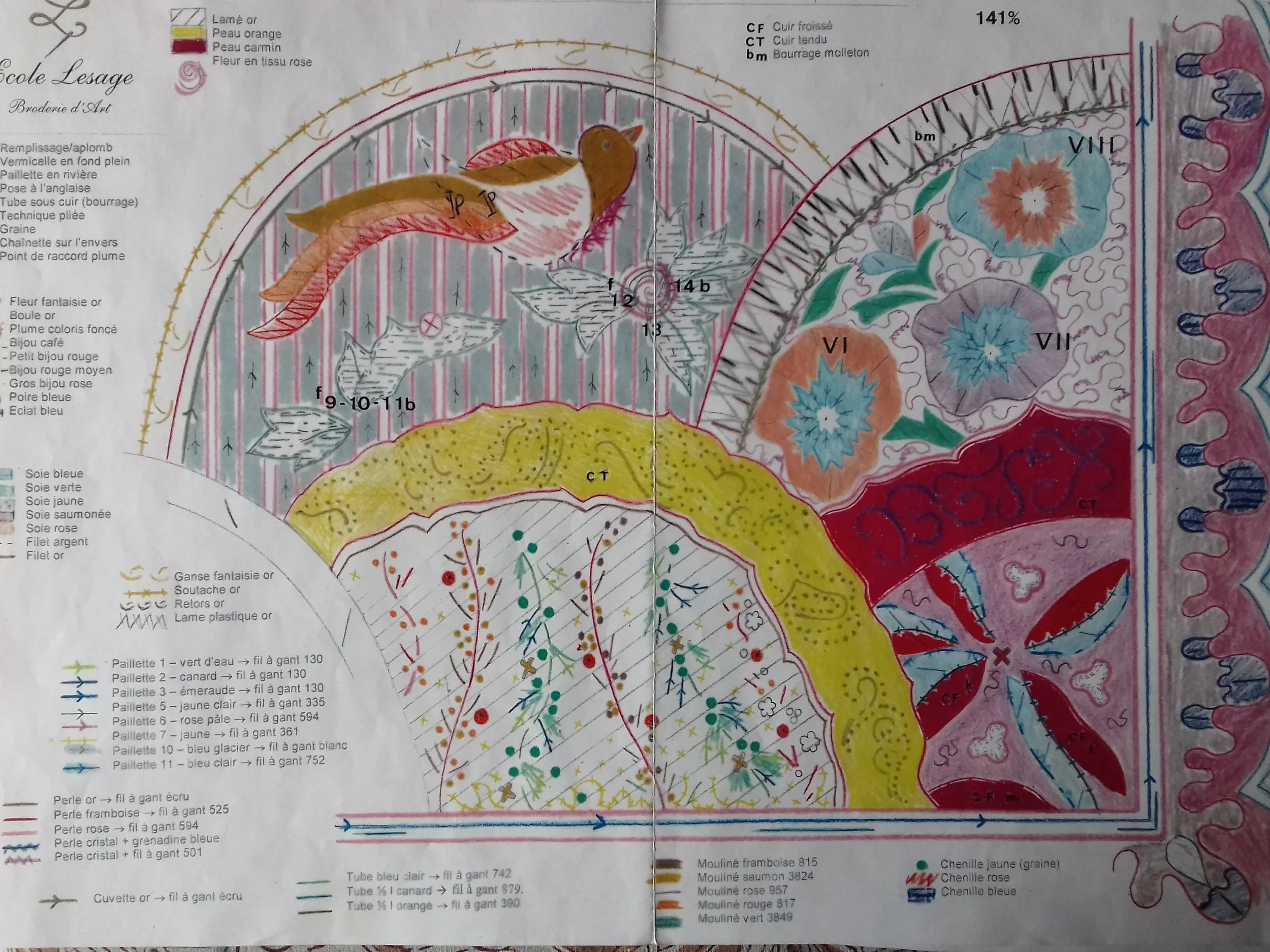
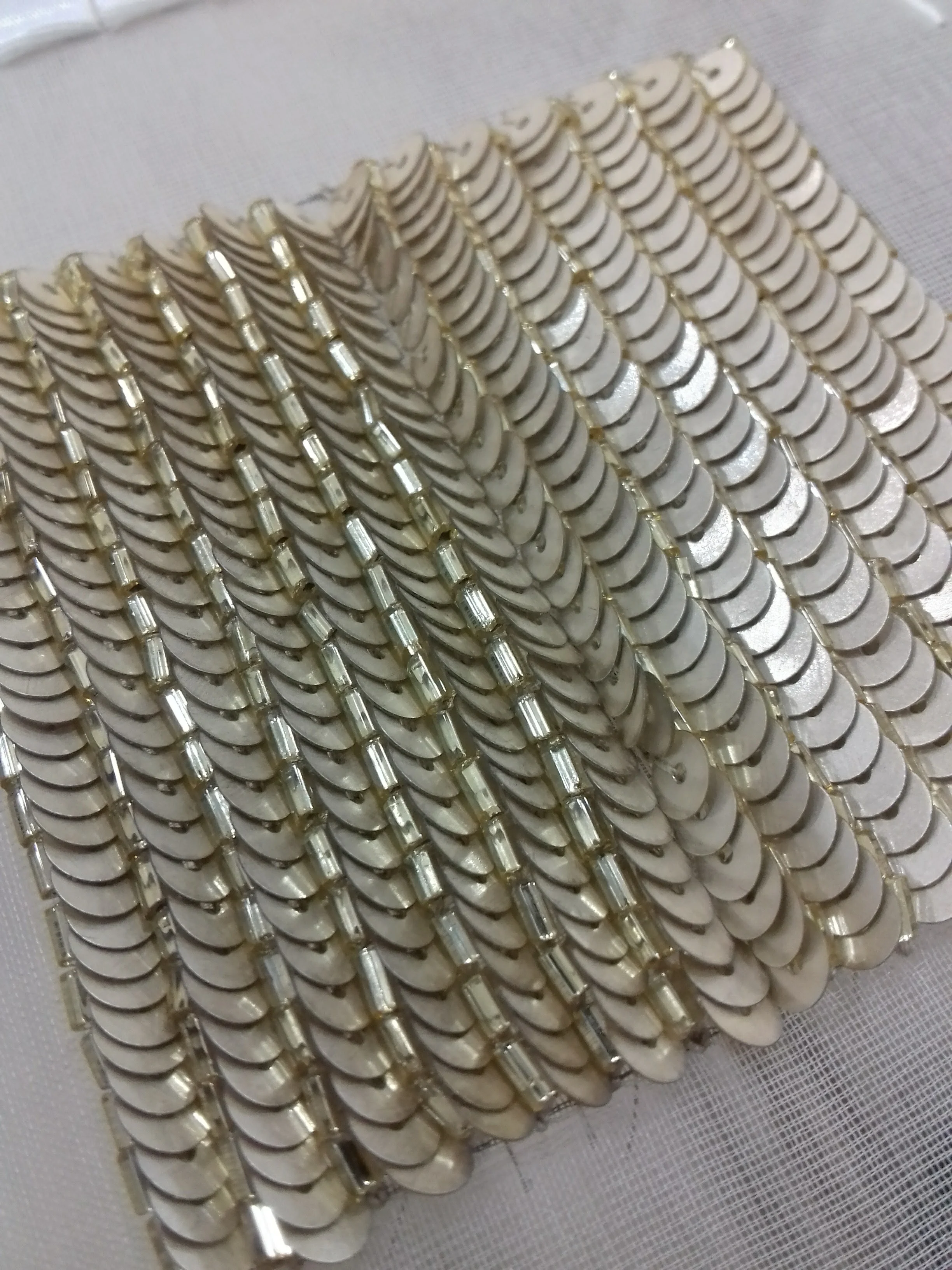
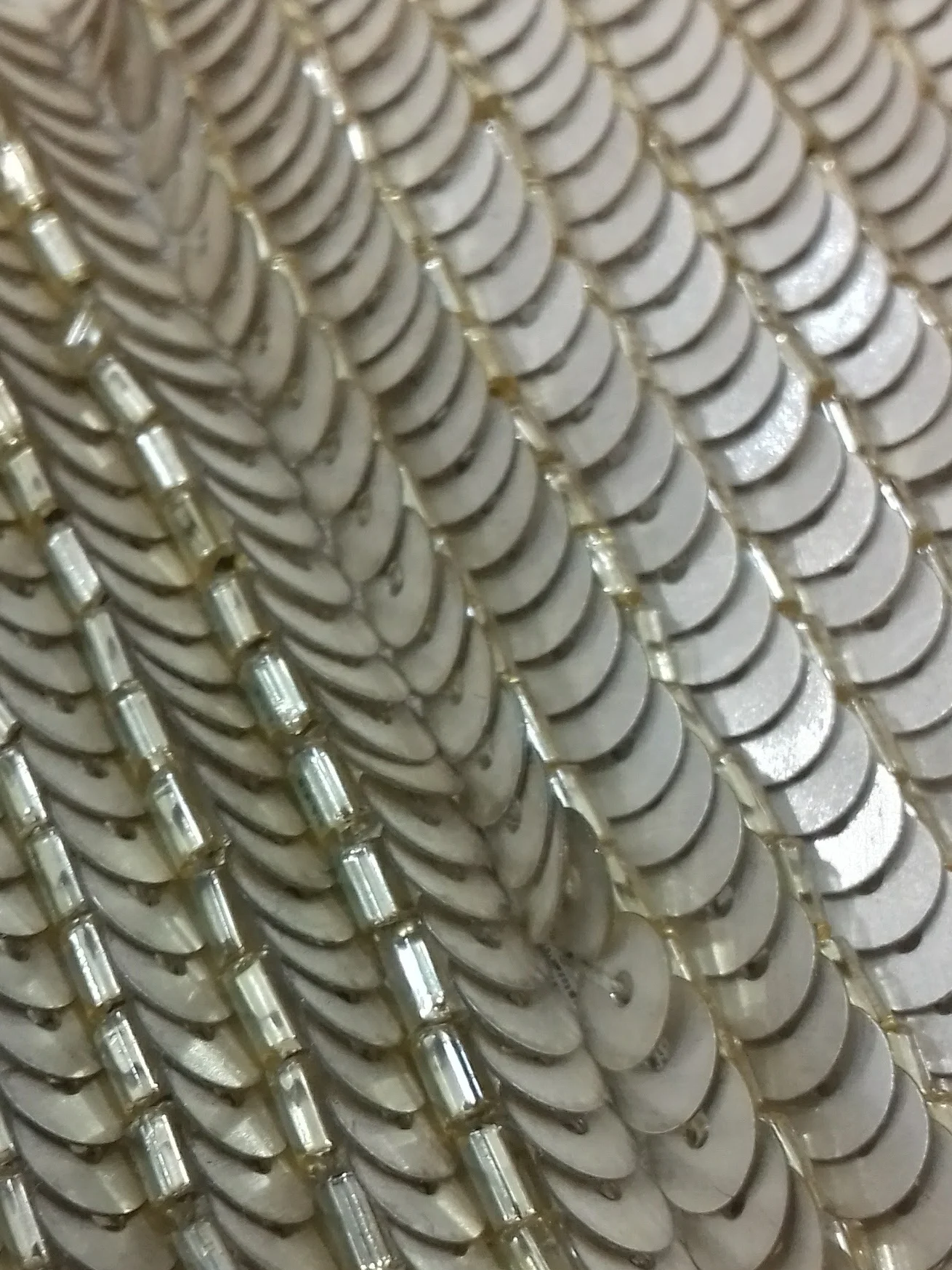
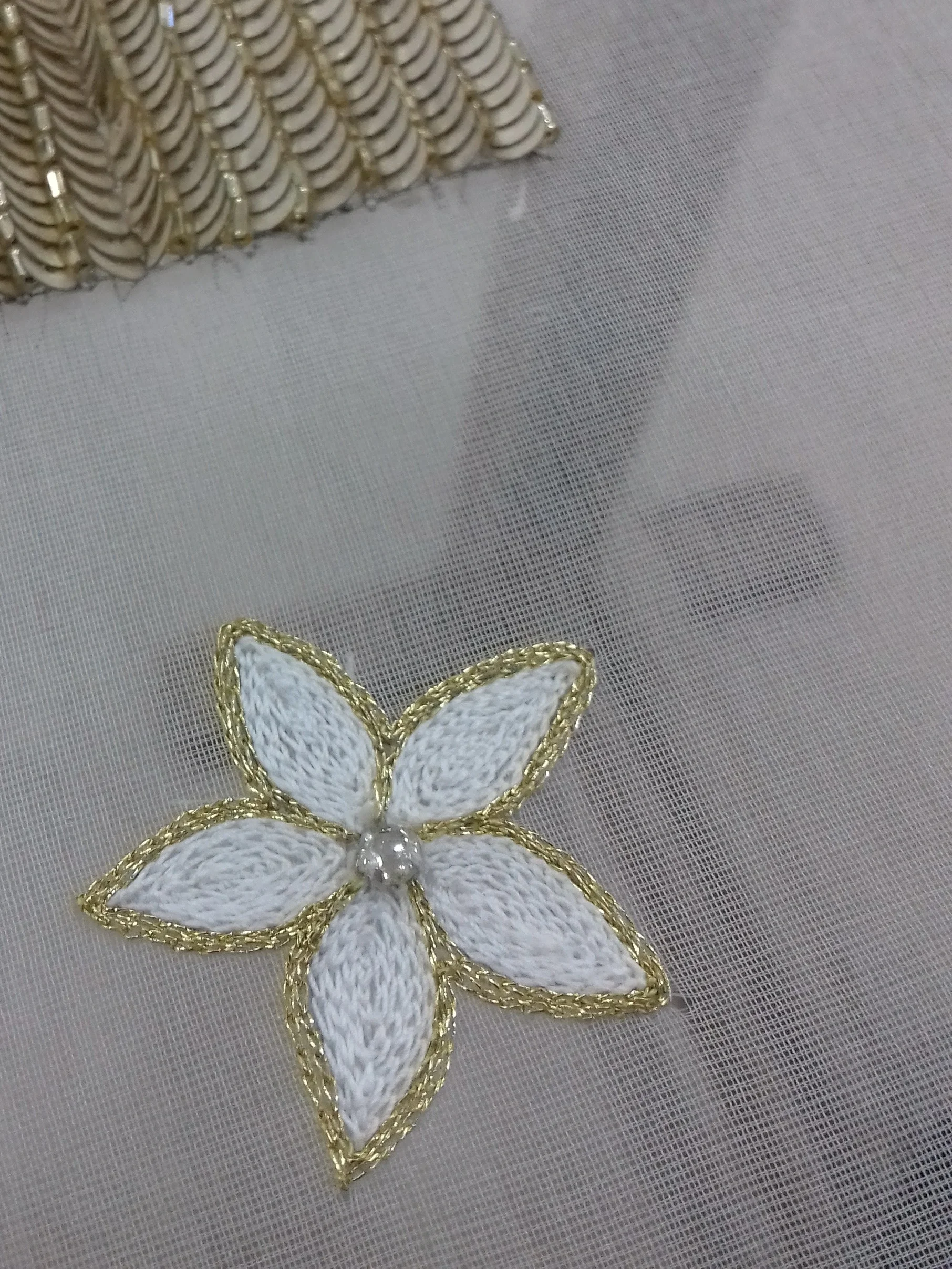
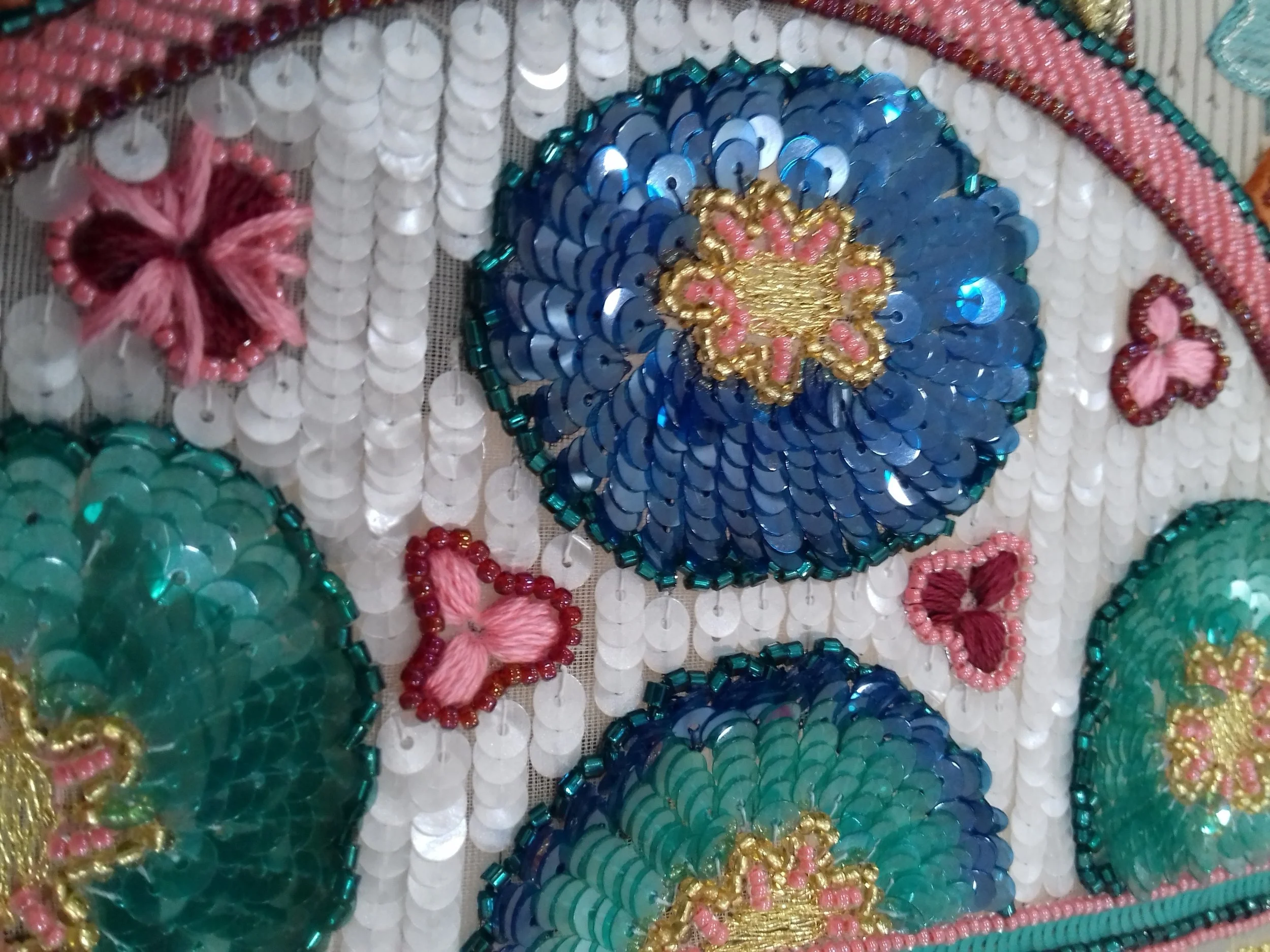
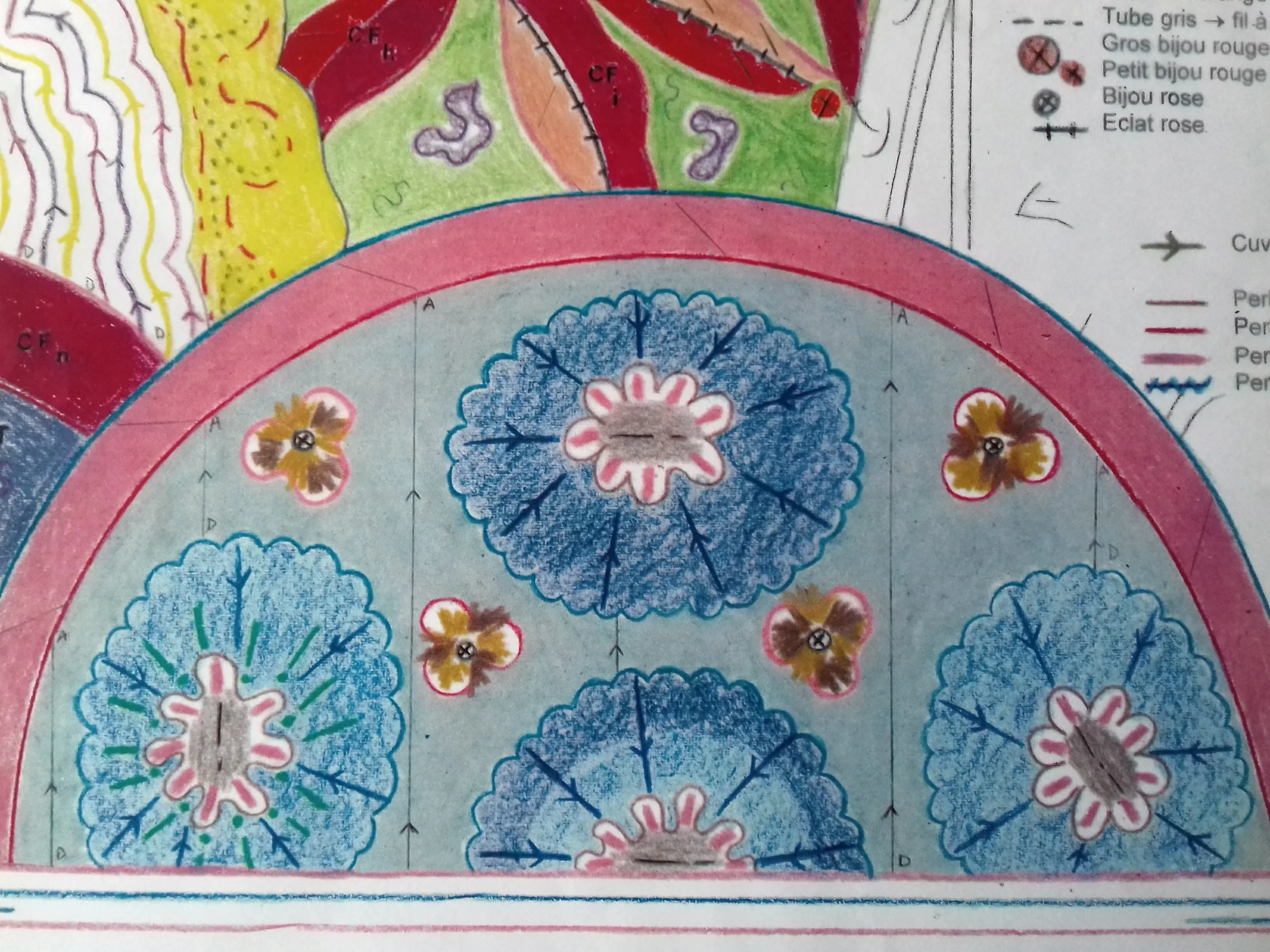
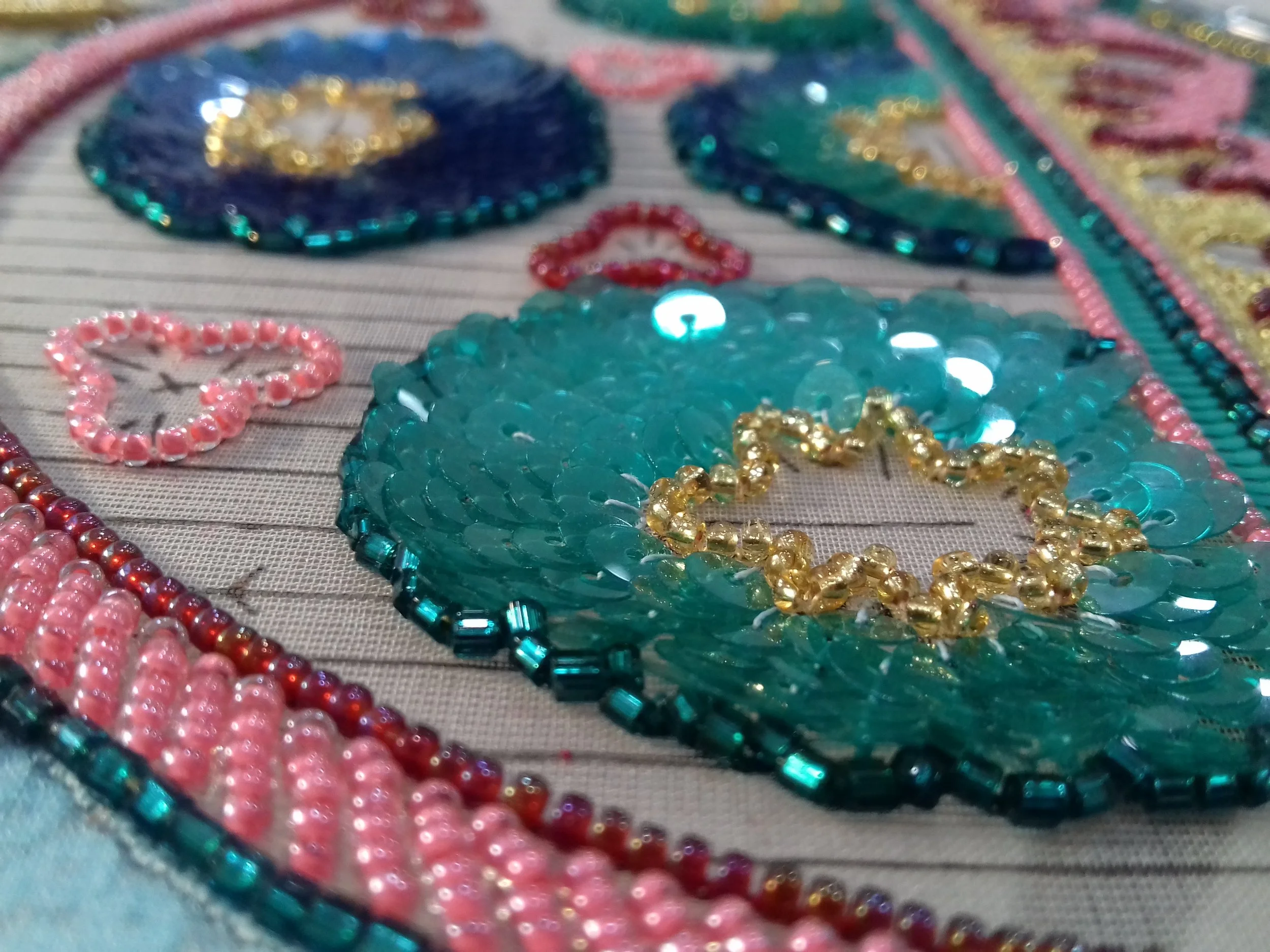
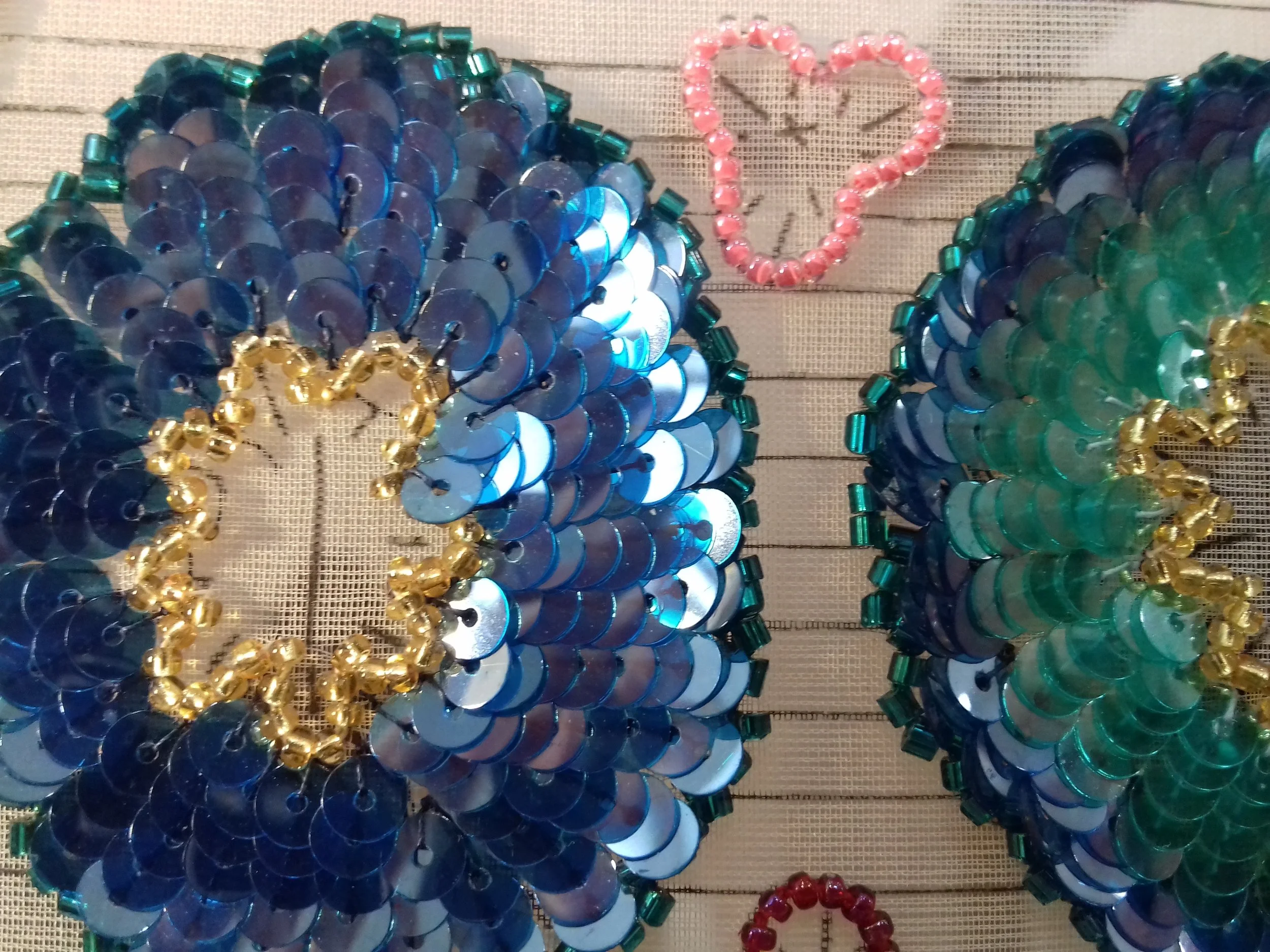
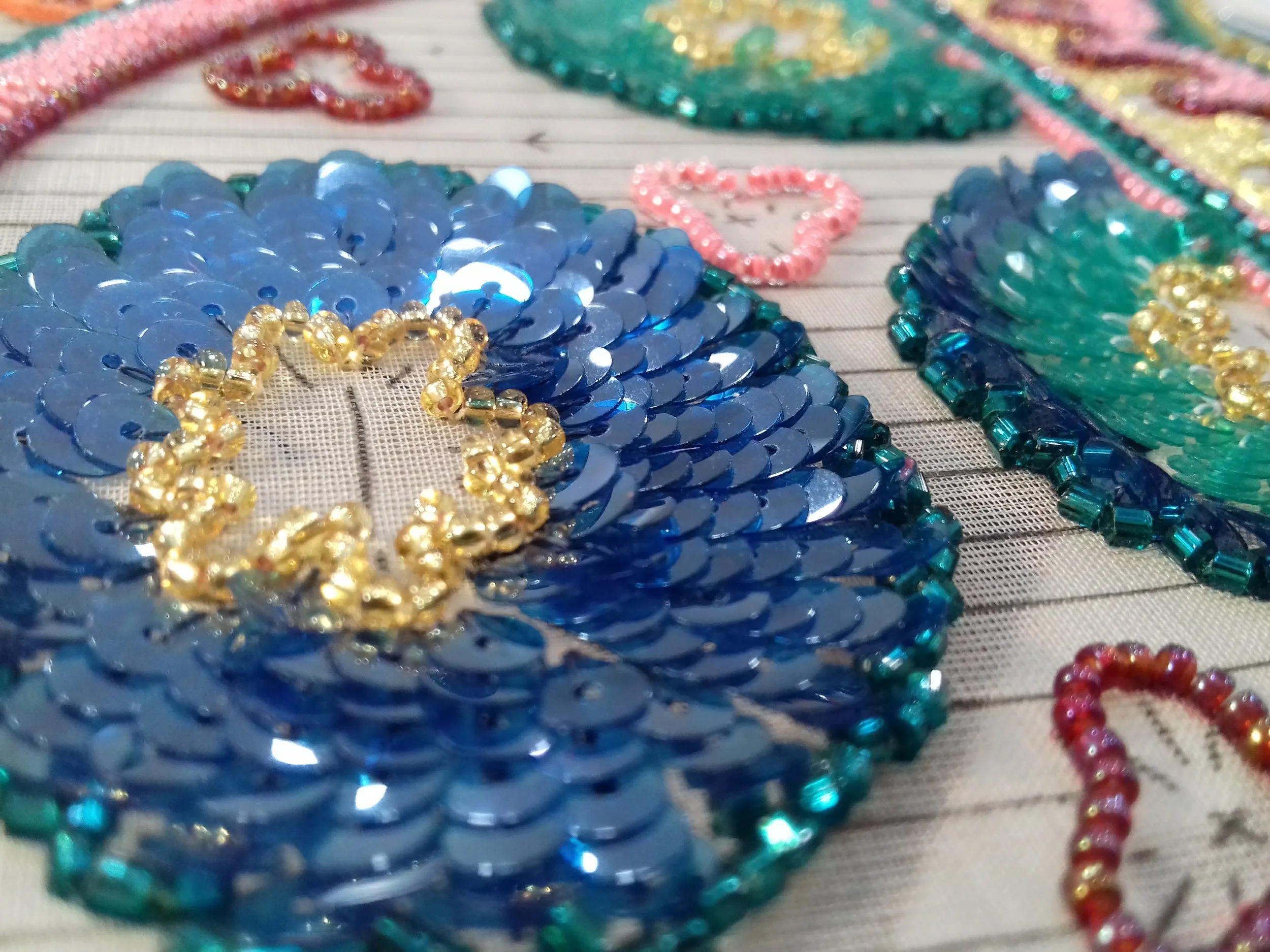
This was one of my favourite sections to create as the effect of the overlapping sequins is so dramatic and the technique turned out to be surprisingly easy! There were two of these sections that featured flowers made entirely with sequins, with a background of linear rows of iridescent sequins that were interrupted by tiny blossoms created with traditional needlework. The first featured a rich colour scheme of dark turquoise, navy blue, gold, raspberry red and bright pink. The second used light pink, salmon, coral, raspberry red and a light green.  

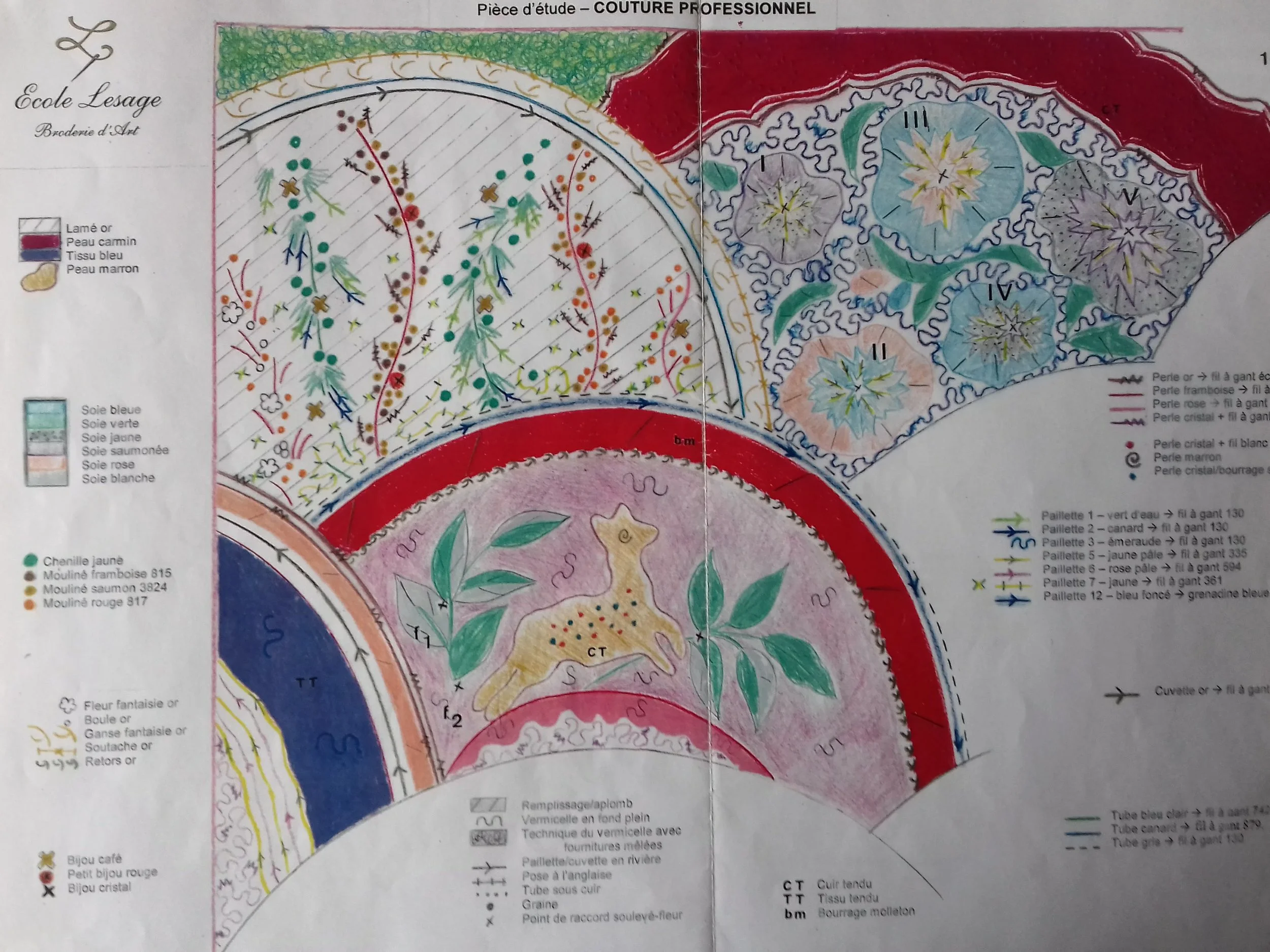
The little arrows in the pattern denote the direction of the sequins and the change in colour tone within the two central flowers indicates the areas to use the graduated sequin technique.

View fullsize 20171103_094322_Richtone(HDR).jpg
View fullsize 20171103_094104_Richtone(HDR).jpg
View fullsize 20171103_094512_Richtone(HDR).jpg
View fullsize 20171103_094115_Richtone(HDR).jpg

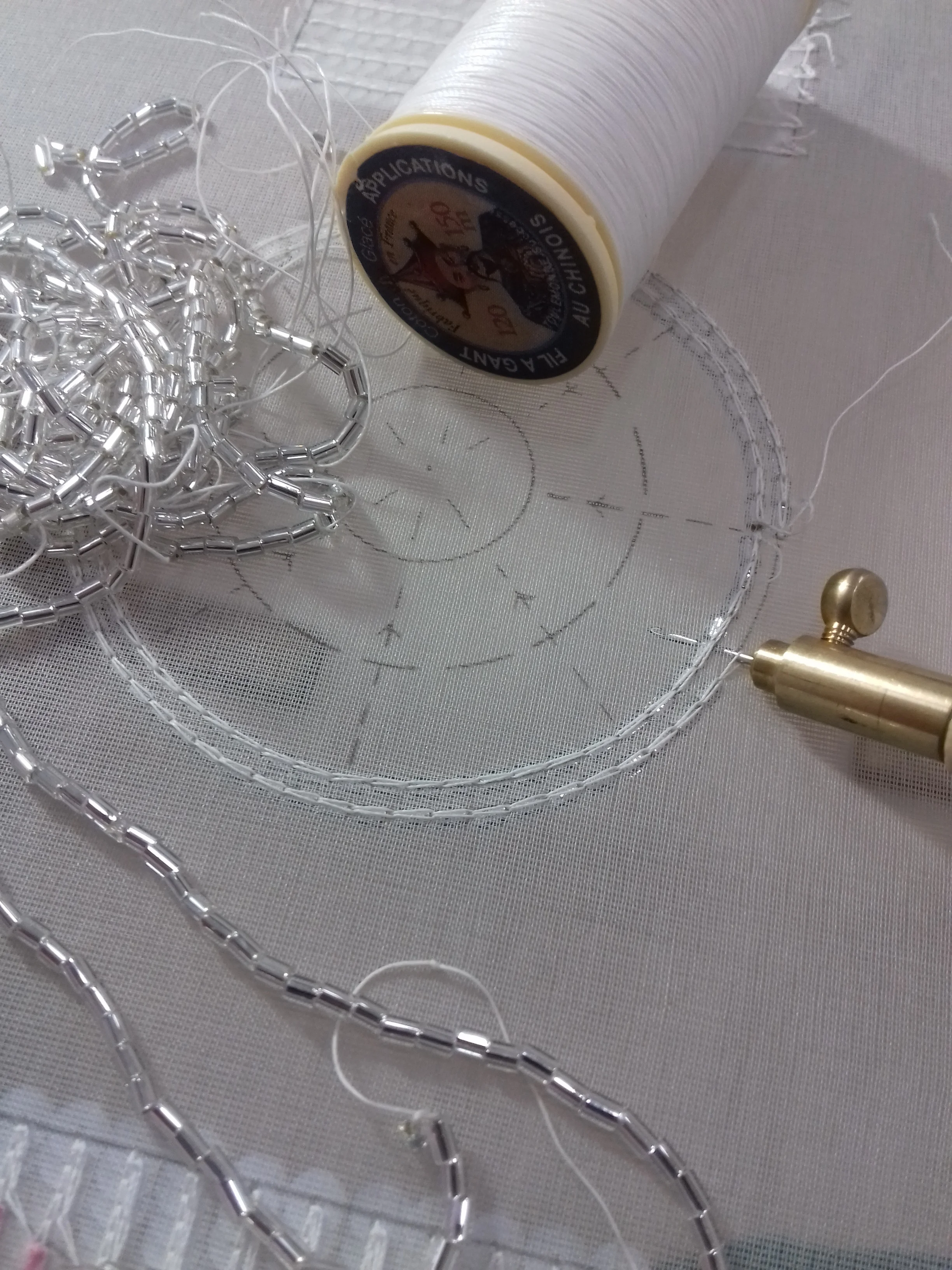
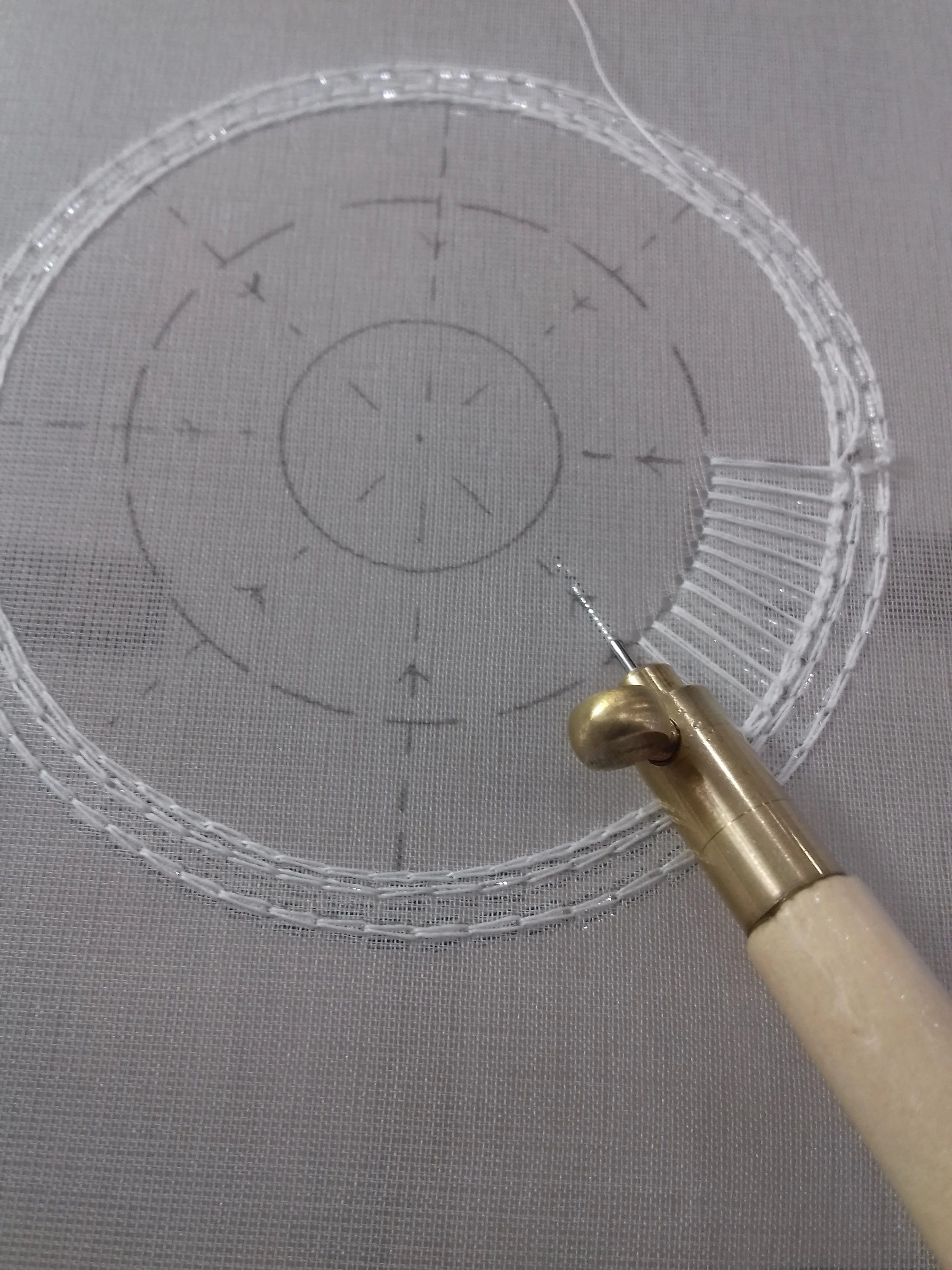
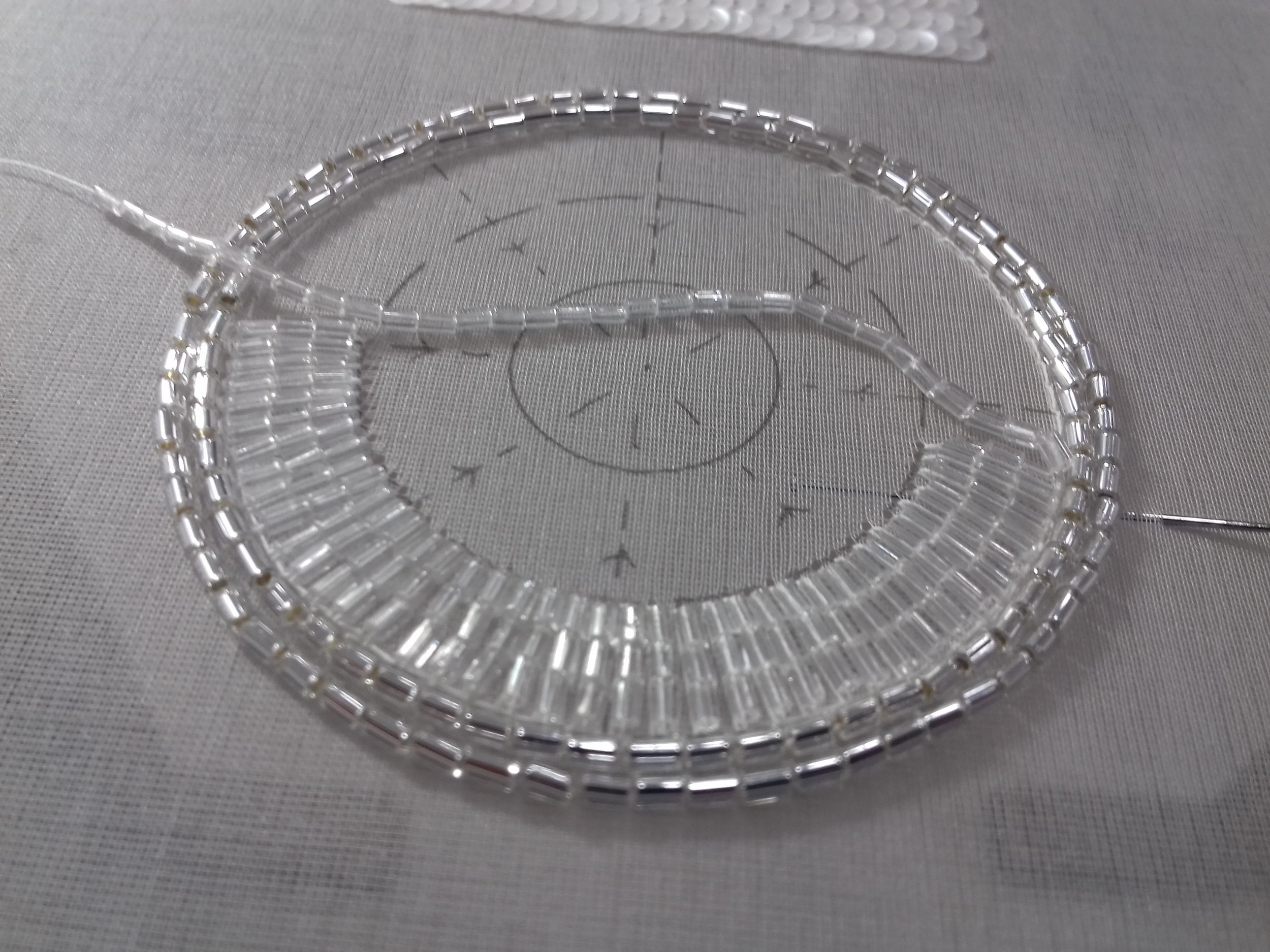
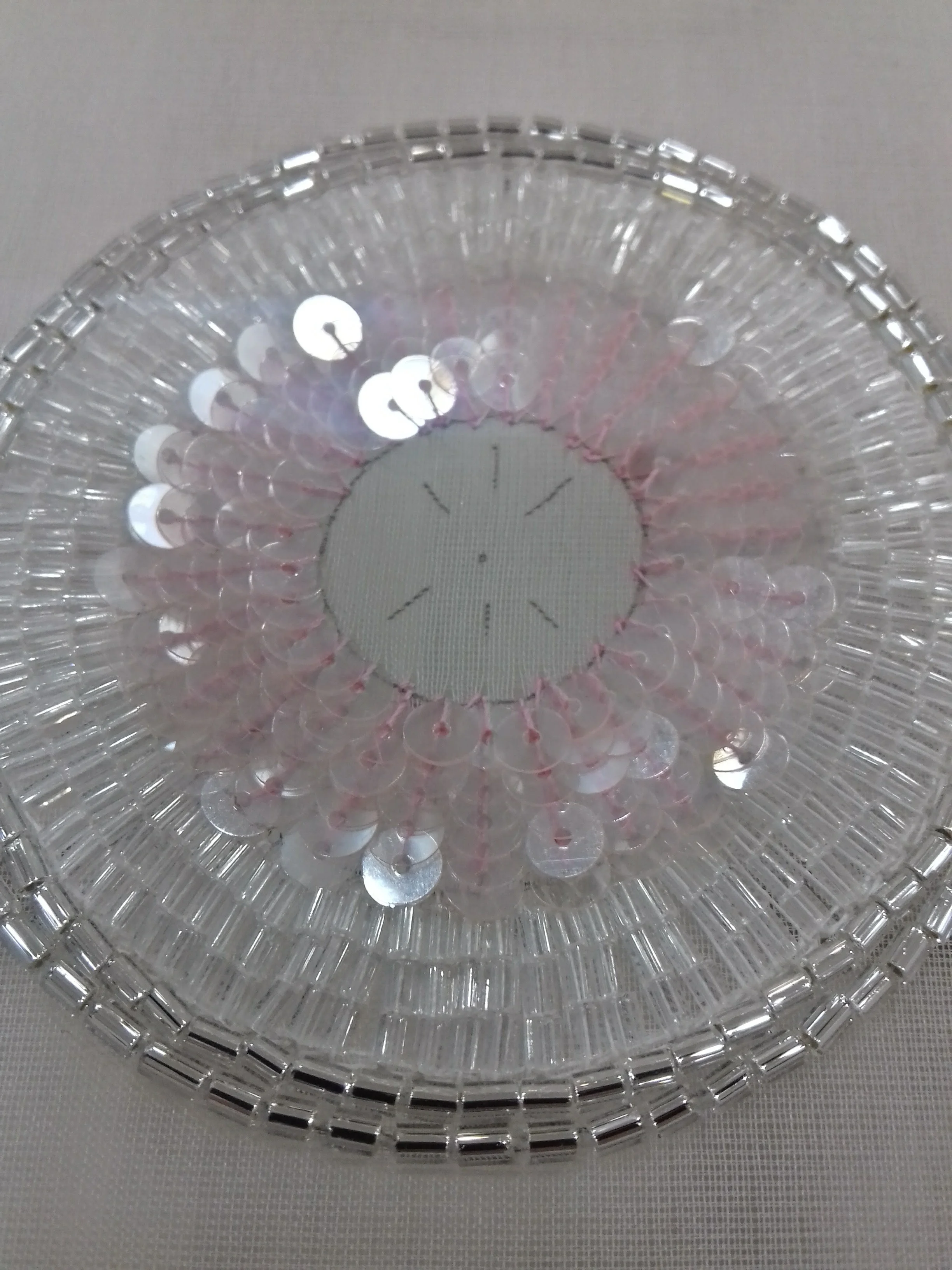
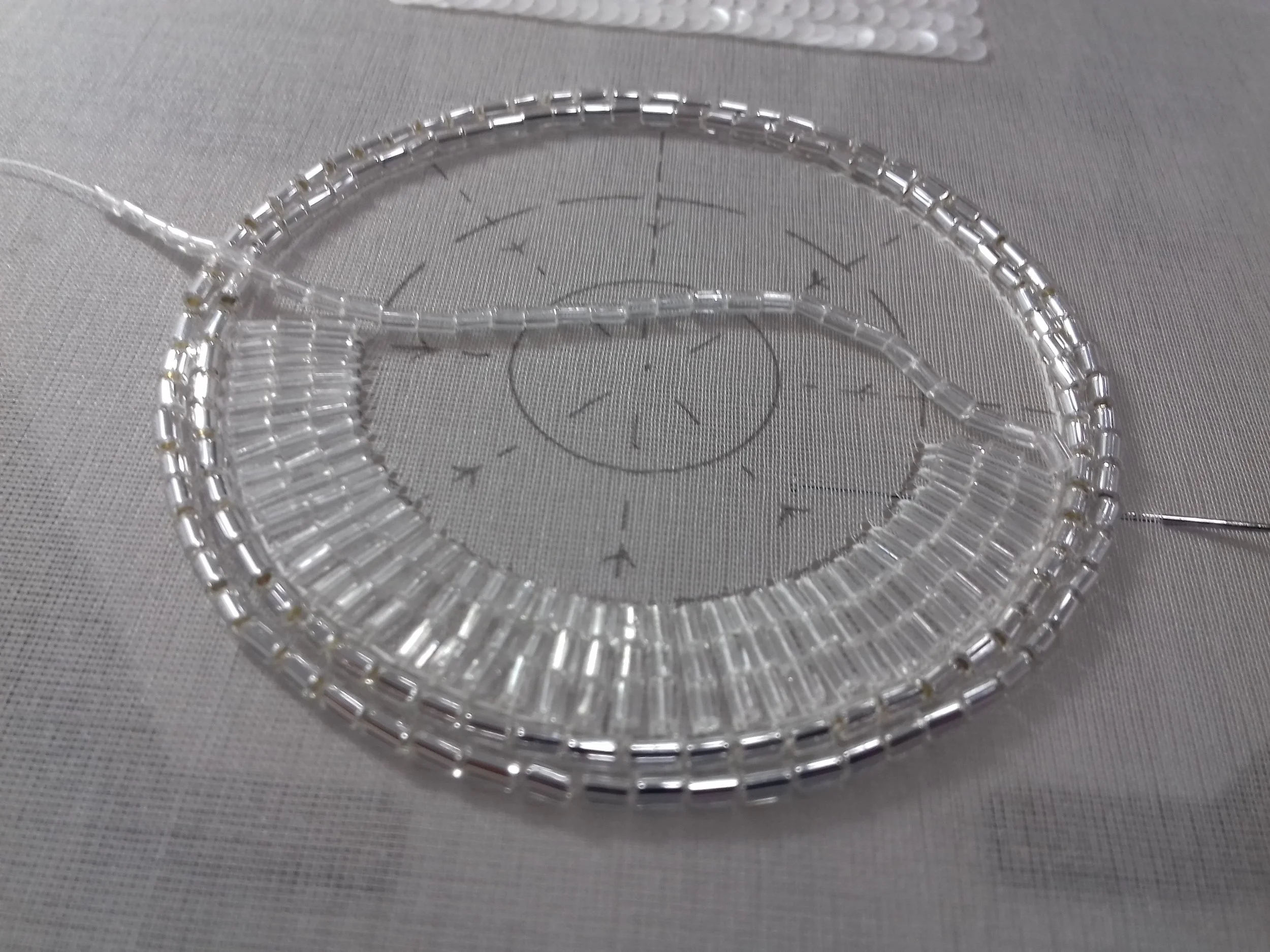
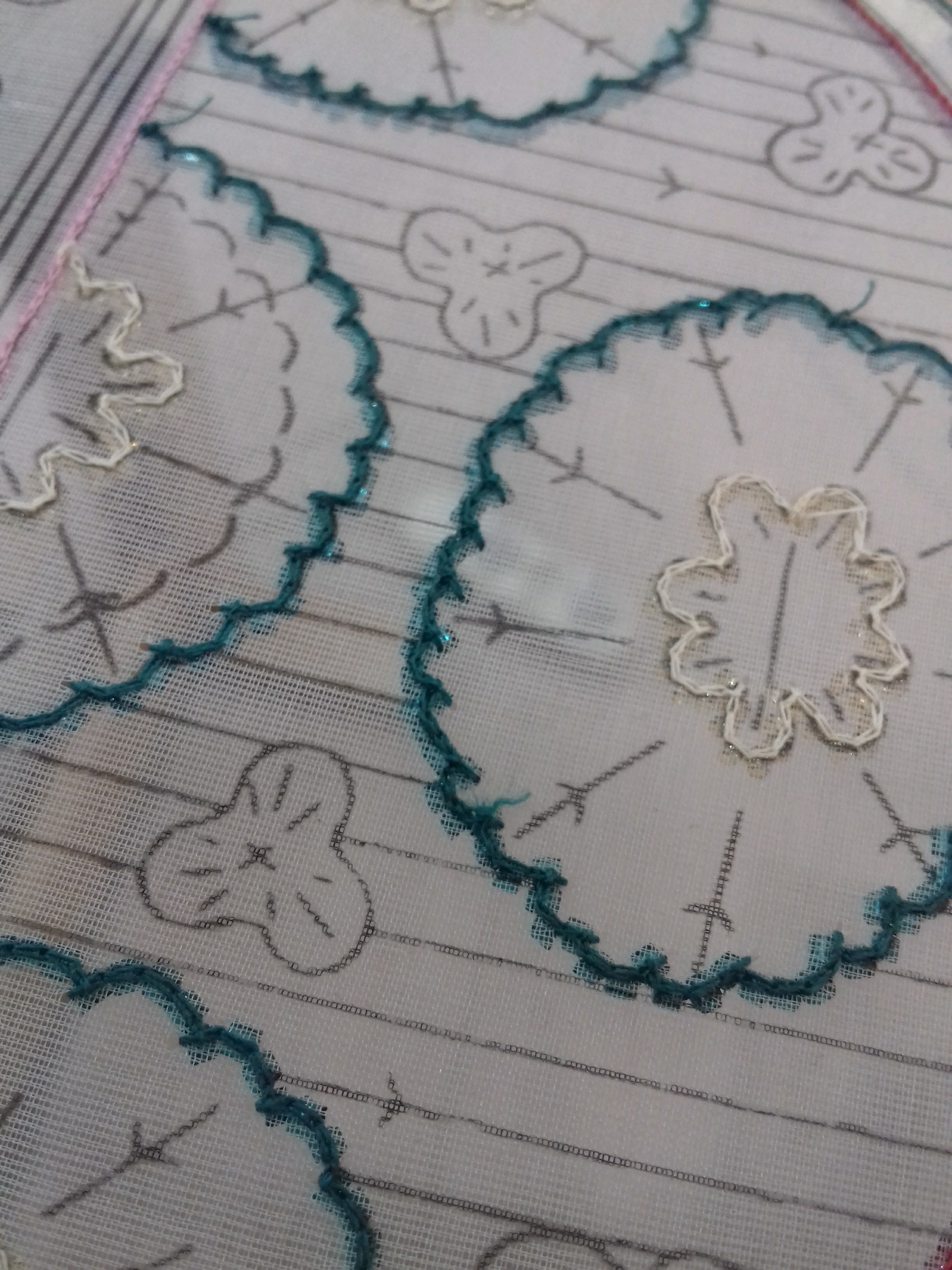
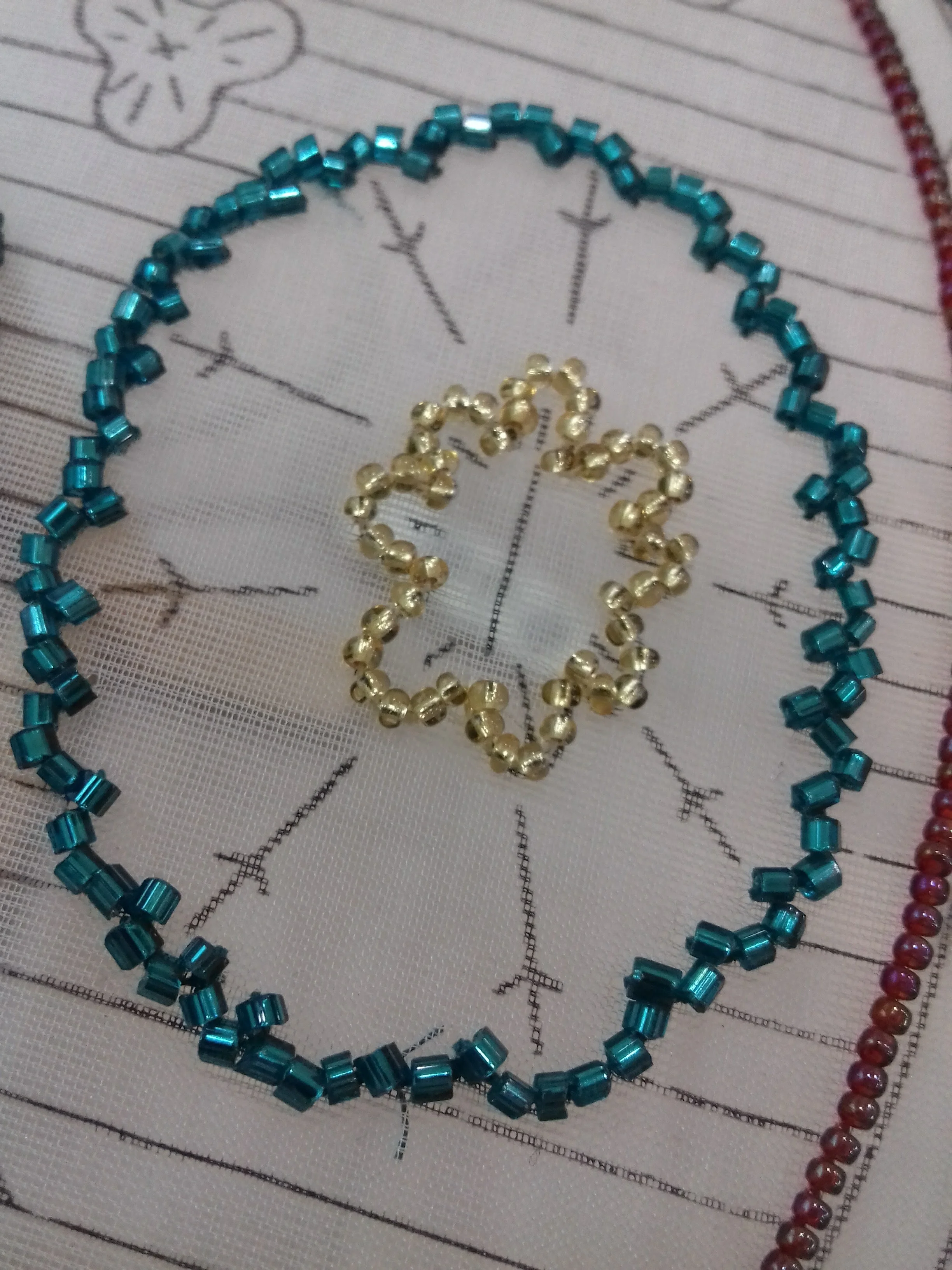
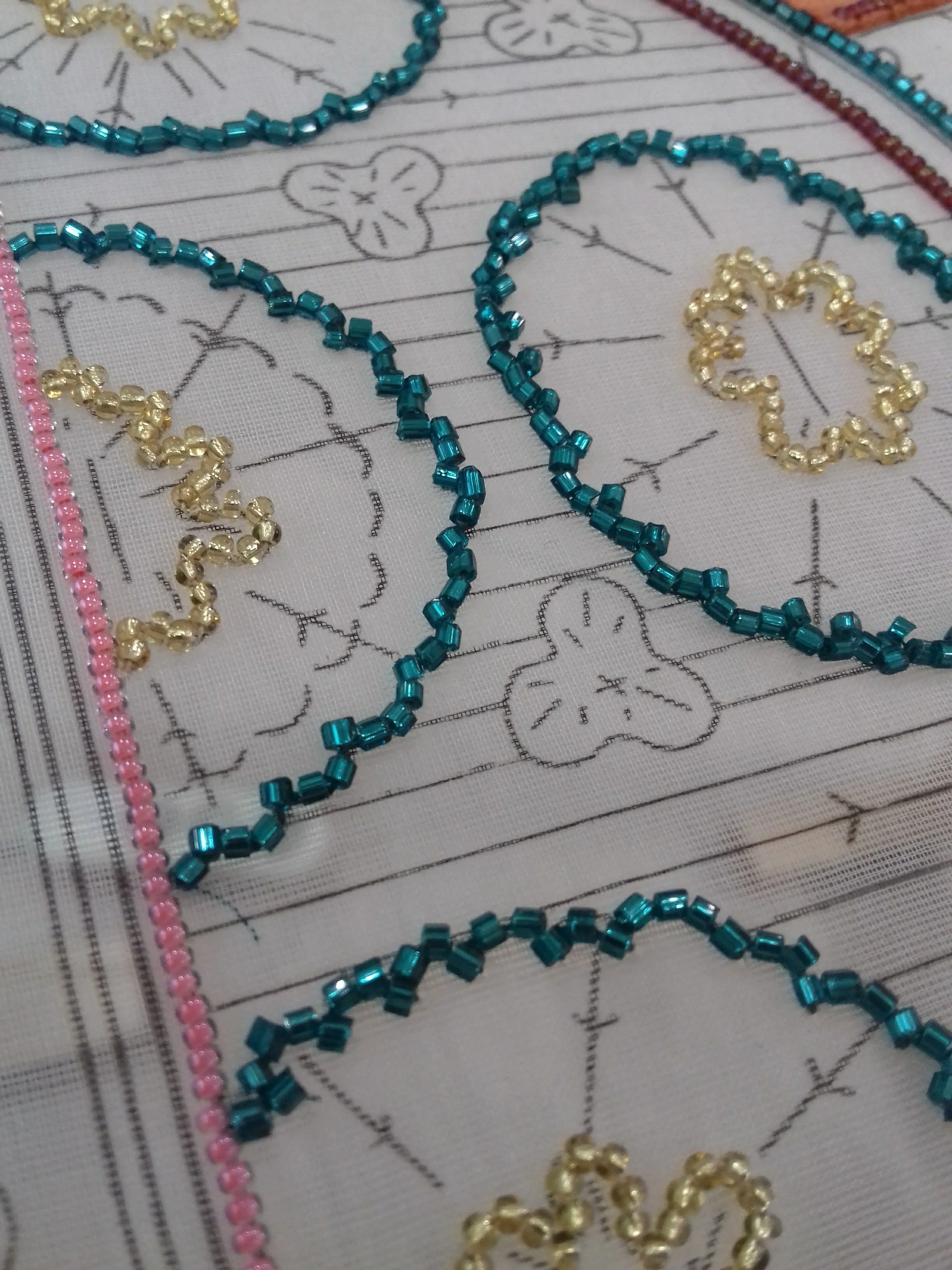
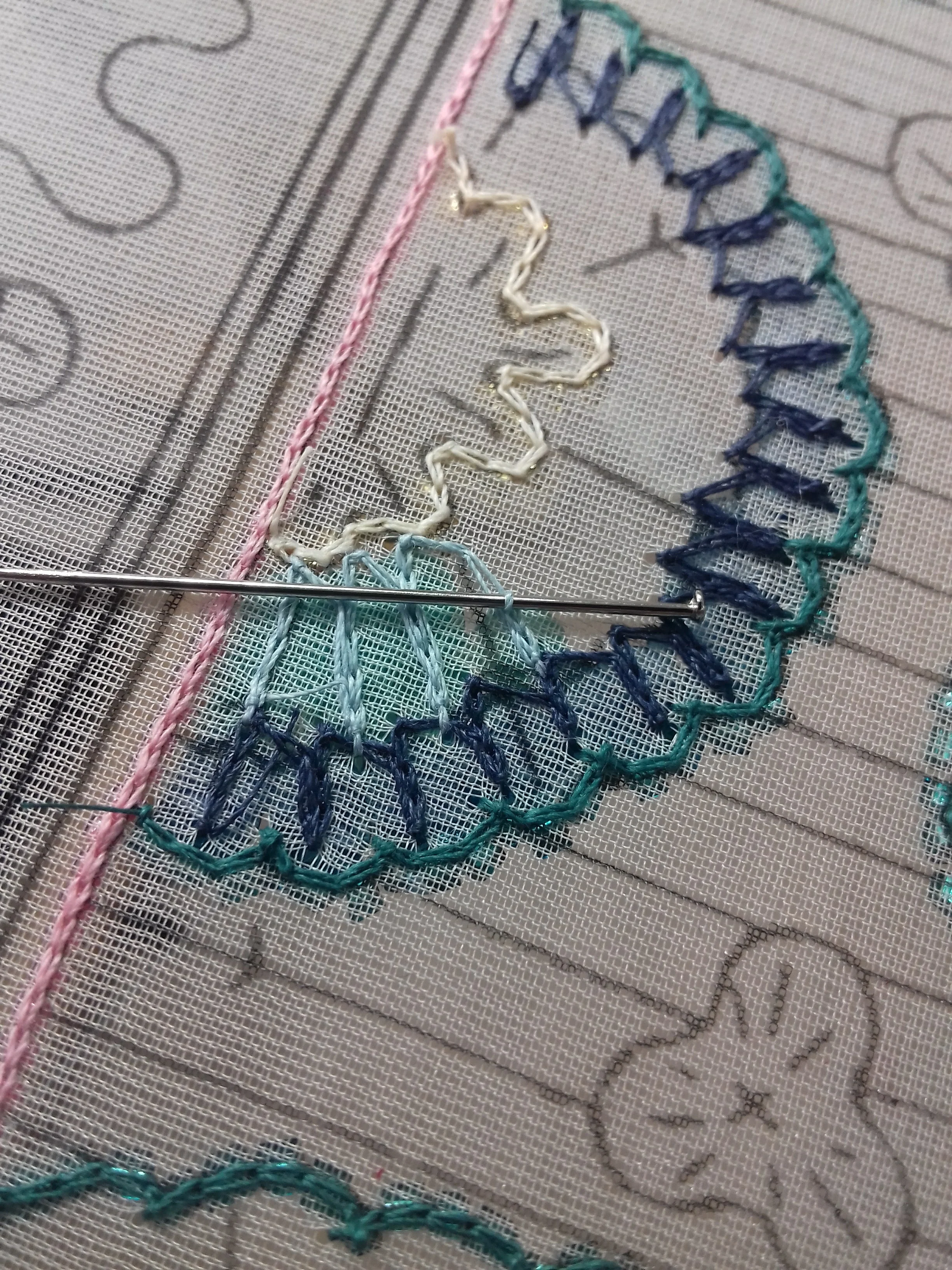
The first step was to outline the shapes with a scalloped contour of turquoise tube beads and to fill the central shapes with curved golden beads. The navy sequins were applied, starting from the outer edge and ensuring that the first sequin was placed to rest on top of the outline of tube beads. This slanted sequin would create the final effect of concave relief. The distance between each row had to be equal and the space between each sequin had to be just smaller than the radius so that the hole would be hidden. The turquoise sequins were applied next and the idea was to create a seamless transition in the rows from navy blue to turquoise. As the shape tapered towards the centre some of the rows had to be adjusted by reducing the number of sequins and creating a dovetail effect with the next row. 

View fullsize 20171103_120554_Richtone(HDR).jpg
View fullsize 20171127_115600_Richtone(HDR).jpg

I may have held my breath throughout the whole precise and exacting exercise but when I eventually turned over the frame I marvelled at the beauty and drama of the effect!

View fullsize 20171129_111034.jpg
View fullsize 20171129_111101.jpg
View fullsize 20171129_111051.jpg
View fullsize 20171129_111039.jpg

The tiny blossoms were outlined with pink and red beads and the background was filled with lines of iridescent sequins. Following on from the success of the sequin flowers I underestimated the difficulty of these lines and found myself under pressure to complete them. While I could manage adding lines of sequins in a river, I didn't realise that the lines had to be adjusted incrementally to accommodate the organic shapes of the flowers, blossoms and curved arch that outlined the section. As these adjustments were meant to be imperceptible, the background turned out to be quite the task of measuring, judging, doubting and finally placing sequins a millimetre or two outside the lines of the pattern! 

View fullsize 20171213_102658.jpg
View fullsize 20171213_102709.jpg
View fullsize 20171213_102717.jpg
View fullsize 20171215_102539_Richtone(HDR).jpg

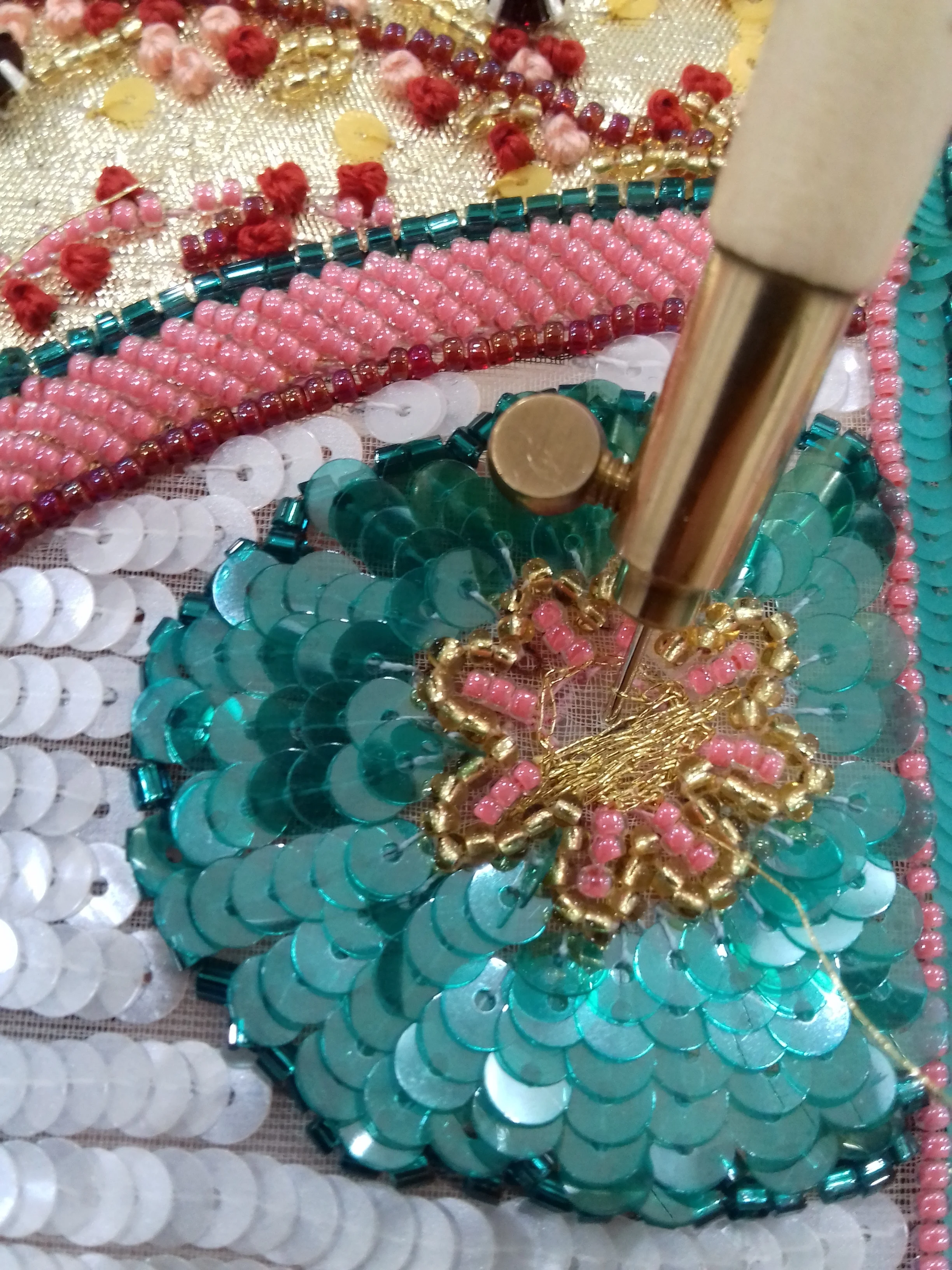
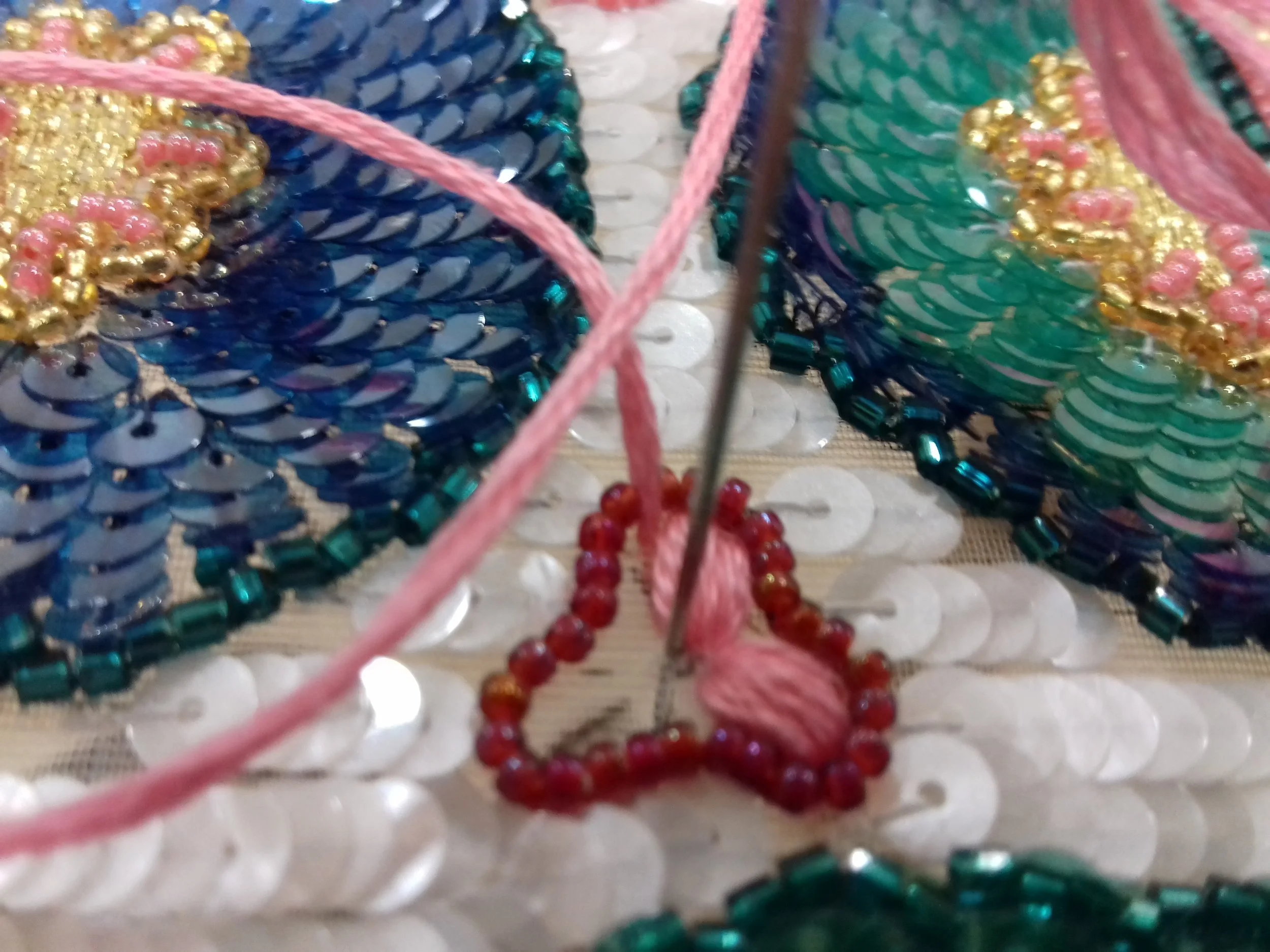
Short rows of pink beads were added inside each curve of the gold beads using the point-tiré and then the chain stitch was used to fill the centre in gold metallic thread. Each petal of the tiny blossoms was created using satin stitch in pink or red embroidery floss and long stitches were added in alternating colours that were to finish between the sequins in the background. Pink sparkling jewels were placed in the centre of the tiny blossoms.

View fullsize 20171215_103018.jpg
View fullsize 20171215_114952.jpg
View fullsize 20171215_111003.jpg
View fullsize 20180112_100827.jpg

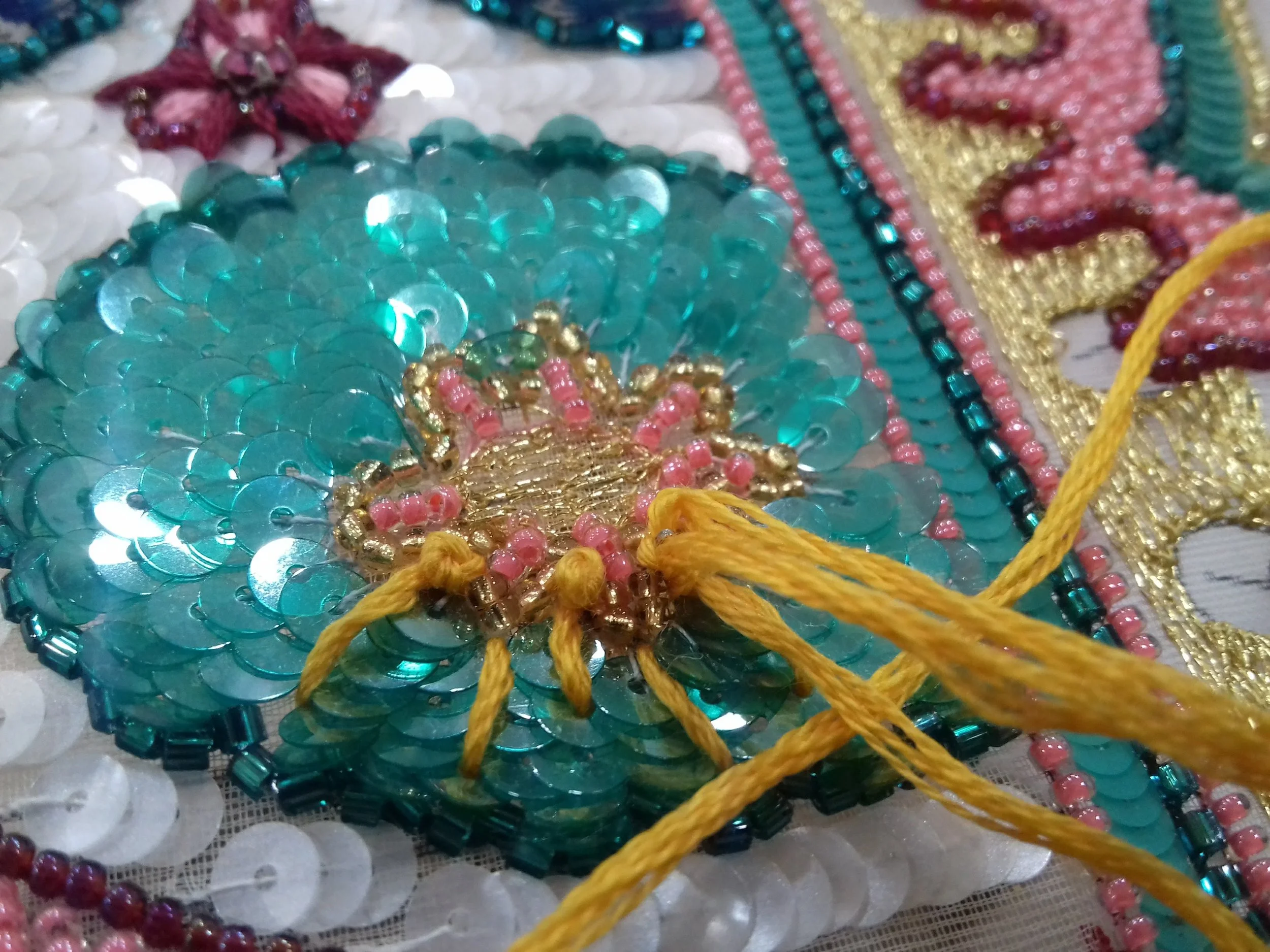
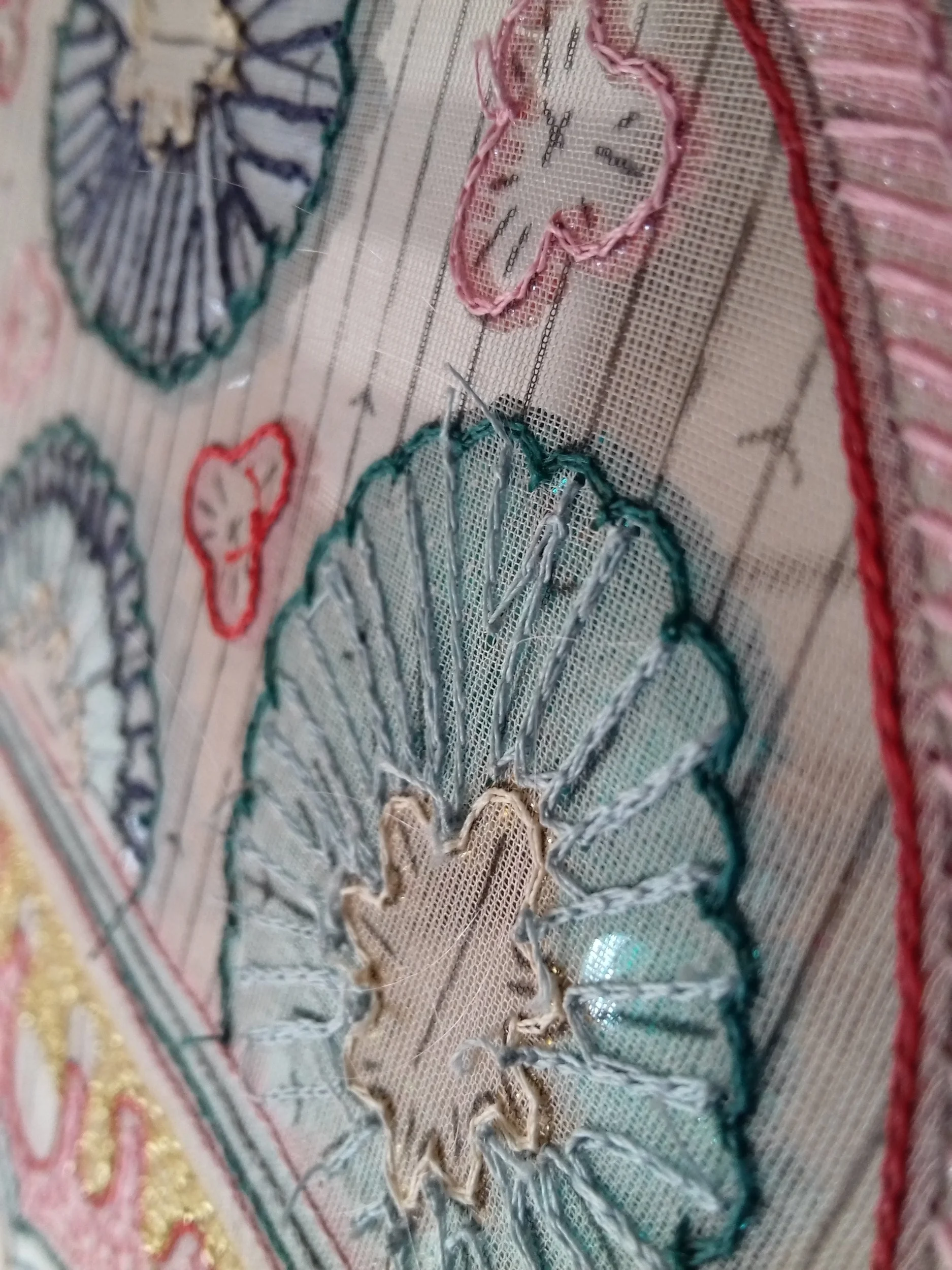
A final flourish was added to one of the sequin flowers with lancé stitches and french knots in sunshine yellow embroidery floss. And voilà! I would have to say that I was delighted when I made this section, it was relatively easy and I think the technique has such a dramatic effect. I was really curious to discover if it is used in contemporary embroidery and decided that it was high time to do a bit of window-shopping at the famous Grands Magasins of Paris...

20180311_115125_Richtone(HDR).jpg
20171215_112730.jpg

Textile Tours of Paris

Join Rebecca on a tour of Paris’ charming haberdasheries nestled deep in the winding streets of Le Sentier, the city’s historic textile and fashion district. Enjoy a Sunday morning with Rebecca on a Flea Market Tour as she guides you through the labyrinth alleys of Paris’ oldest marché-aux-puces to uncover hidden treasure troves filled with vintage lace, linen, passementerie, golden threads and gossamer lingerie. To find out more visit Textile Tours of Paris.
C'est la Haute Couture

March 18, 2018 Rebecca Devaney
20180122_094756_Richtone(HDR).jpg
View fullsize 20171110_102645_Richtone(HDR).jpg

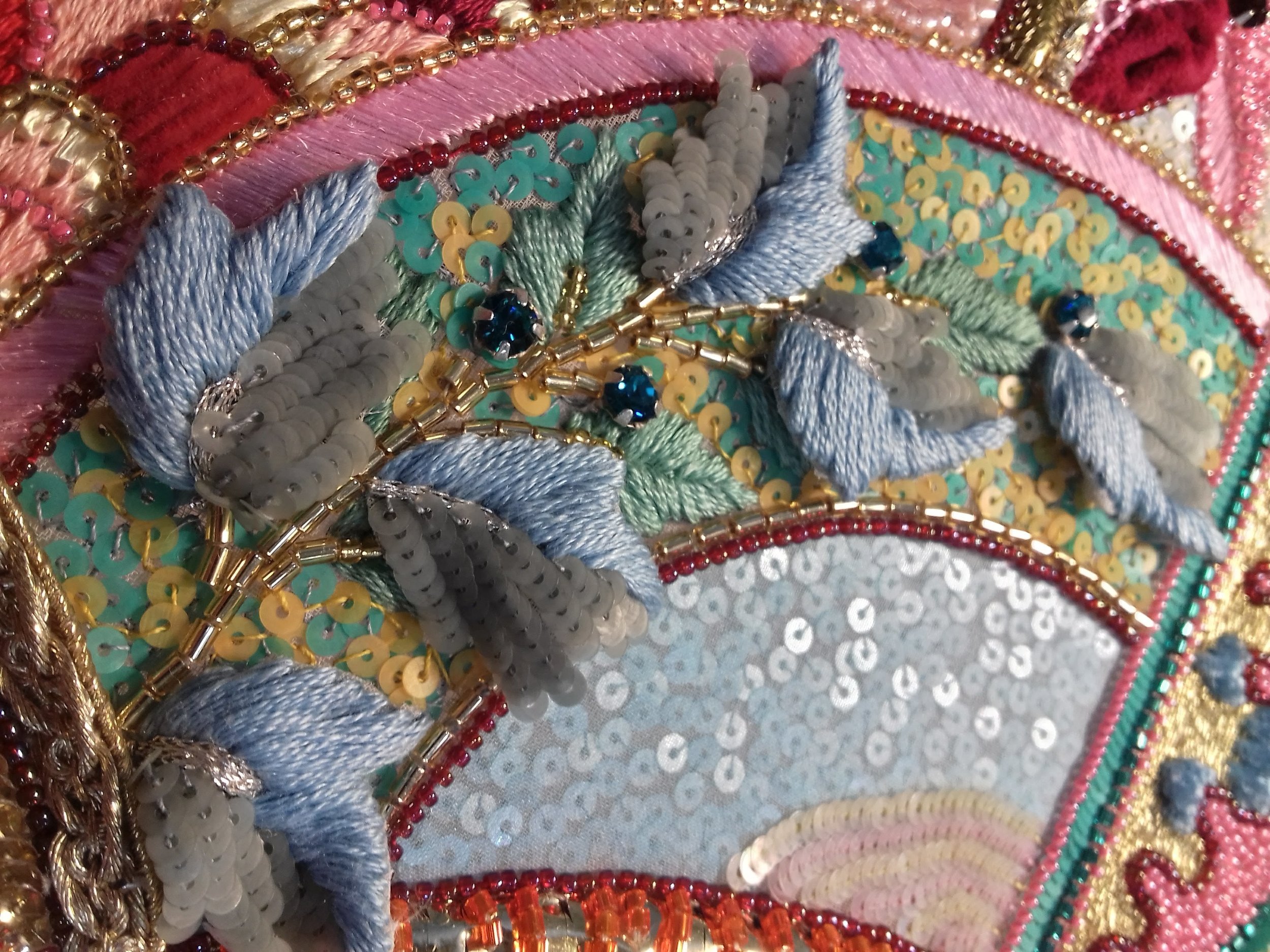
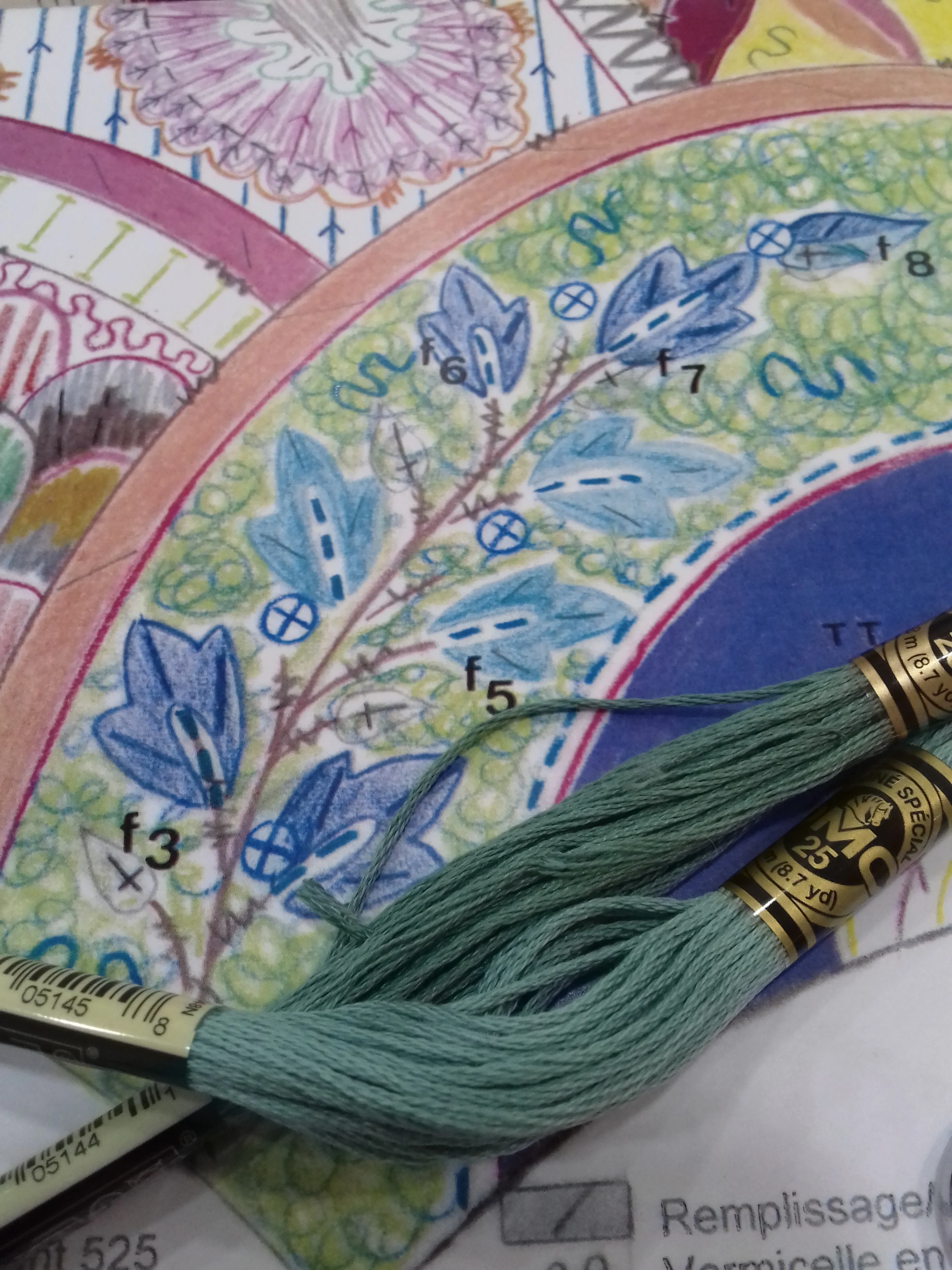
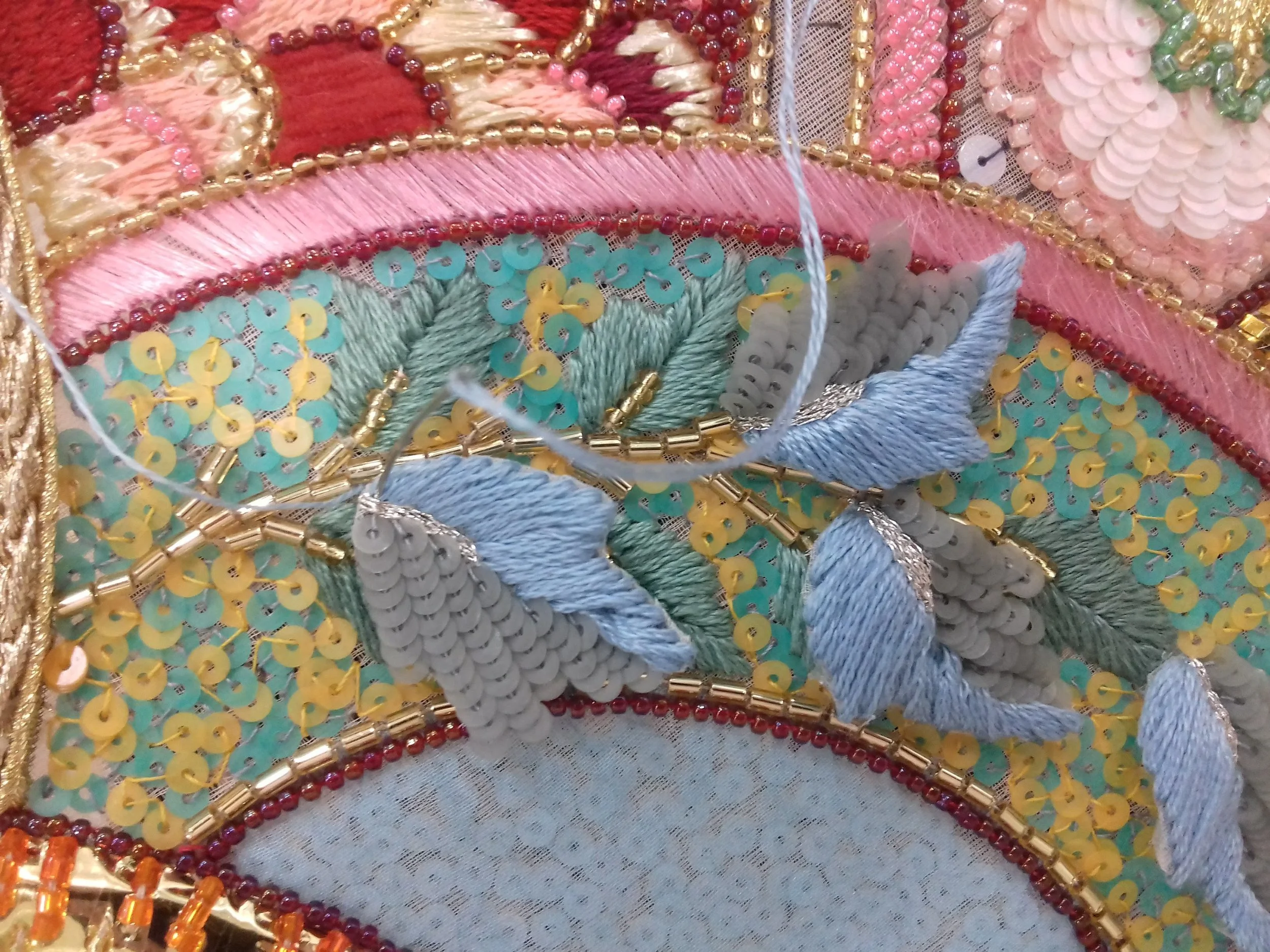
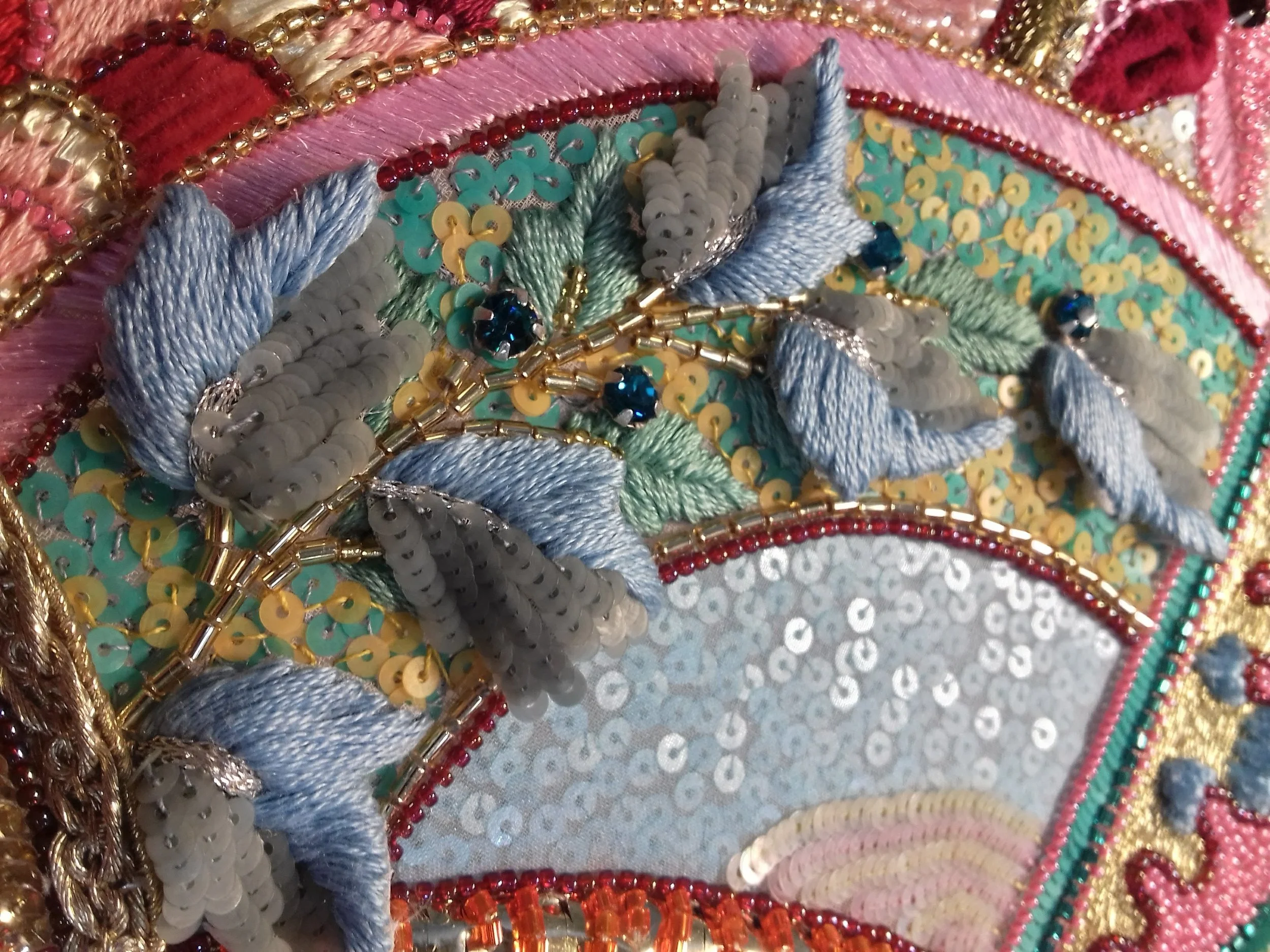
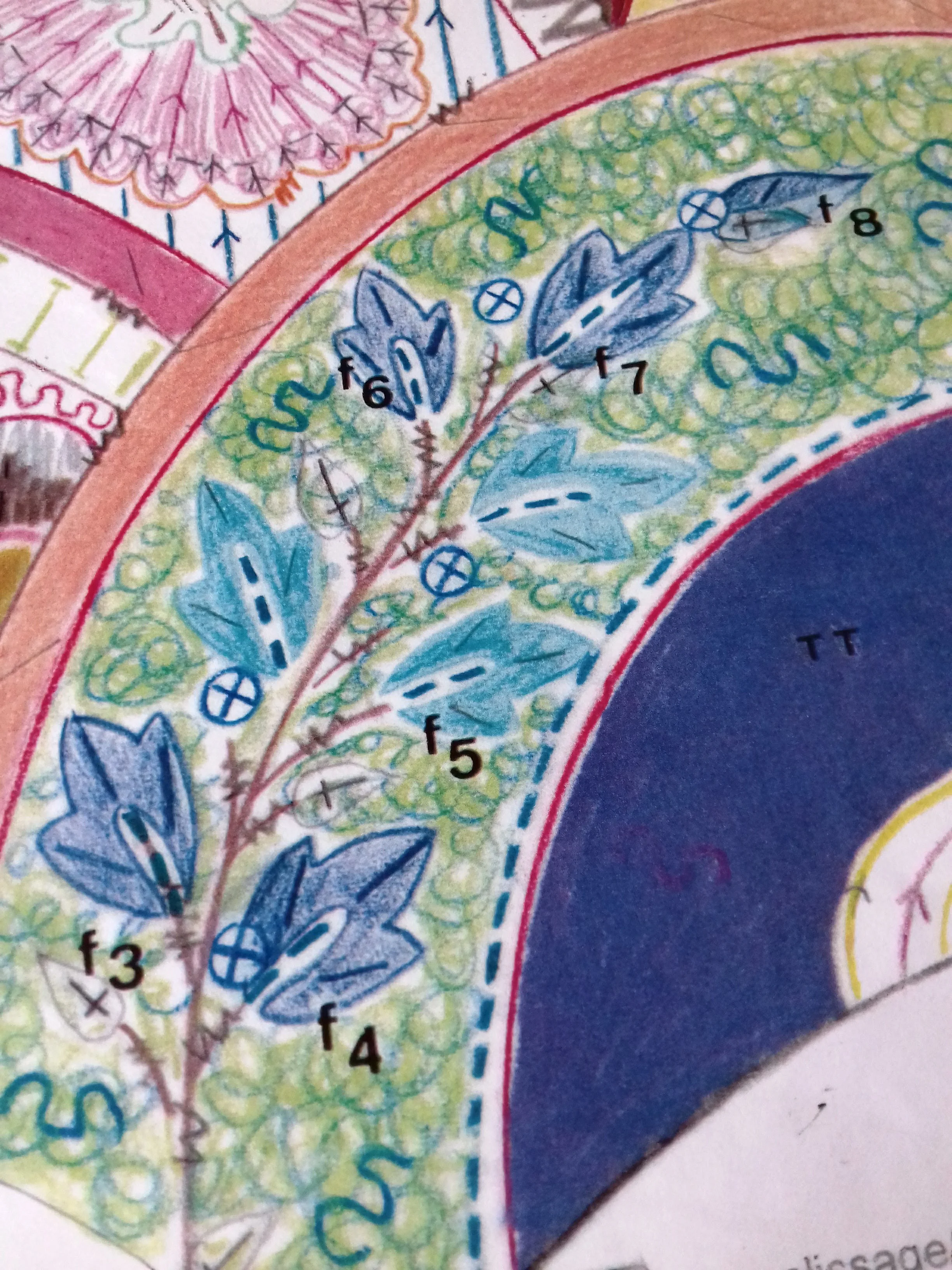
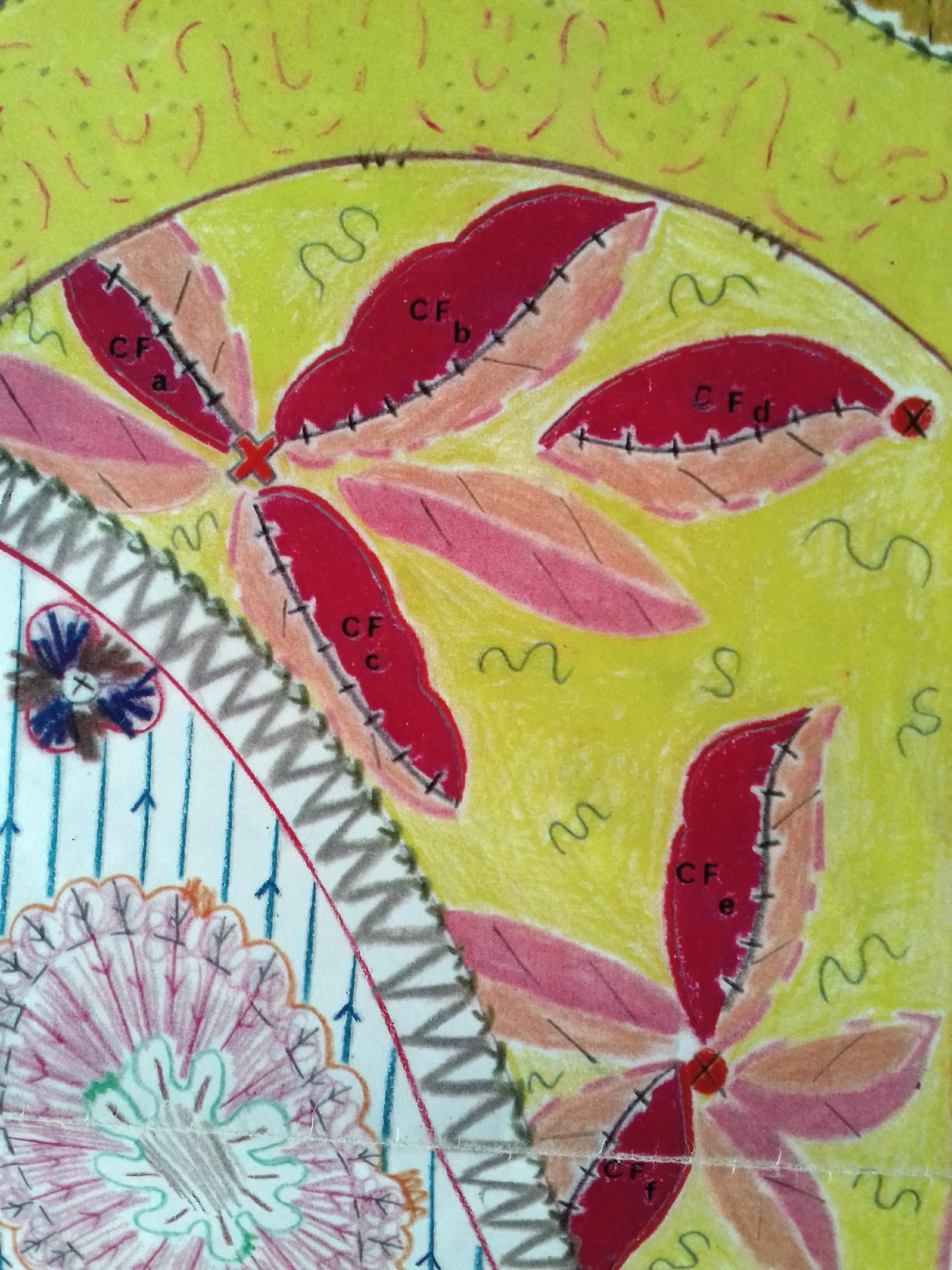
As with the other sections, this little section was completed in several steps as it included a few different techniques. The blue leaves in the pattern indicate needlework, the green and blue background with squiggles is double vermicelli with sequins, the letters and numbers are the addition of 3D elements and the circles with crosses are jewels.

I was to learn a rather surprising lesson about Haute Couture in this section as there are frequently areas that are hidden. This means that you may spend hours, days even, working on a certain piece, making sure that it is as perfect as you can get it to discover that it will be covered by something else! An added detail will completely hide your painstaking work from view and admiration. The teachers assured me that the consolation was that you, the embroiderer, knew the work that was involved and could quietly appreciate the attention to detail. C'est la Haute Couture they patiently explained. I was incredulous at the thought of this humble acknowledgement of craftsmanship, because the pride I felt after learning each new technique made me want to exclaim my glory on the streets of Paris! 


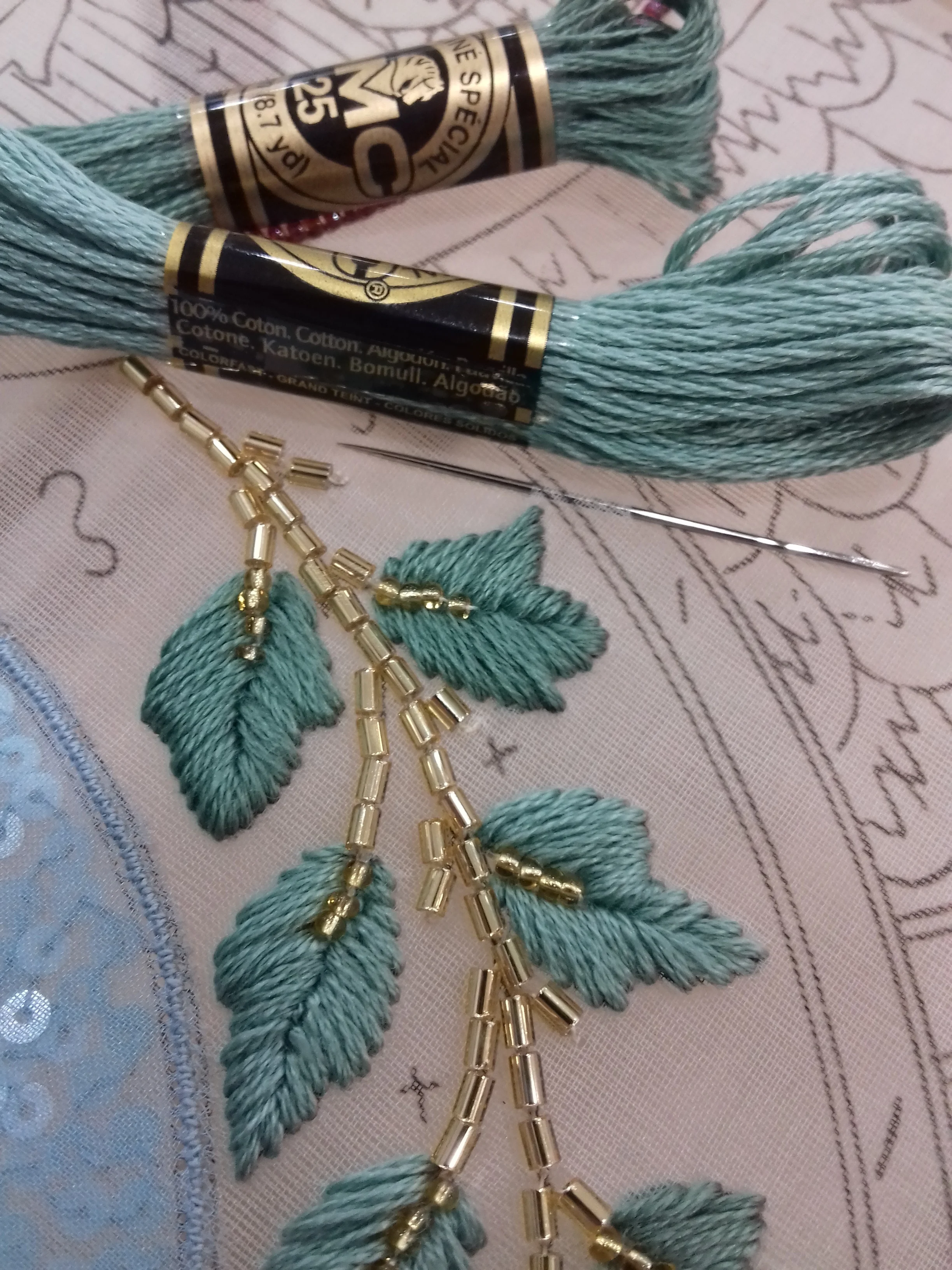
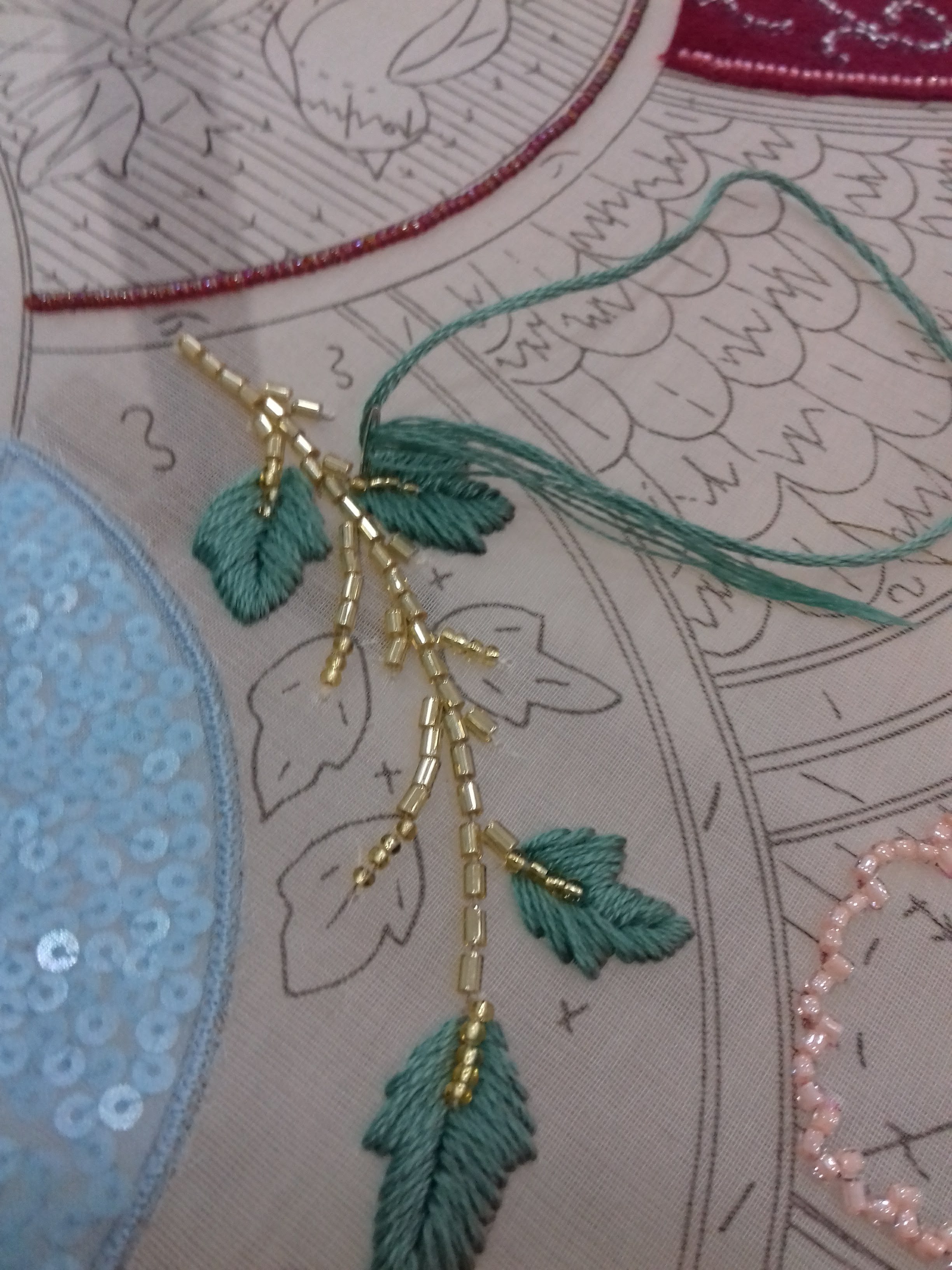
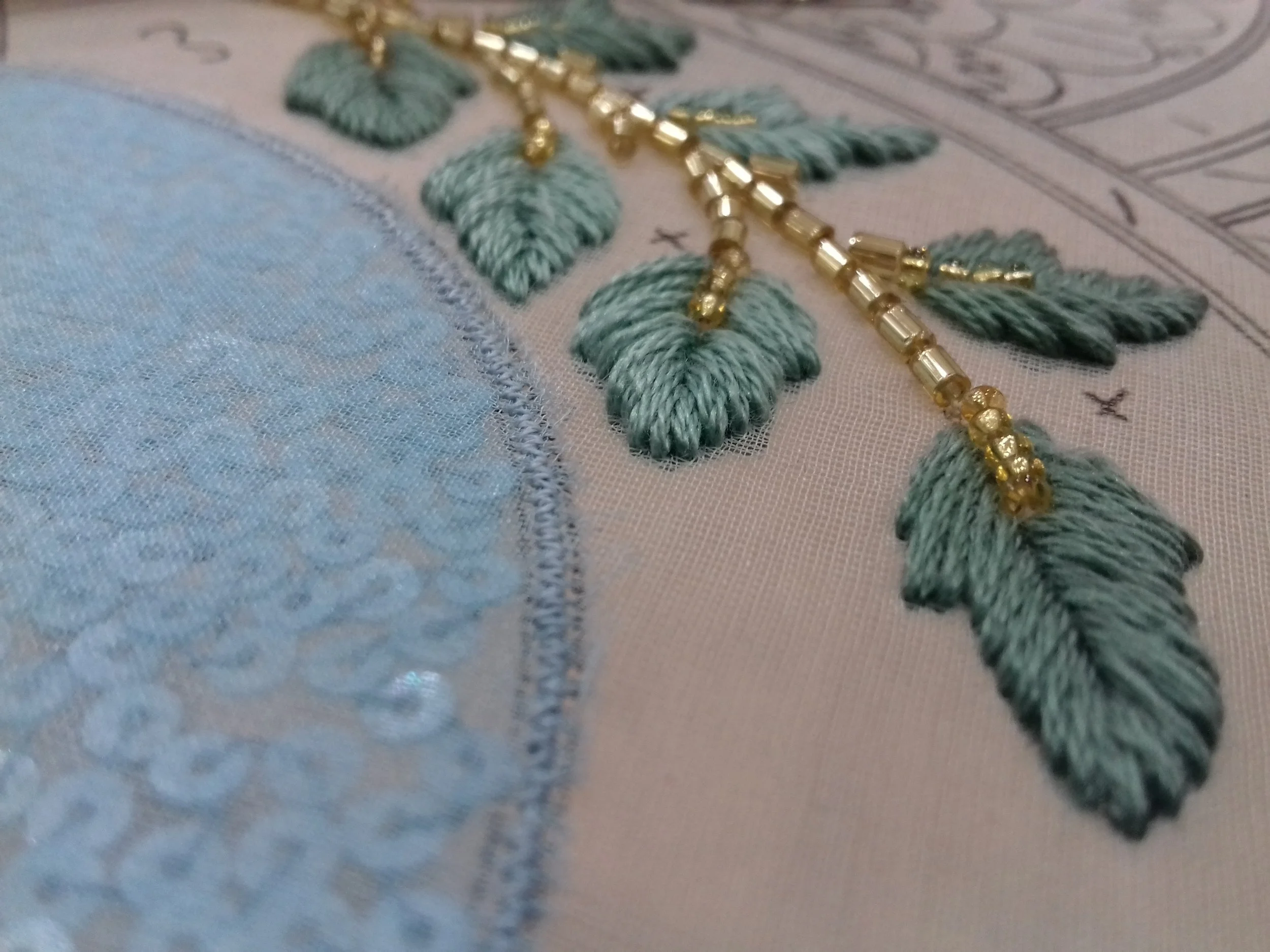
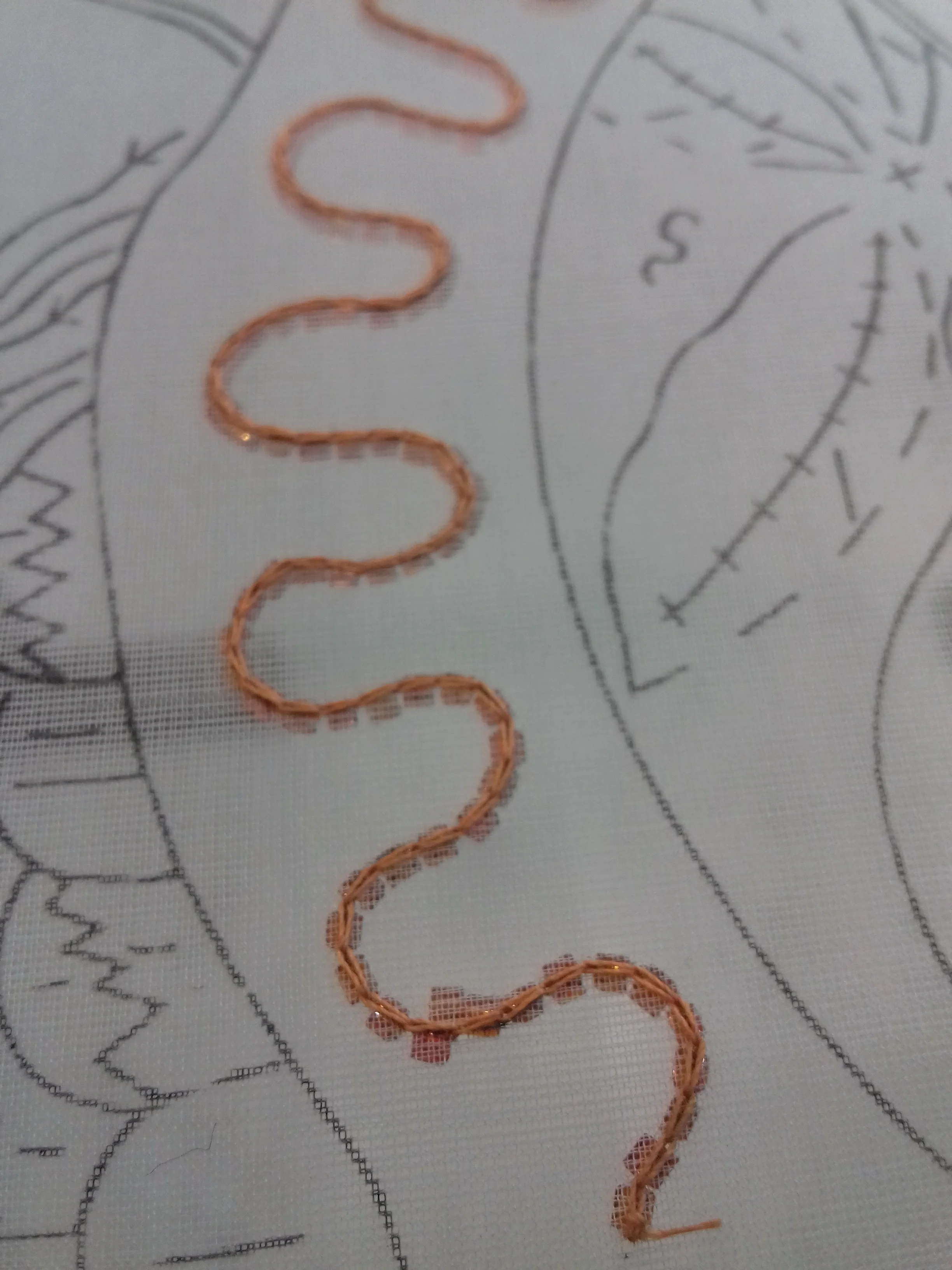
Of course I didn't realise any of this at the first stages and so I carefully created the stem in gold tube beads, using the technique for merging rows of beads. Next the leaves were added in two slightly different shades of green embroidery floss using satin stitch. I was much happier with my satin stitch here compared with the sampler of techniques and was delighted with my improvement. The teacher advised that I wasn't pulling the tension of the thread tightly enough after each stitch and this made them uneven and untidy. Also, these stitches were diagonal which definitely worked to my advantage!

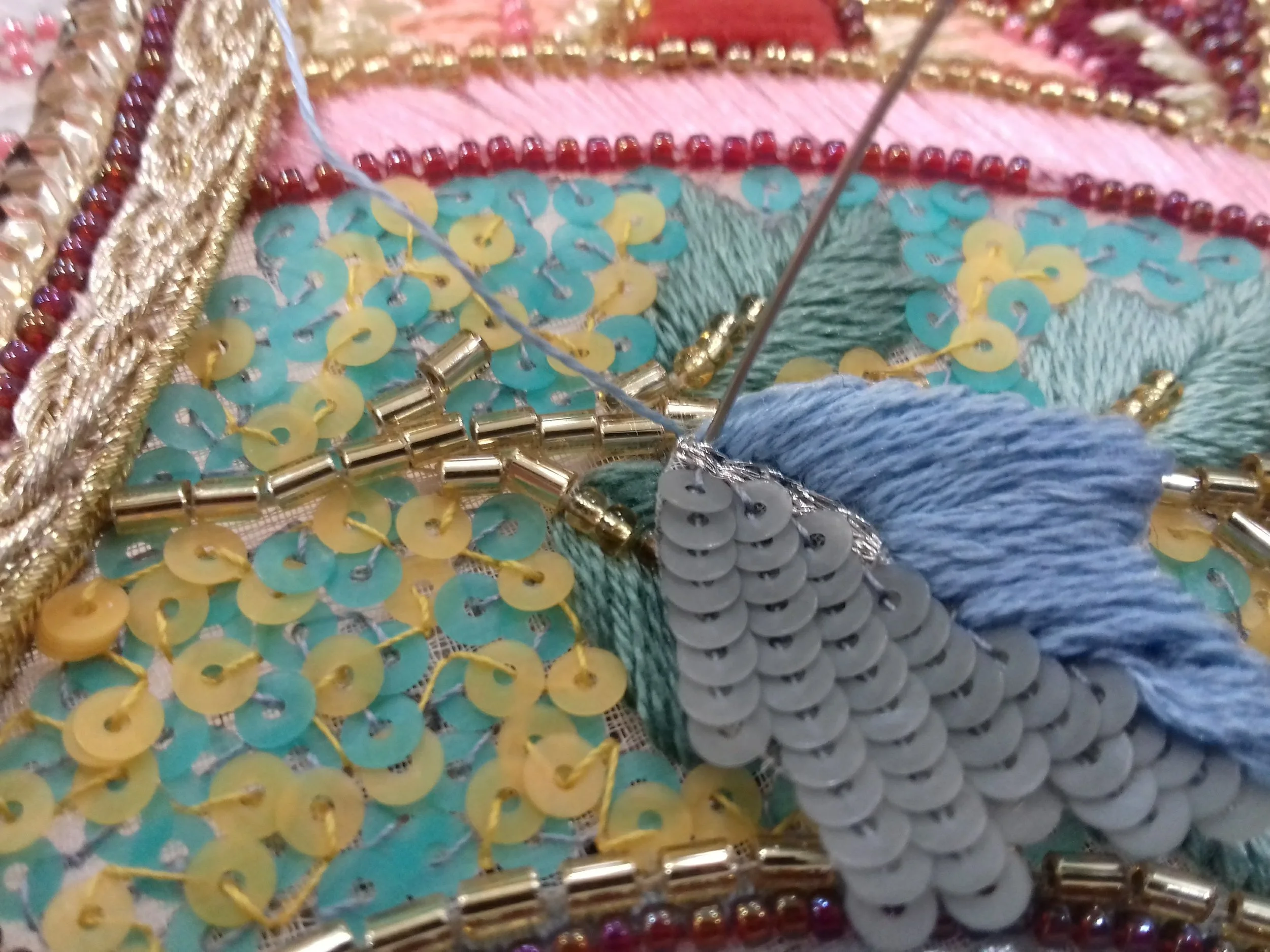
The double vermicelli technique involves the same principle as the regular vermicelli, remembering to change the direction your stitches each time and working in curved waves that never develop into a pattern. With the double vermicelli an empty stitch is included between each sequin that is placed, leaving the space to fill in with the next layer. The first layer was turquoise and the second layer was sunshine yellow matt sequins. Again, the matt sequins are very tricky to work with as they don't slide apart and are often stuck together, not to mention their minuscule size of 4 millimetres of diameter. 

View fullsize 20171110_102731_Richtone(HDR).jpg
View fullsize 20171110_094930.jpg
View fullsize 20171110_102748_Richtone(HDR).jpg
View fullsize 20171204_113620.jpg

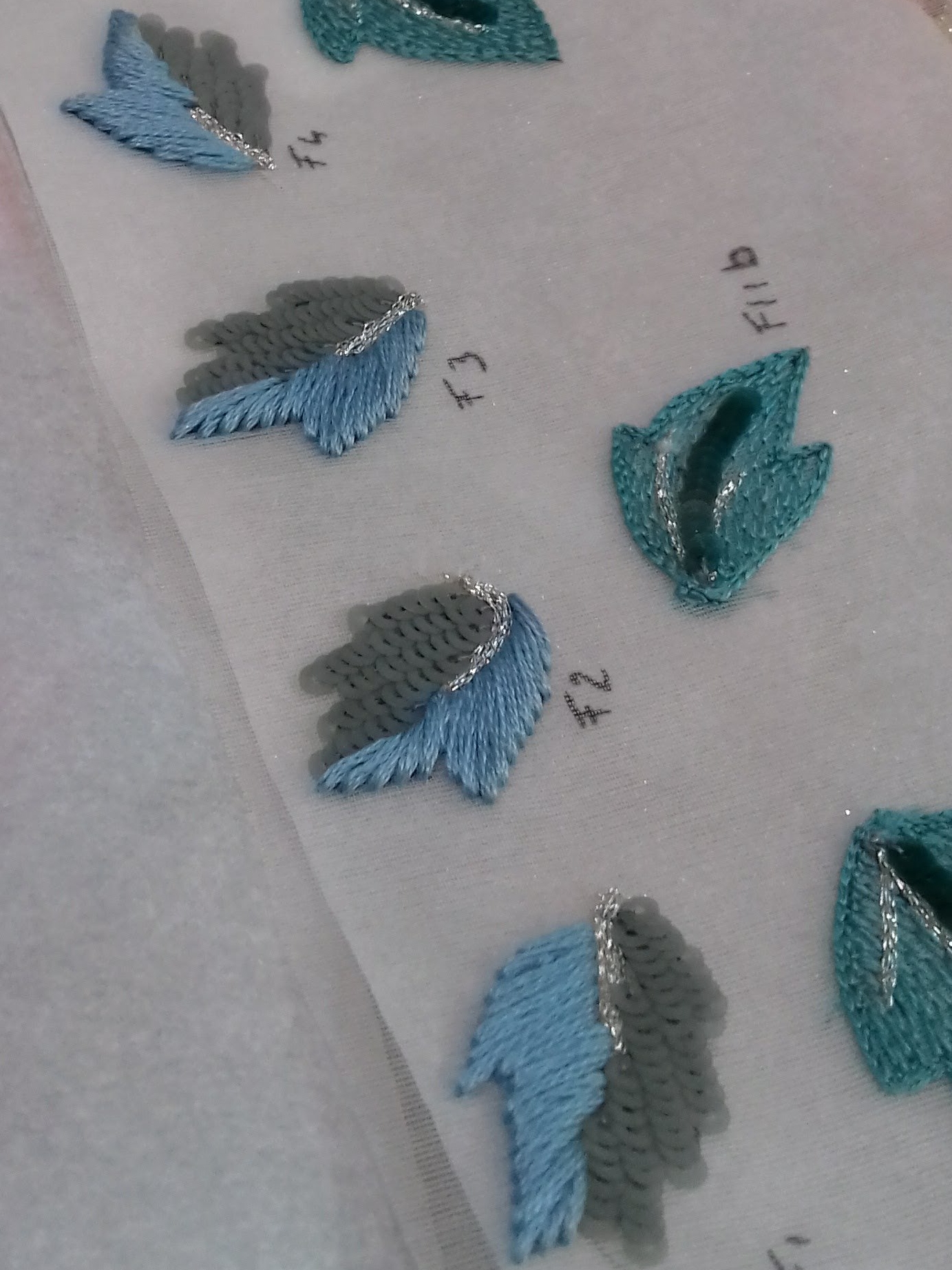
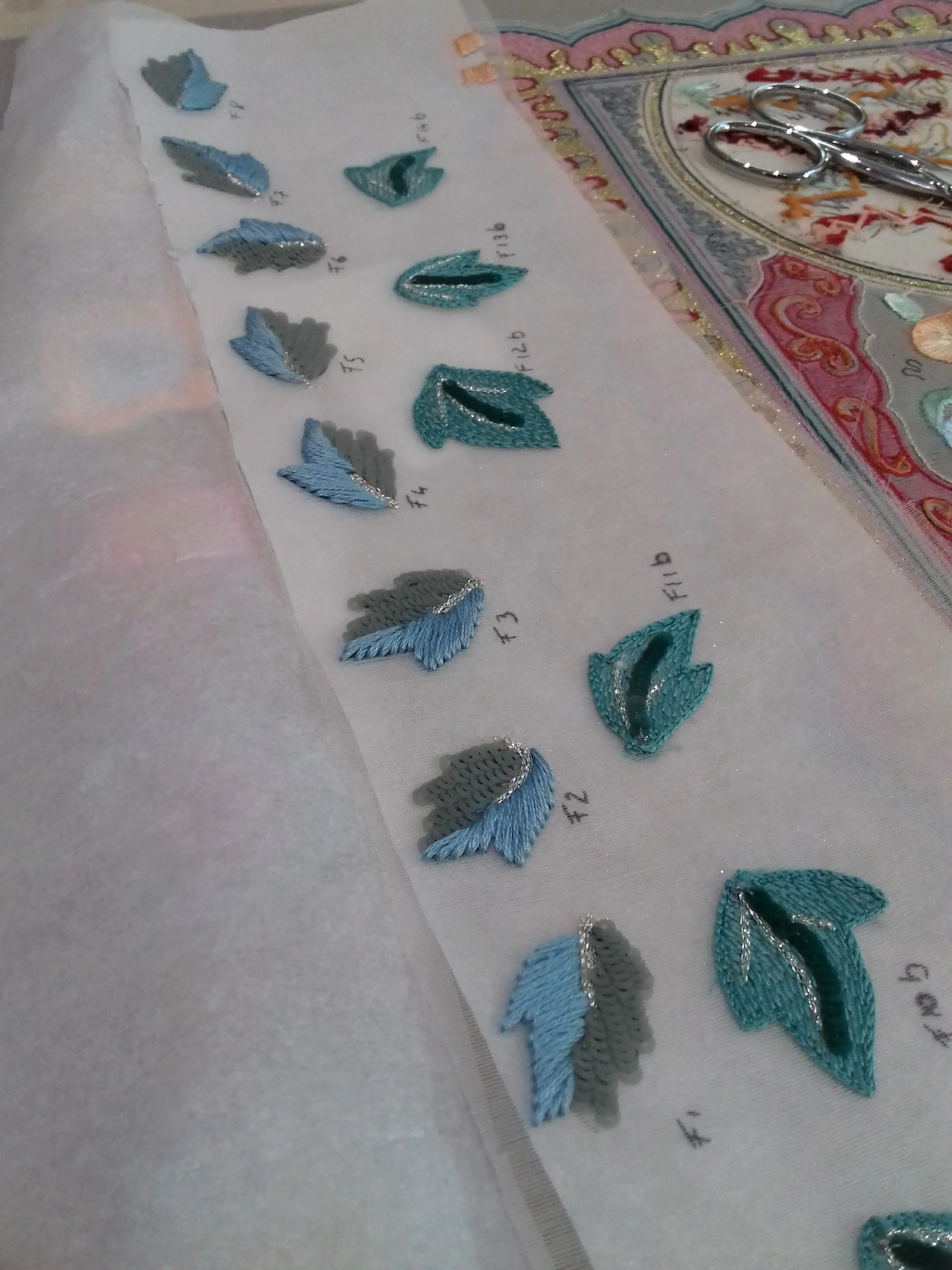
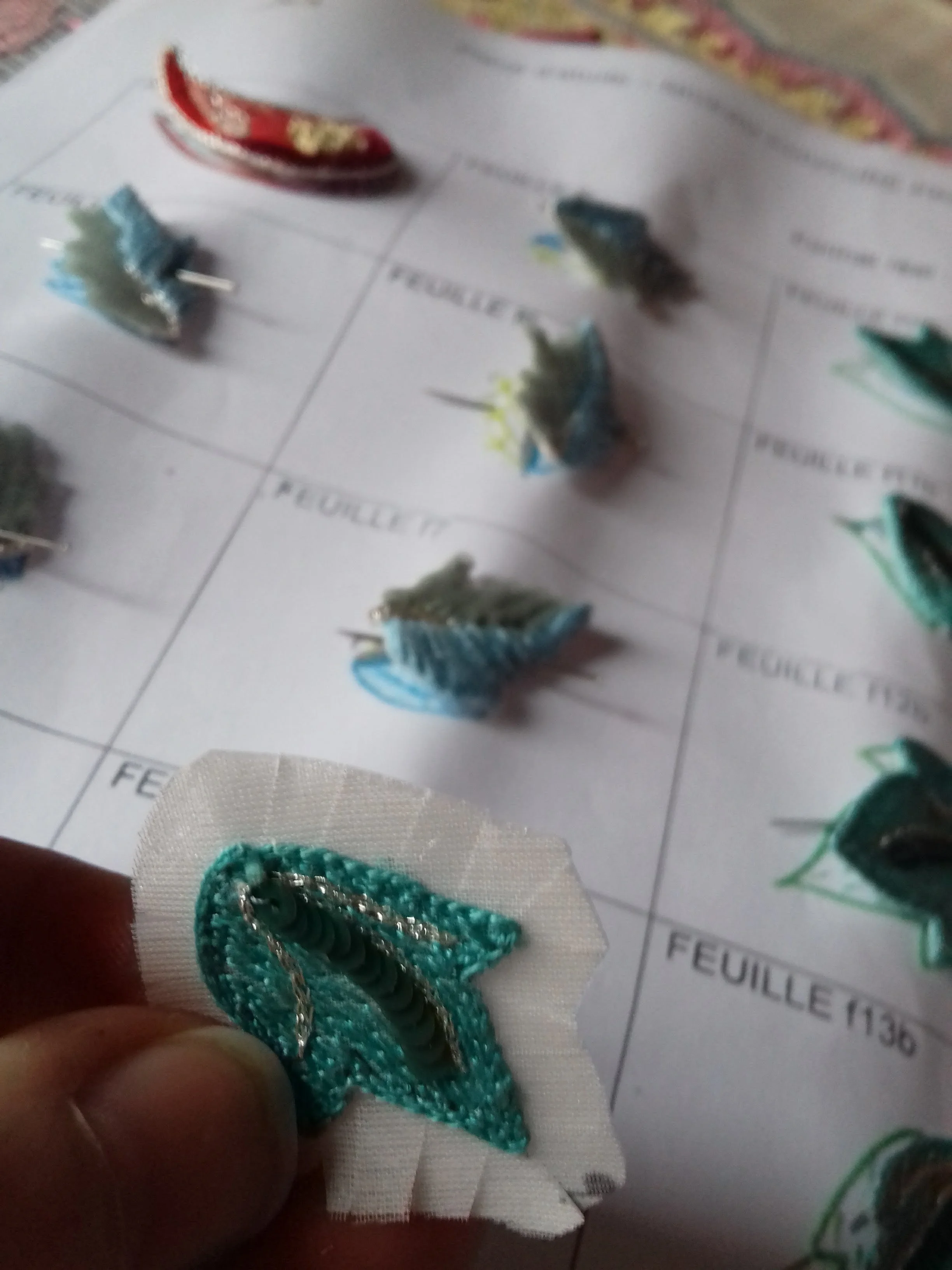
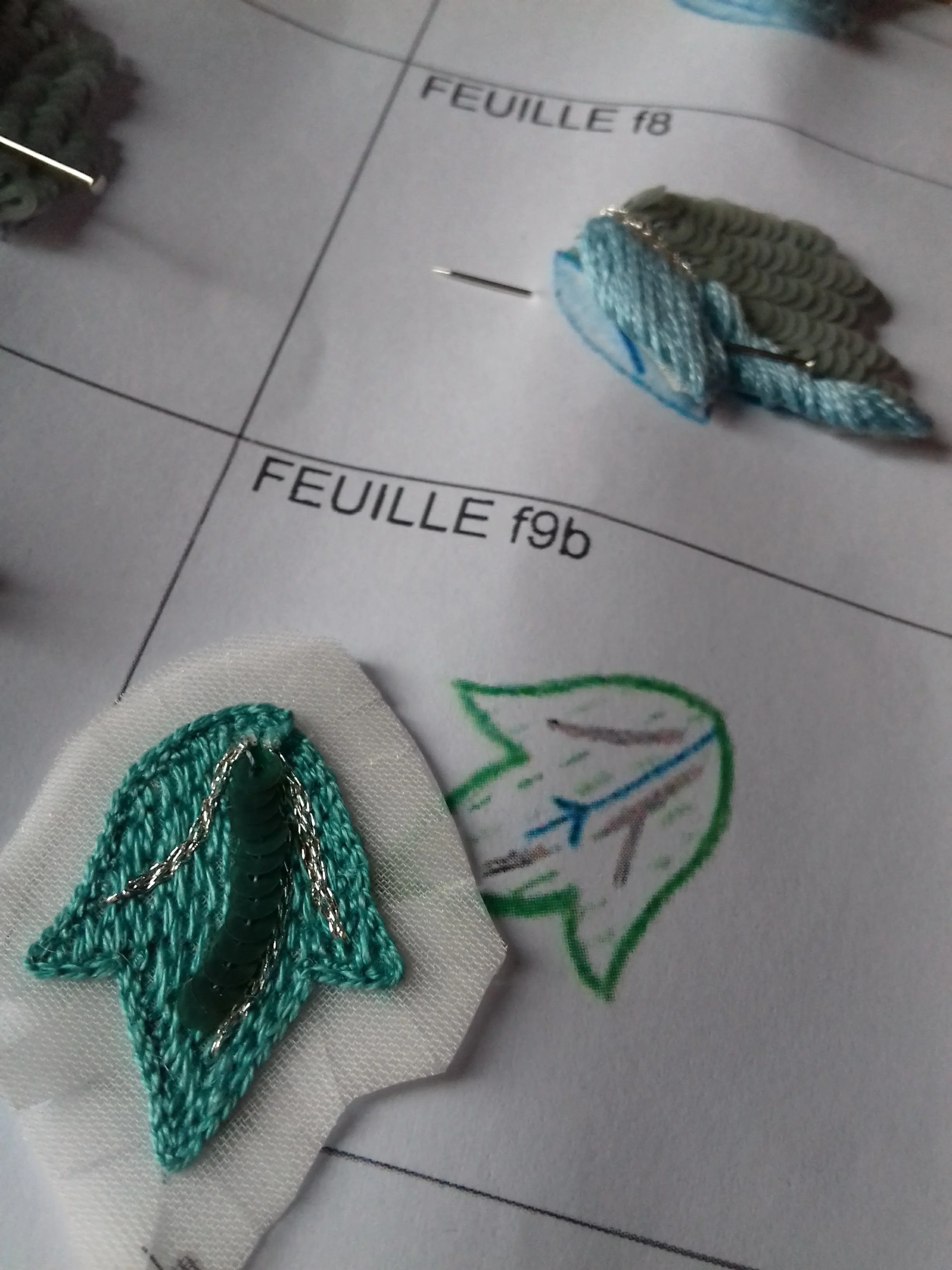
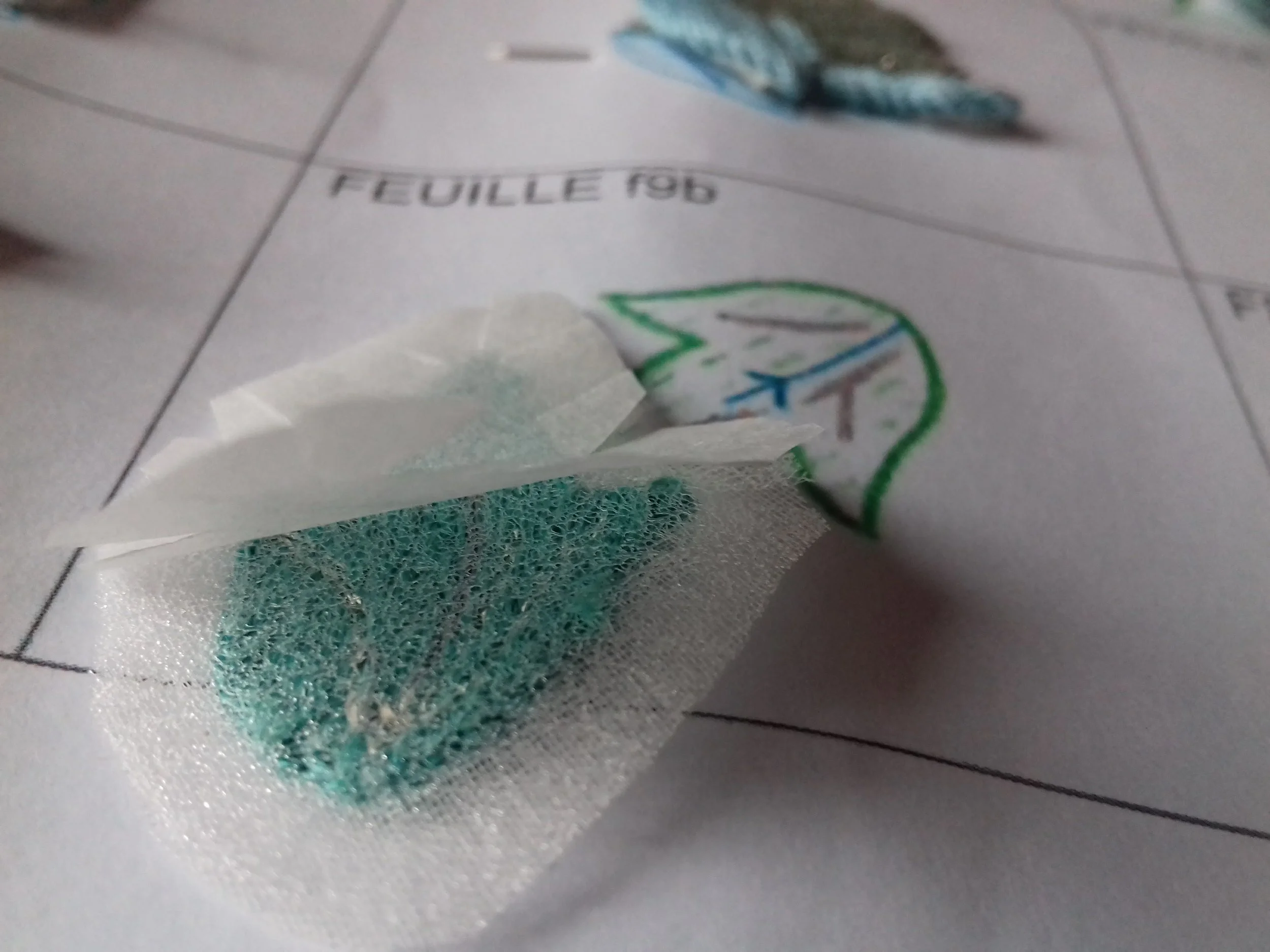
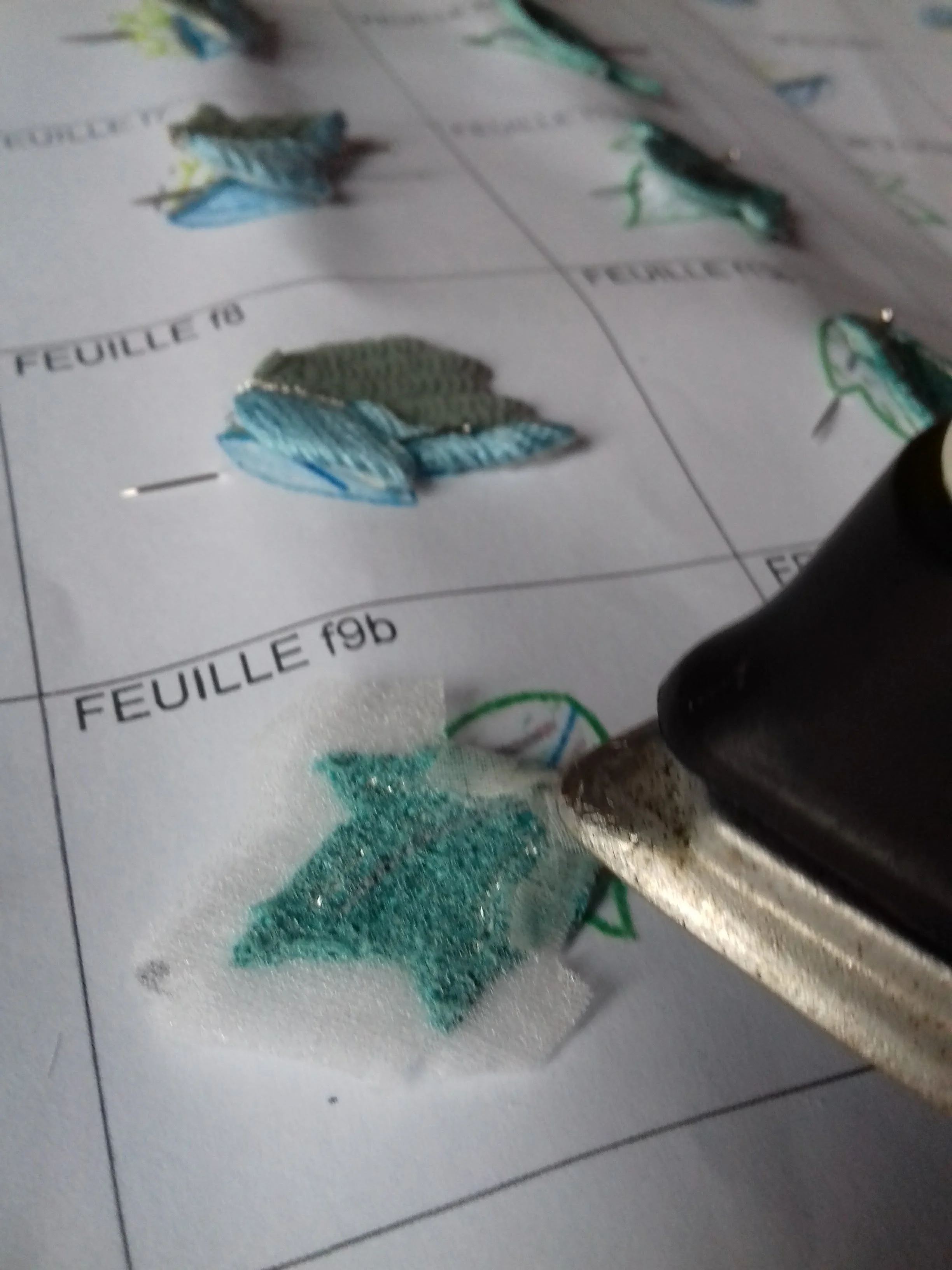
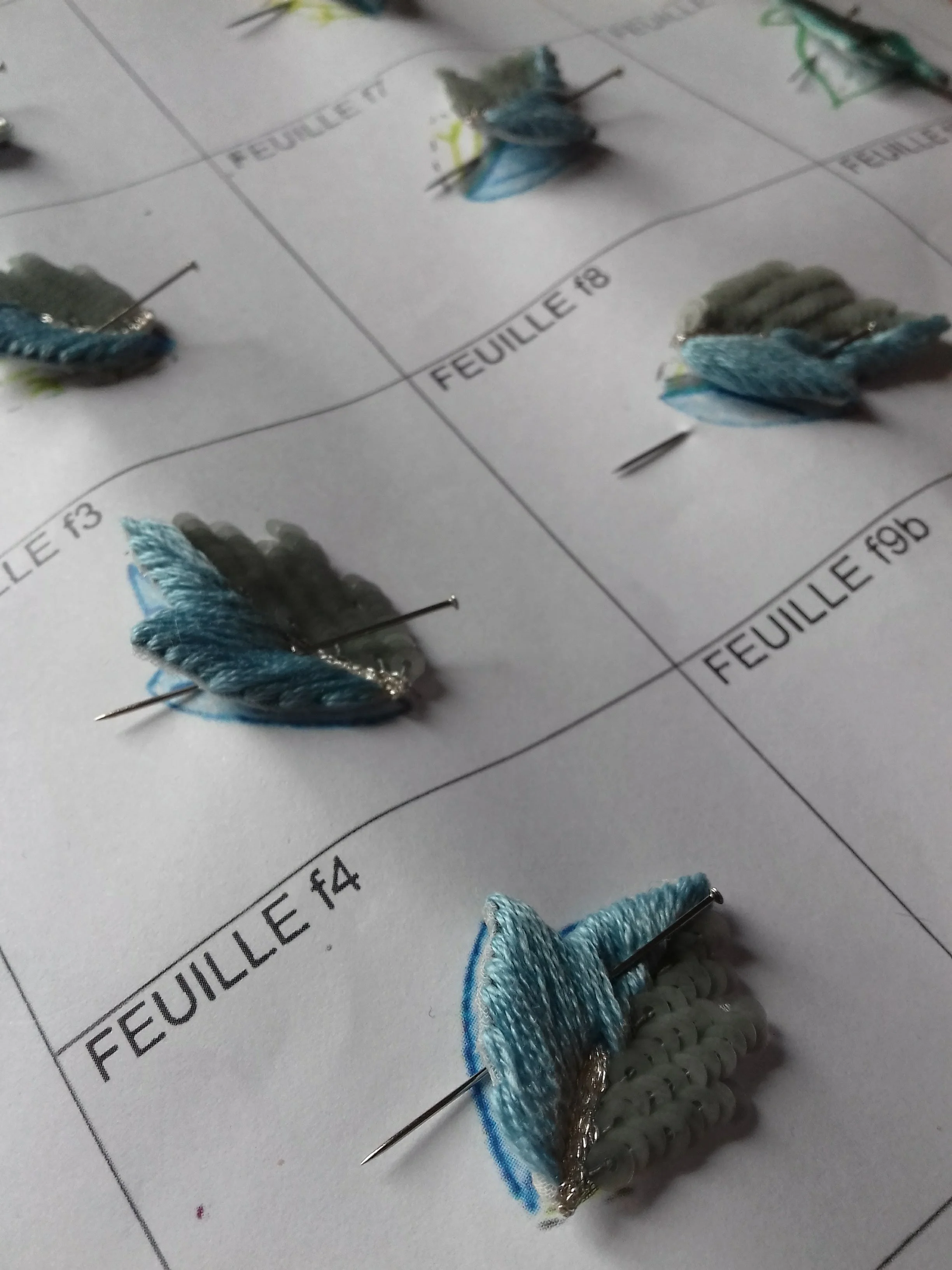
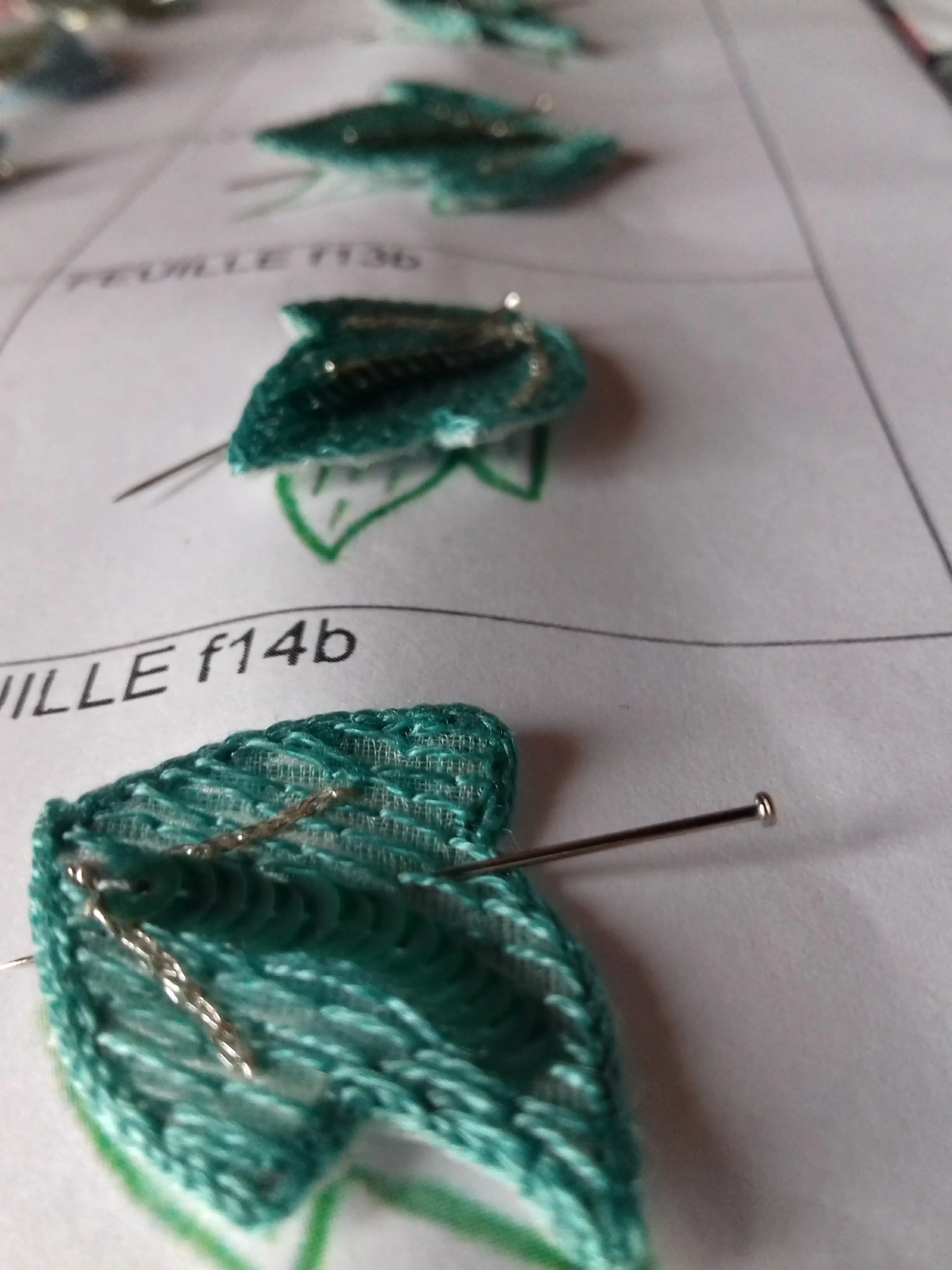
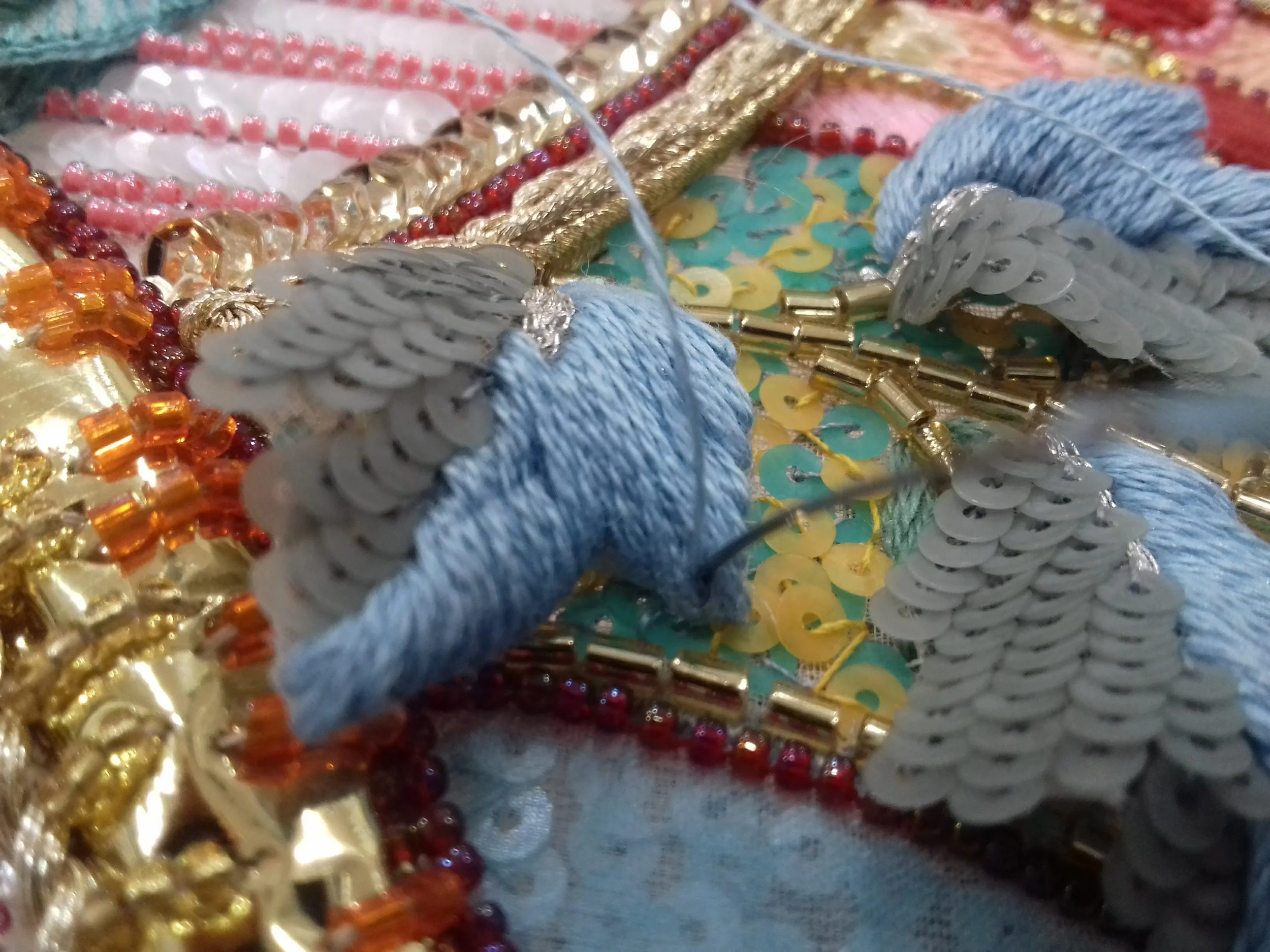
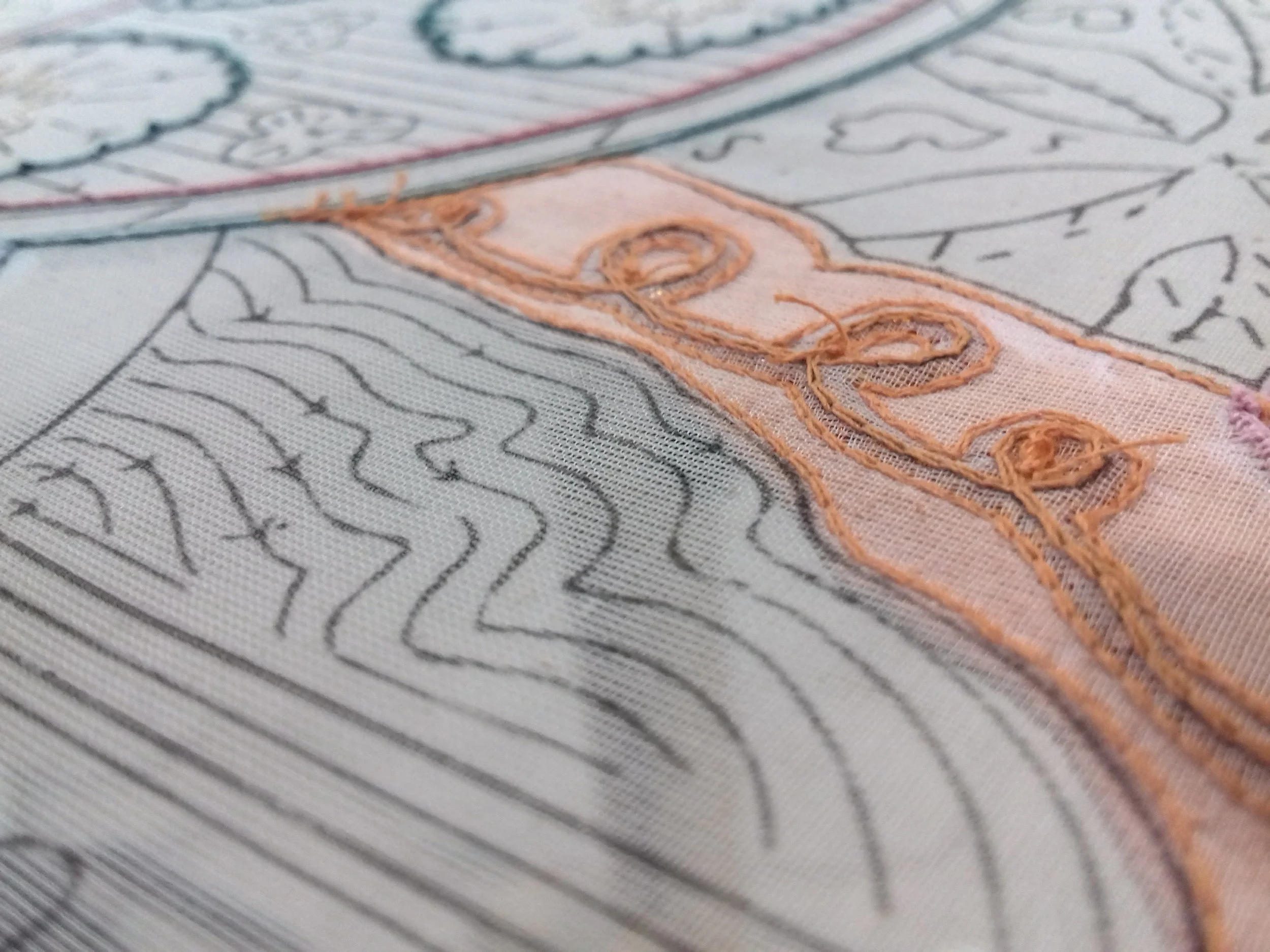
Along the side of the design is the pattern for 14 different leaves. The ones with light blue satin stitch, grey sequins in a river and silver stems are for this section (the other leaves were used in other sections). Once they are completed transfer glue is ironed onto the reverse and then they are cut out of the organza and the frame is re-mounted. Each leaf is cut with a 7 mm border and then cuts are made as close to the stitching and sequins as you dare. The paper is removed and the organza border is ironed onto the back using a very low heat. As each leaf is individual, it was necessary to keep them organised carefully so that there would be no confusion later.

View fullsize 20180108_113627_Richtone(HDR).jpg
View fullsize 20180109_144725.jpg
View fullsize 20180109_144737.jpg
View fullsize 20180109_144754.jpg
View fullsize 20180109_144849.jpg
View fullsize 20180109_145354_Richtone(HDR).jpg
View fullsize 20180109_145730_Richtone(HDR).jpg

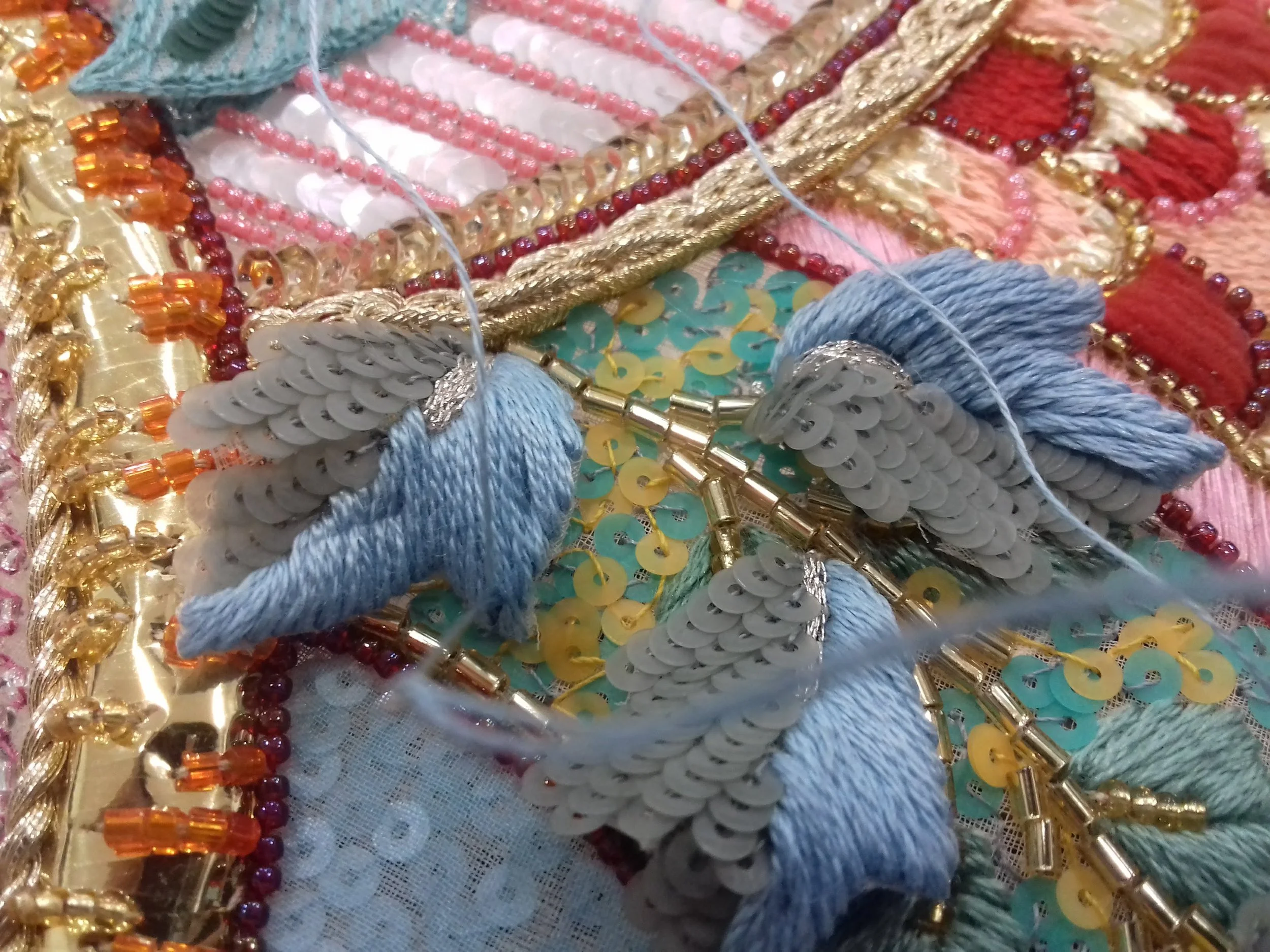
The time arrived for me to learn the meaning of Haute Couture... I gasped when the teacher explained that the individual 3D leaves were to be applied on top of my lovely satin stitch leaves! I lamented as they receded into the leafy shadows of the extravagantly curved, flicked and overlapping foliage.

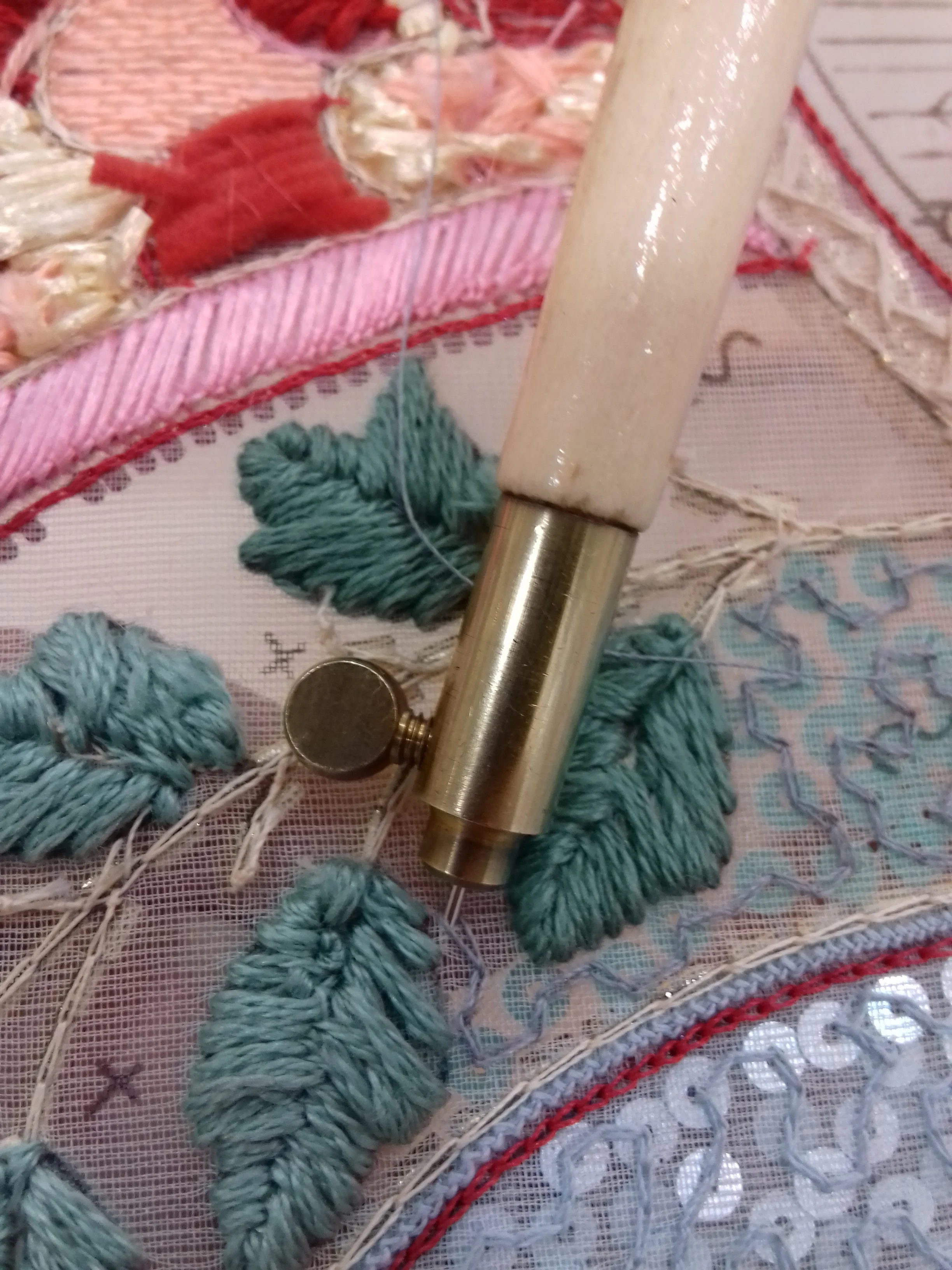
To create the undulating effect of the 3D leaves a single strand of embroidery floss was used to fasten the base of the leaf towards the stem. A pin is used to draw the leaf back on itself and form a curve in the centre or the sides and a flick at the tip. Two or three more anchoring stitches are added to hold the form and the pin is removed. Finally the sparkling blue turquoise jewels were added, fastened securely in place using the technique for applying  clawed jewels.

20180112_111535_Richtone(HDR).jpg
20180112_111556_Richtone(HDR).jpg
20180112_122018.jpg
20180112_122012.jpg
20180122_094756_Richtone(HDR).jpg

Textile Tours of Paris

Join Rebecca on a tour of Paris’ charming haberdasheries nestled deep in the winding streets of Le Sentier, the city’s historic textile and fashion district. Enjoy a Sunday morning with Rebecca on a Flea Market Tour as she guides you through the labyrinth alleys of Paris’ oldest marché-aux-puces to uncover hidden treasure troves filled with vintage lace, linen, passementerie, golden threads and gossamer lingerie. To find out more visit Textile Tours of Paris.
The Timeless Allure of Maison Sajou

March 10, 2018 Rebecca Devaney
Maison Sajou

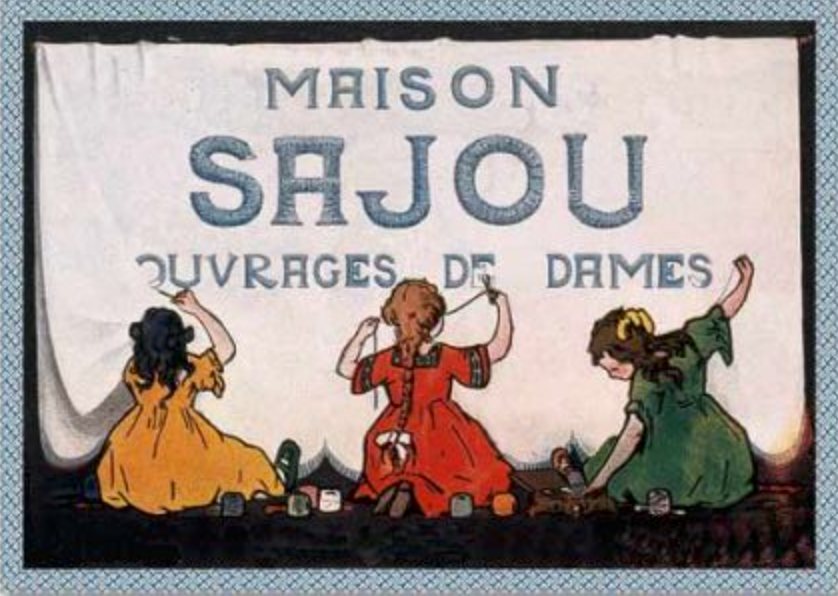
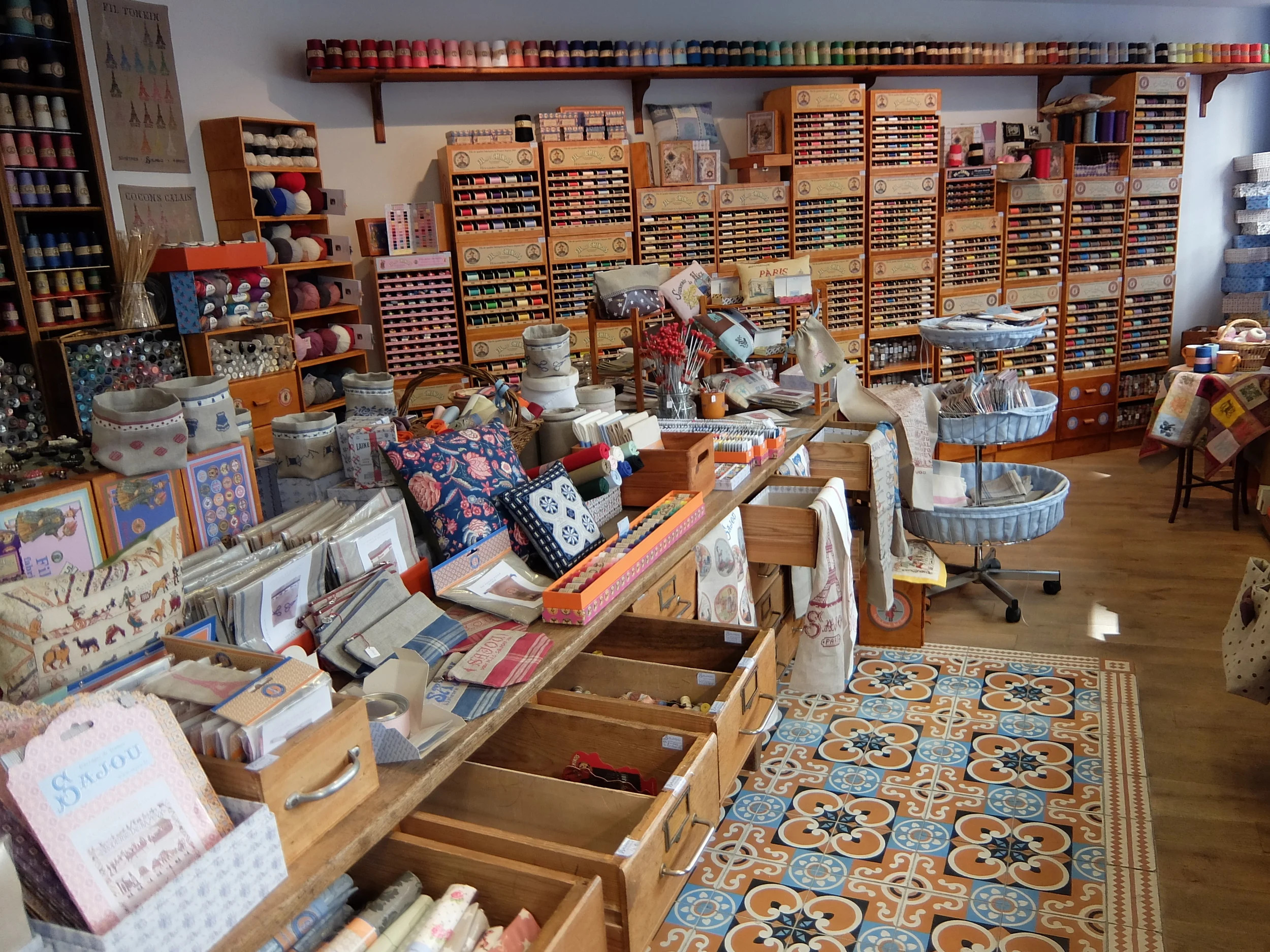
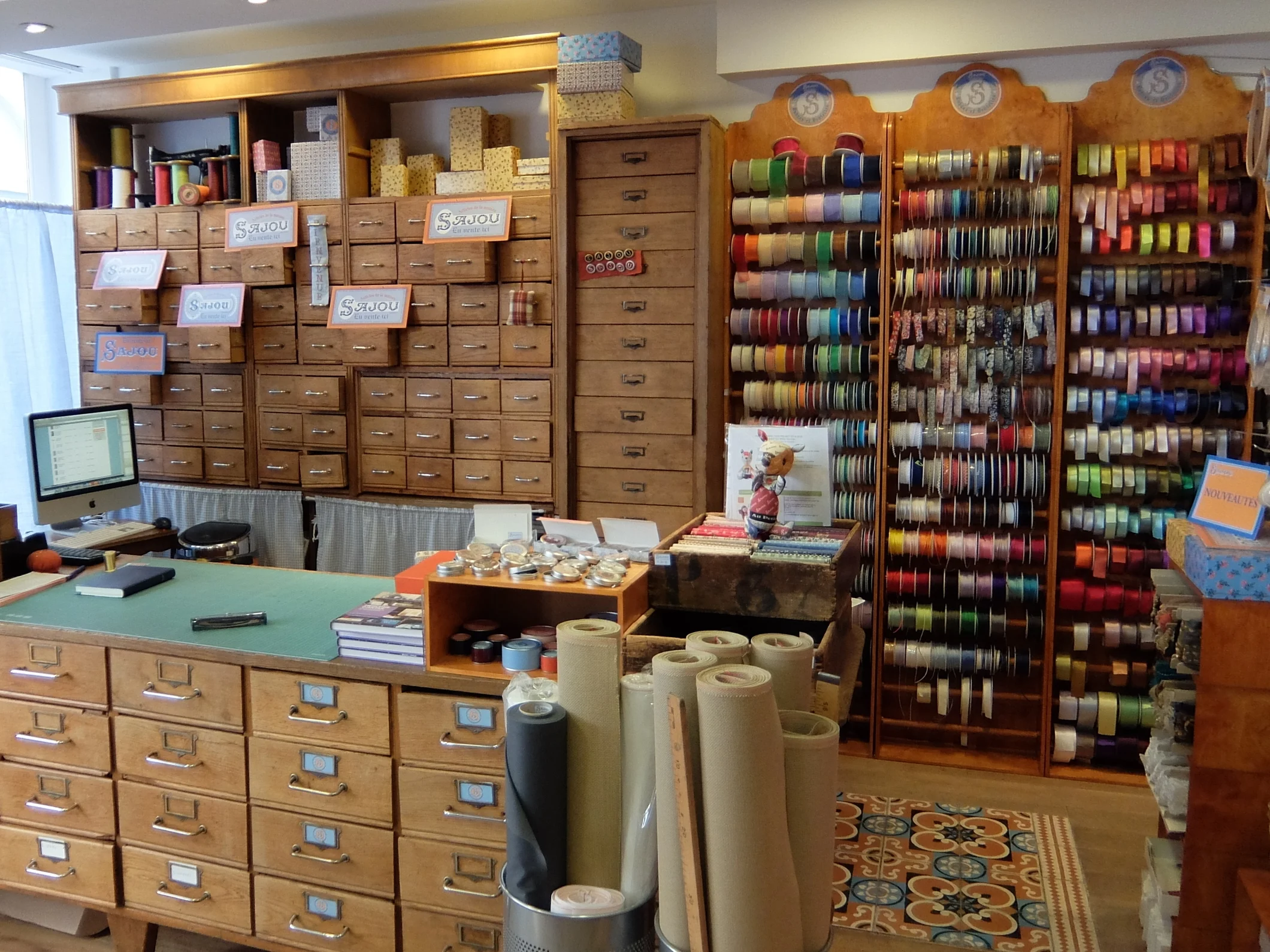
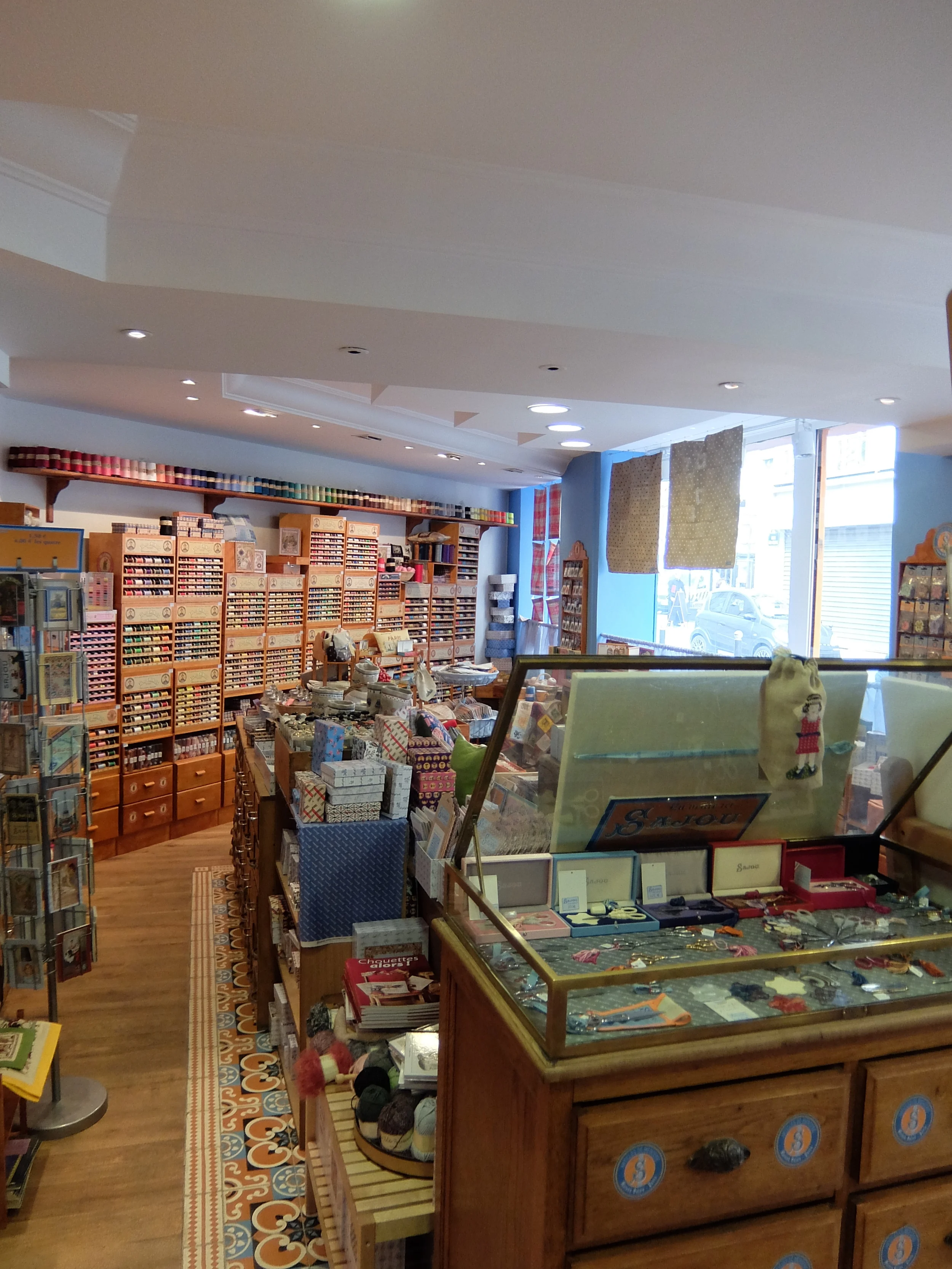
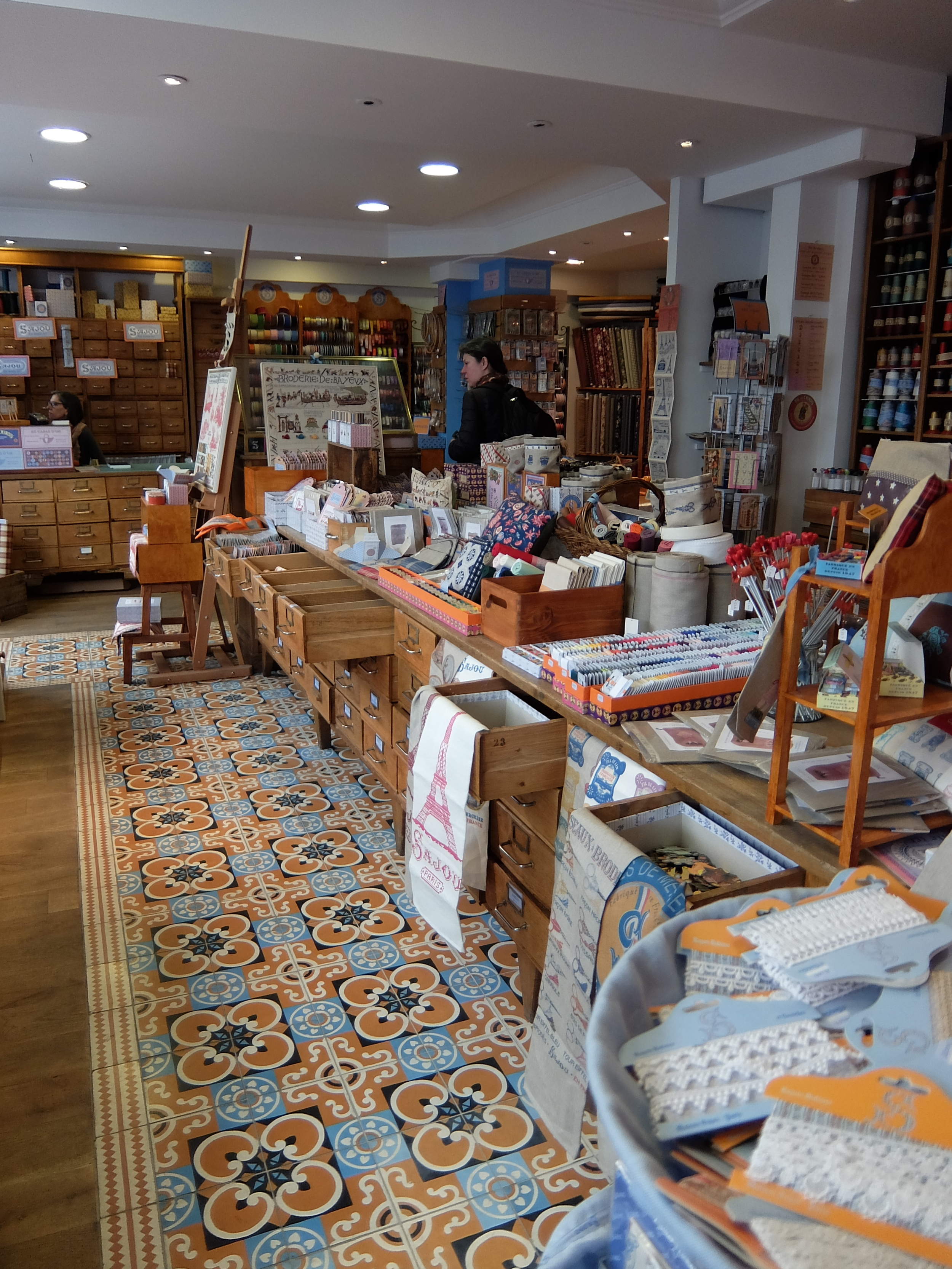
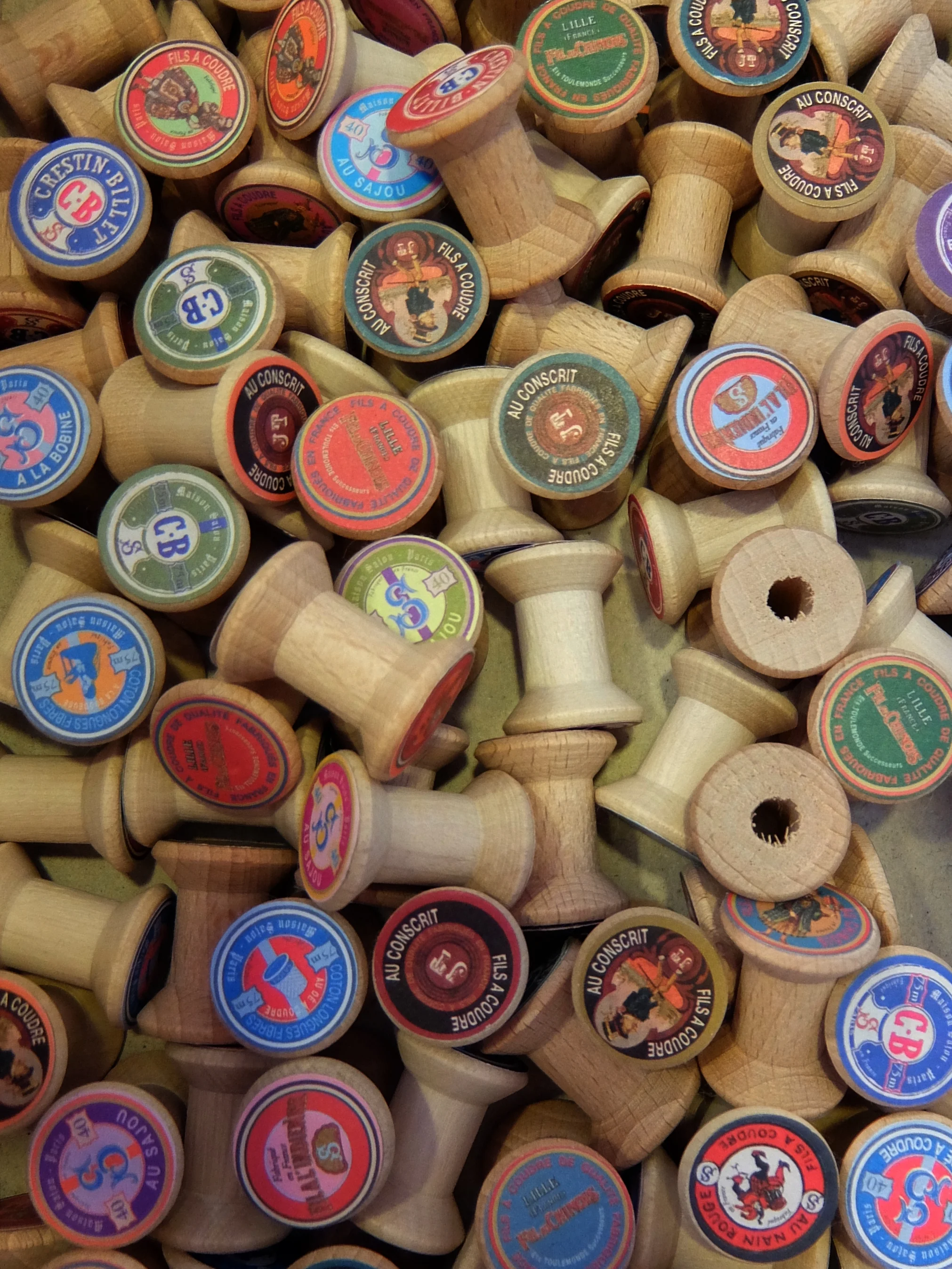
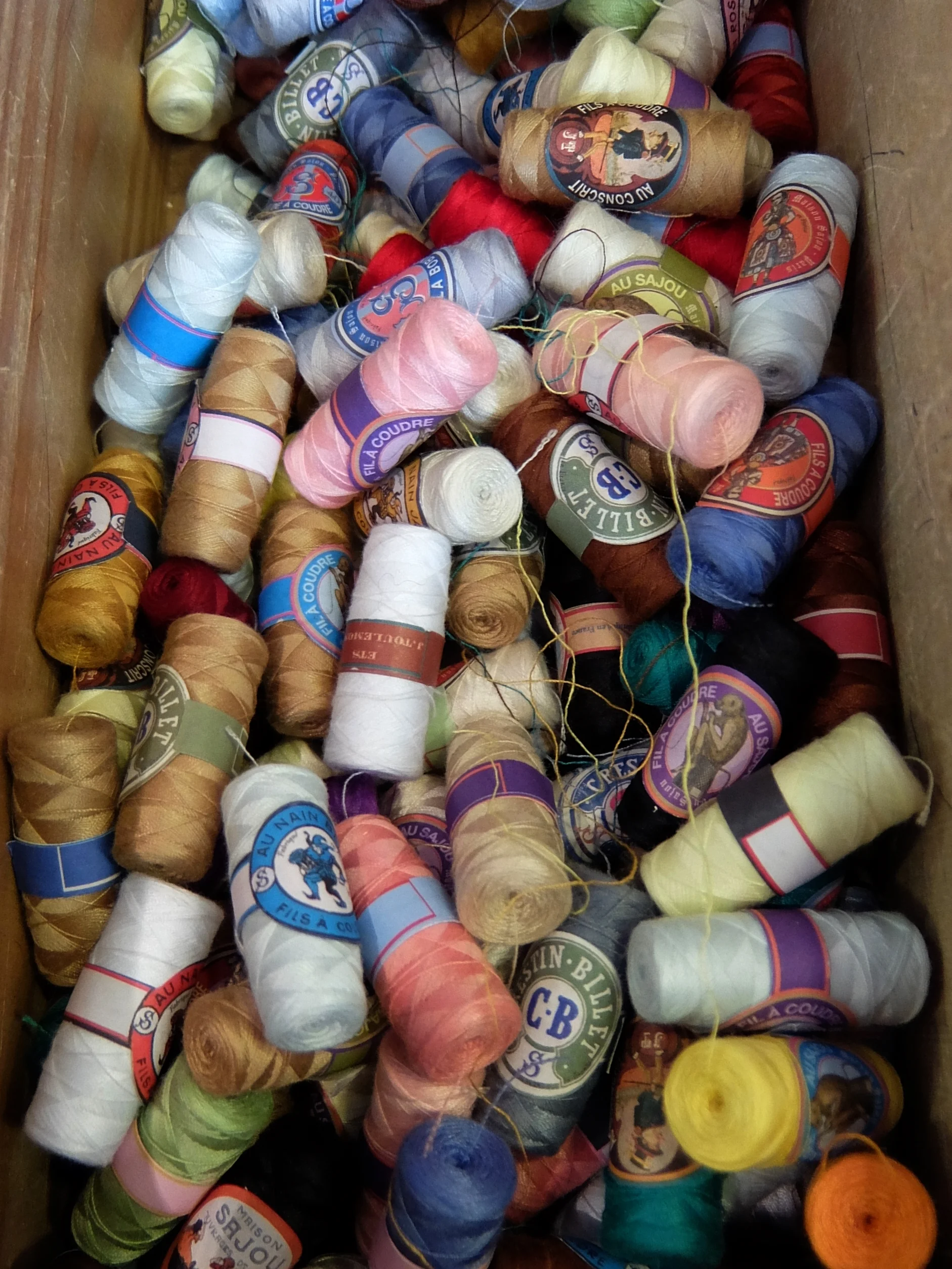
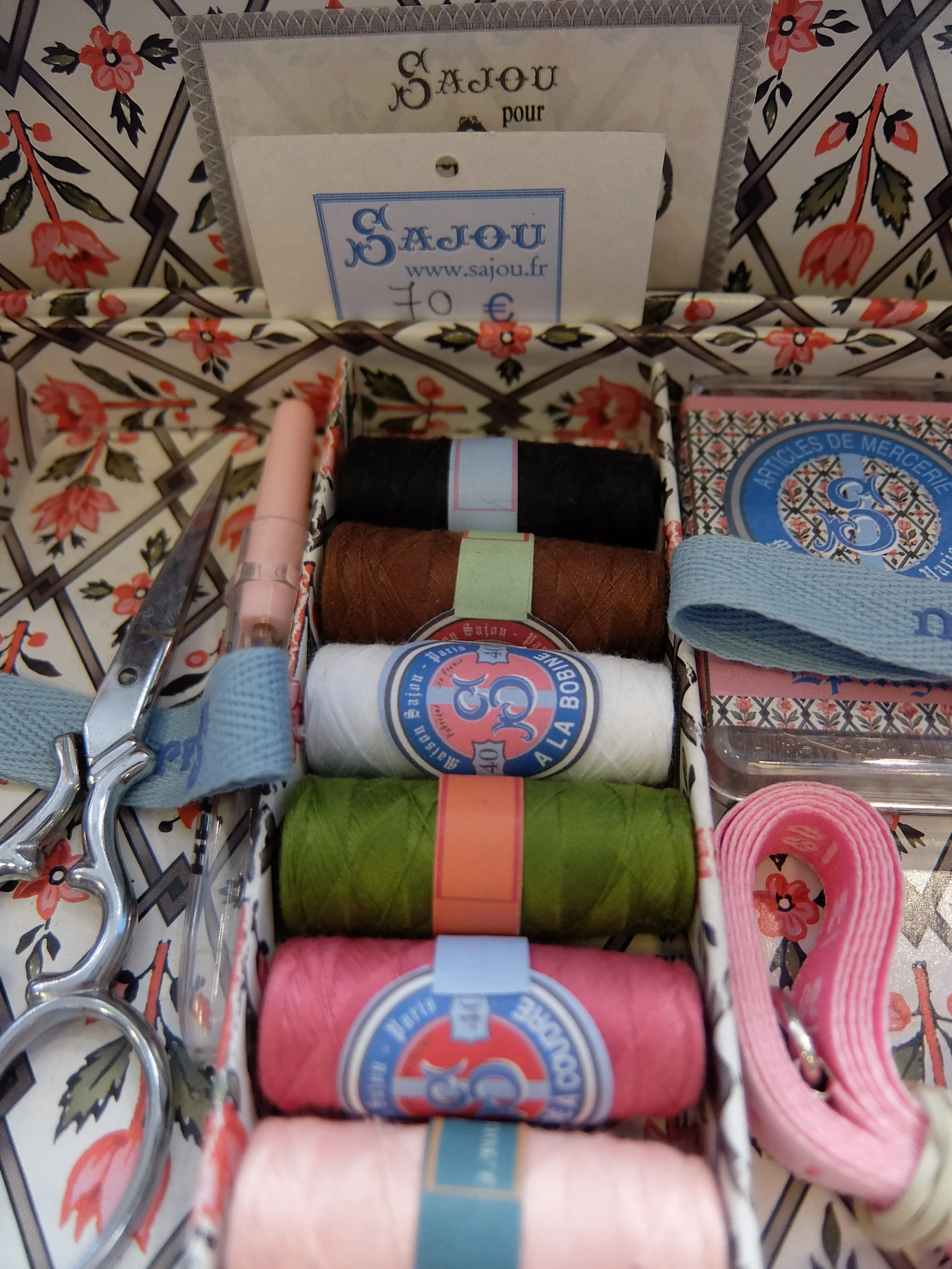
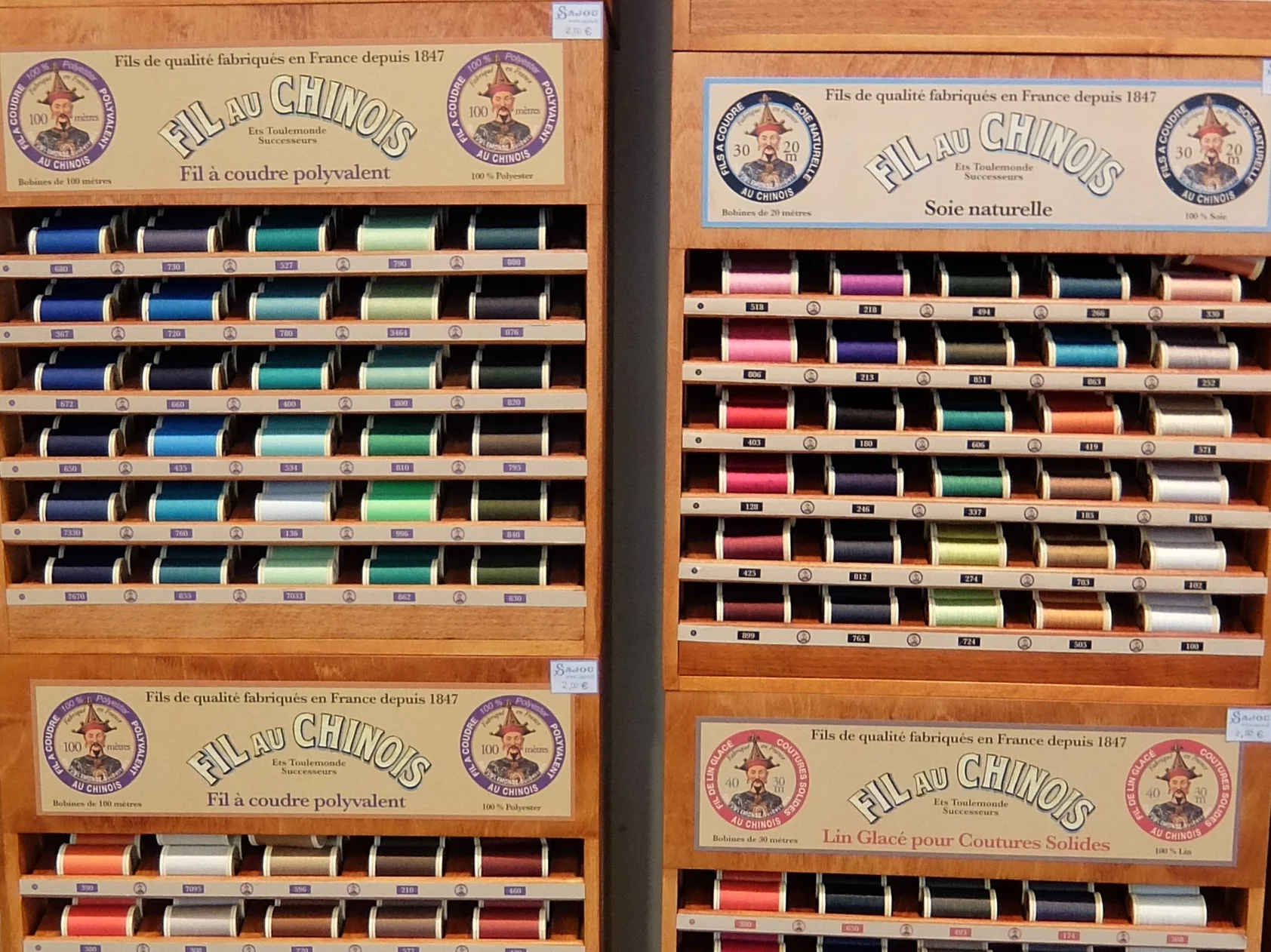
Maison Sajou is a veritable treasure trove for the accoutrements and accessories necessary for embroidery, needlework, tapestry, dress-making and sewing. The beautiful packaging ensures each item, no matter how small, appears like an heirloom and once the first purchase has been made it is impossible not to covet a collection! Walking through the bright orange door is like stepping back in time to the allure of a 19th century Parisienne haberdashery.... 

View fullsize Paris (16).JPG
View fullsize Paris (31).JPG
View fullsize Paris (38).JPG
View fullsize Paris (26).JPG

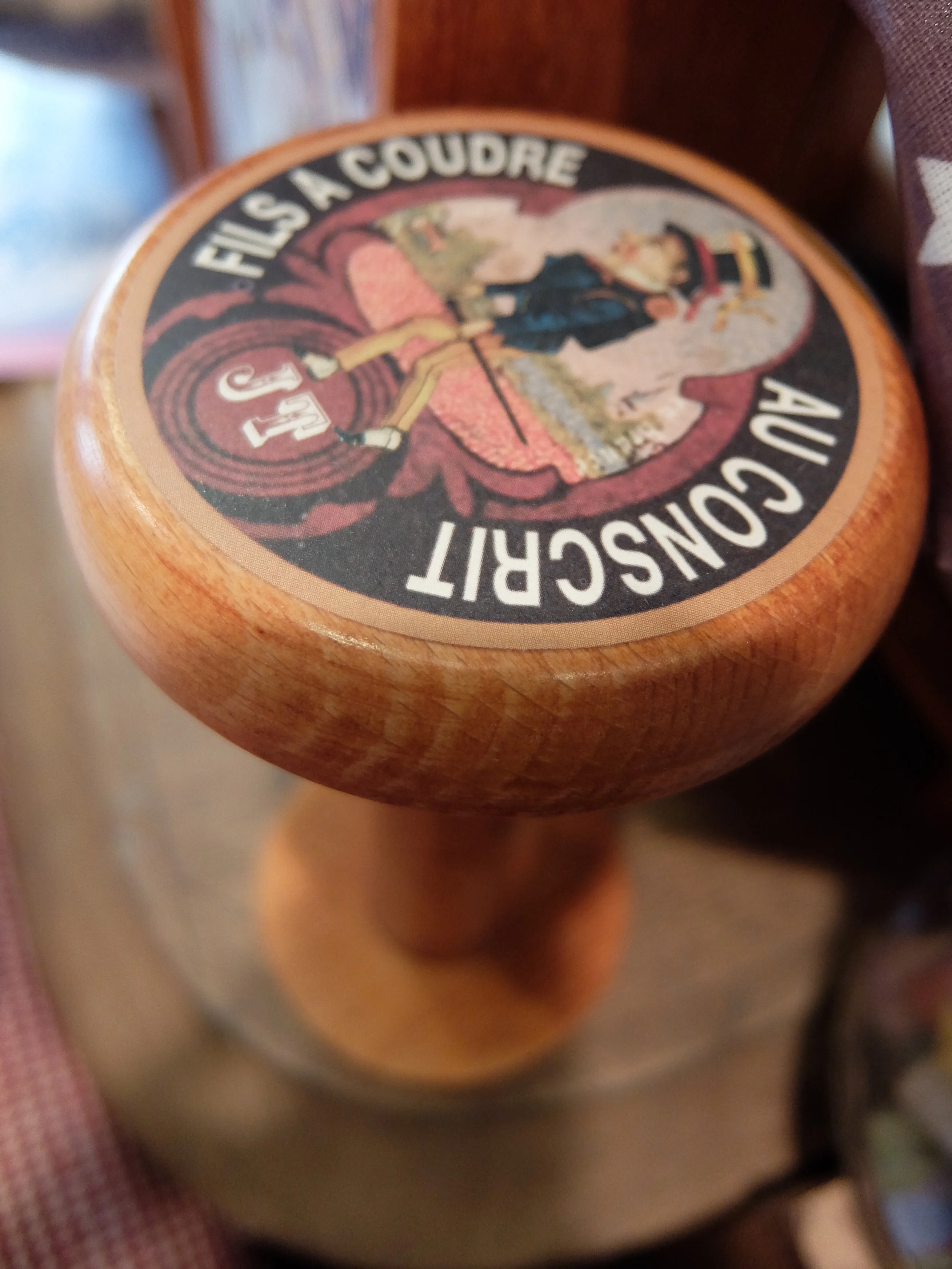
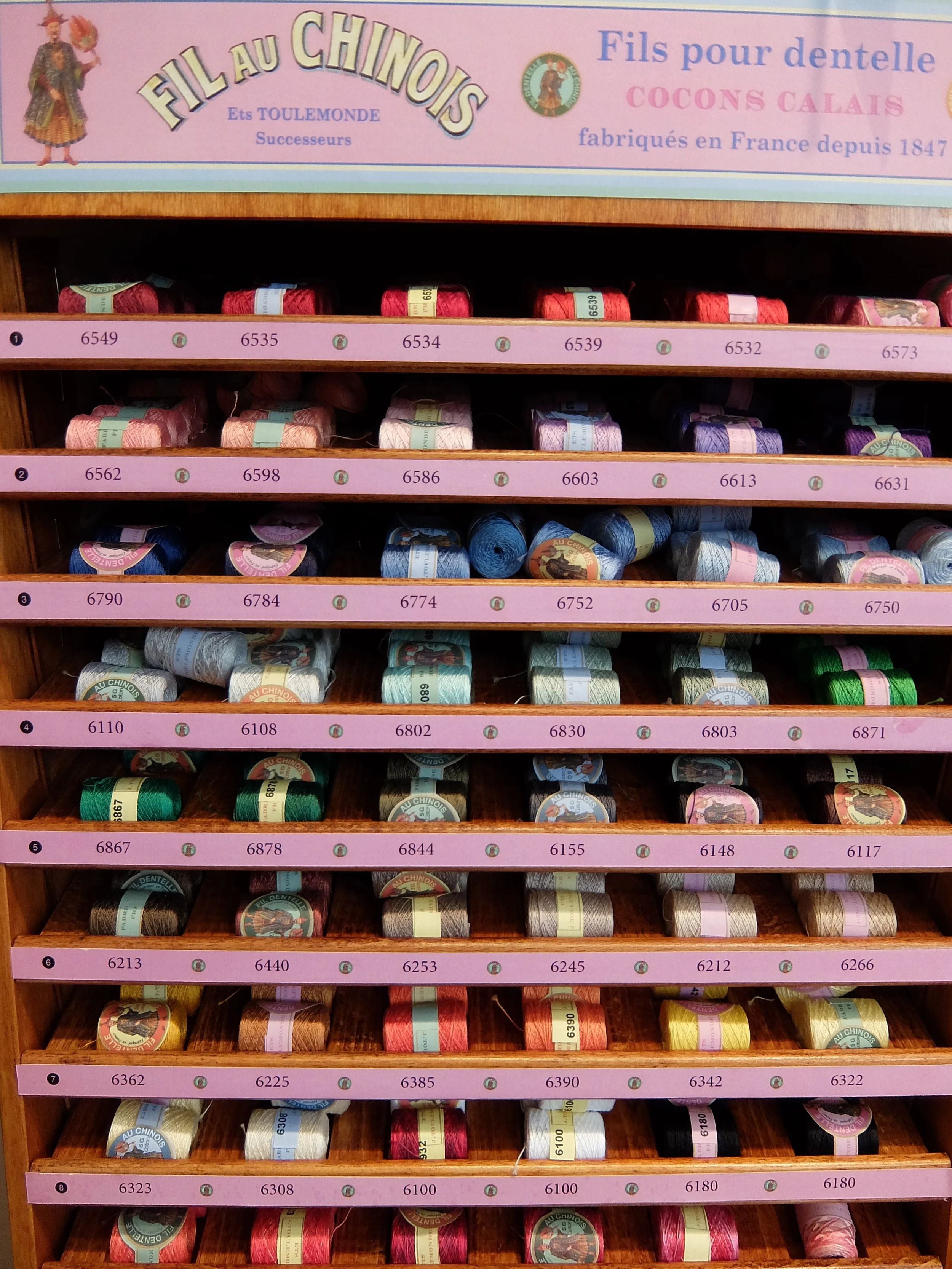
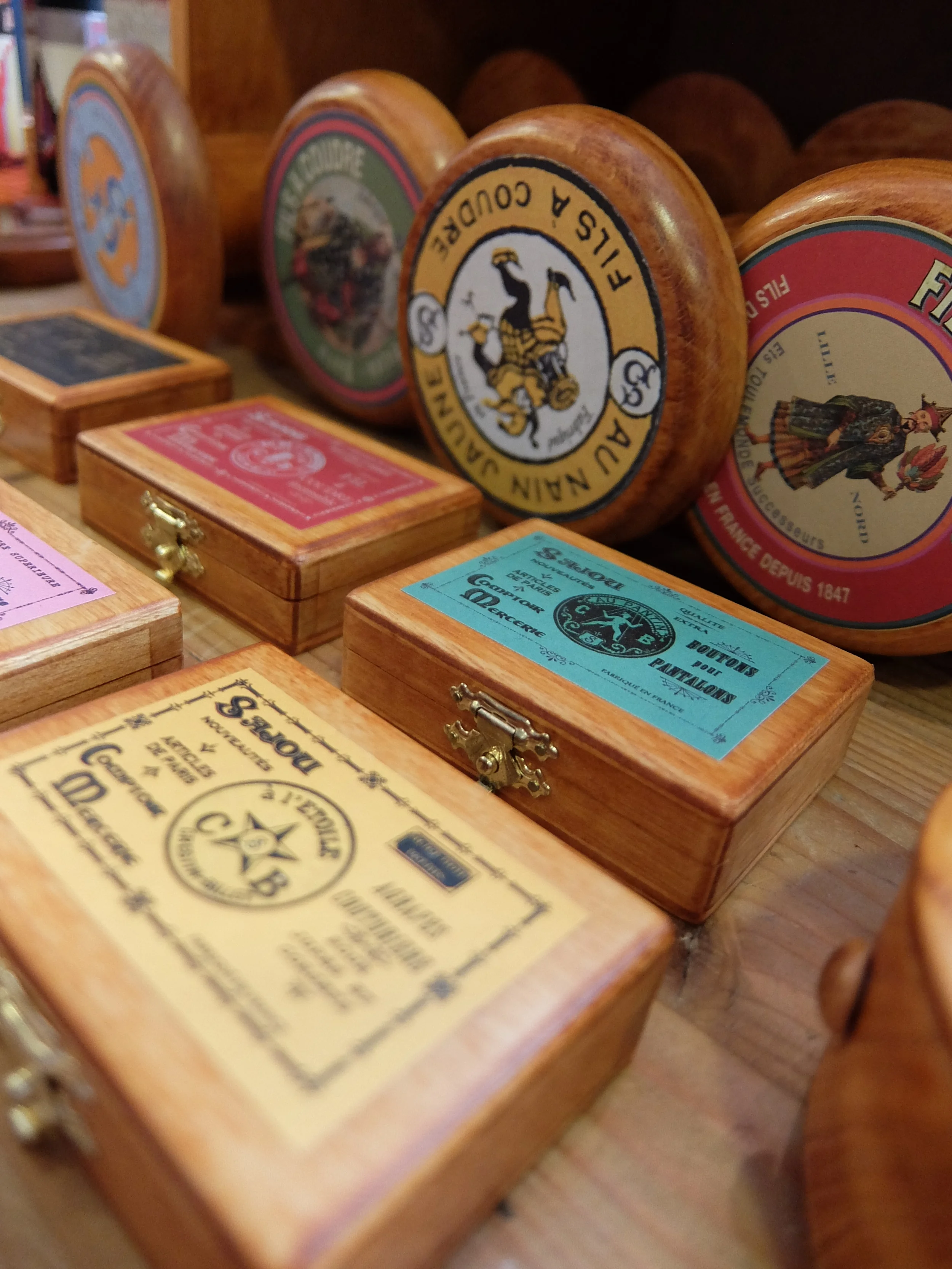
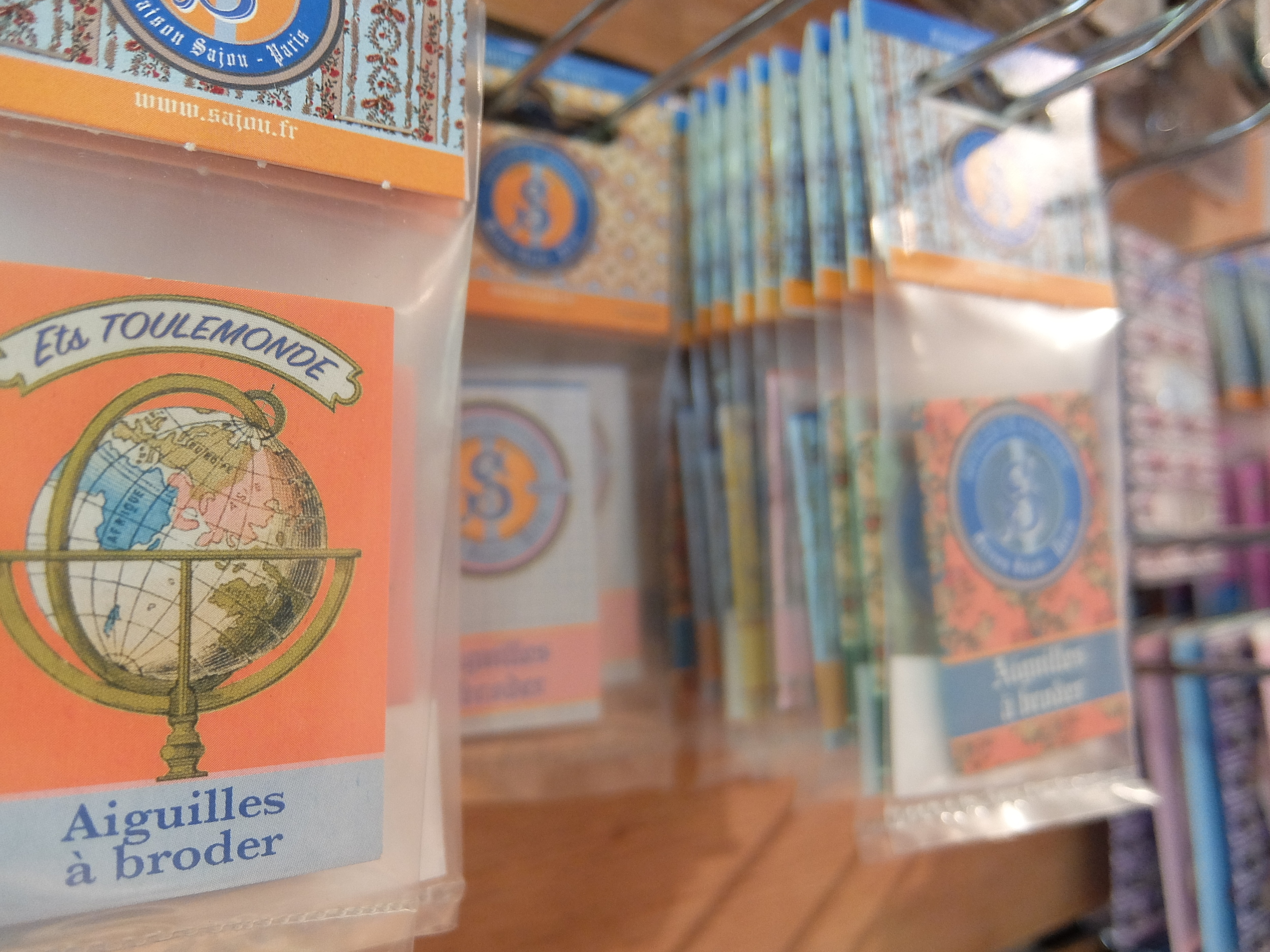
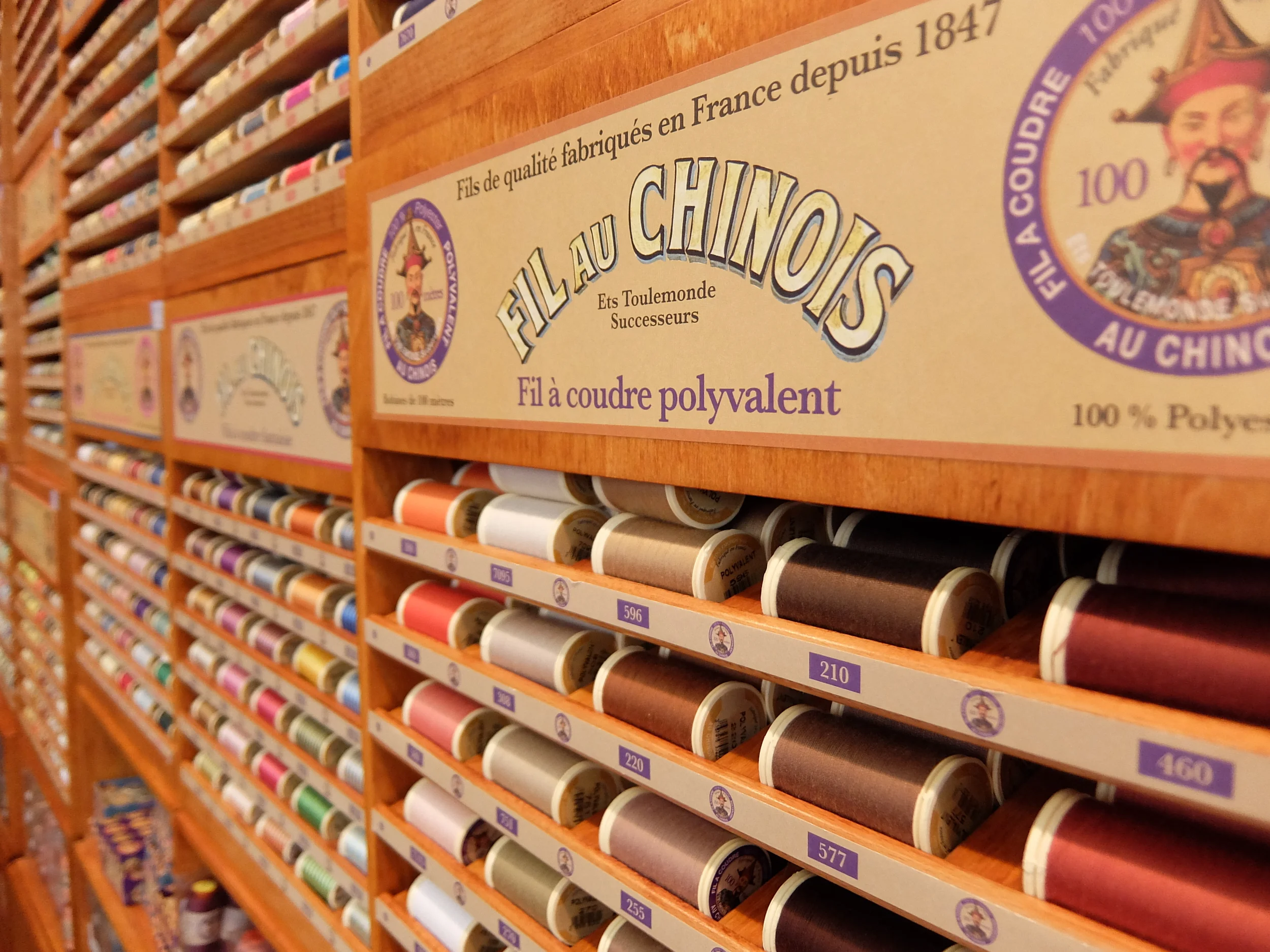
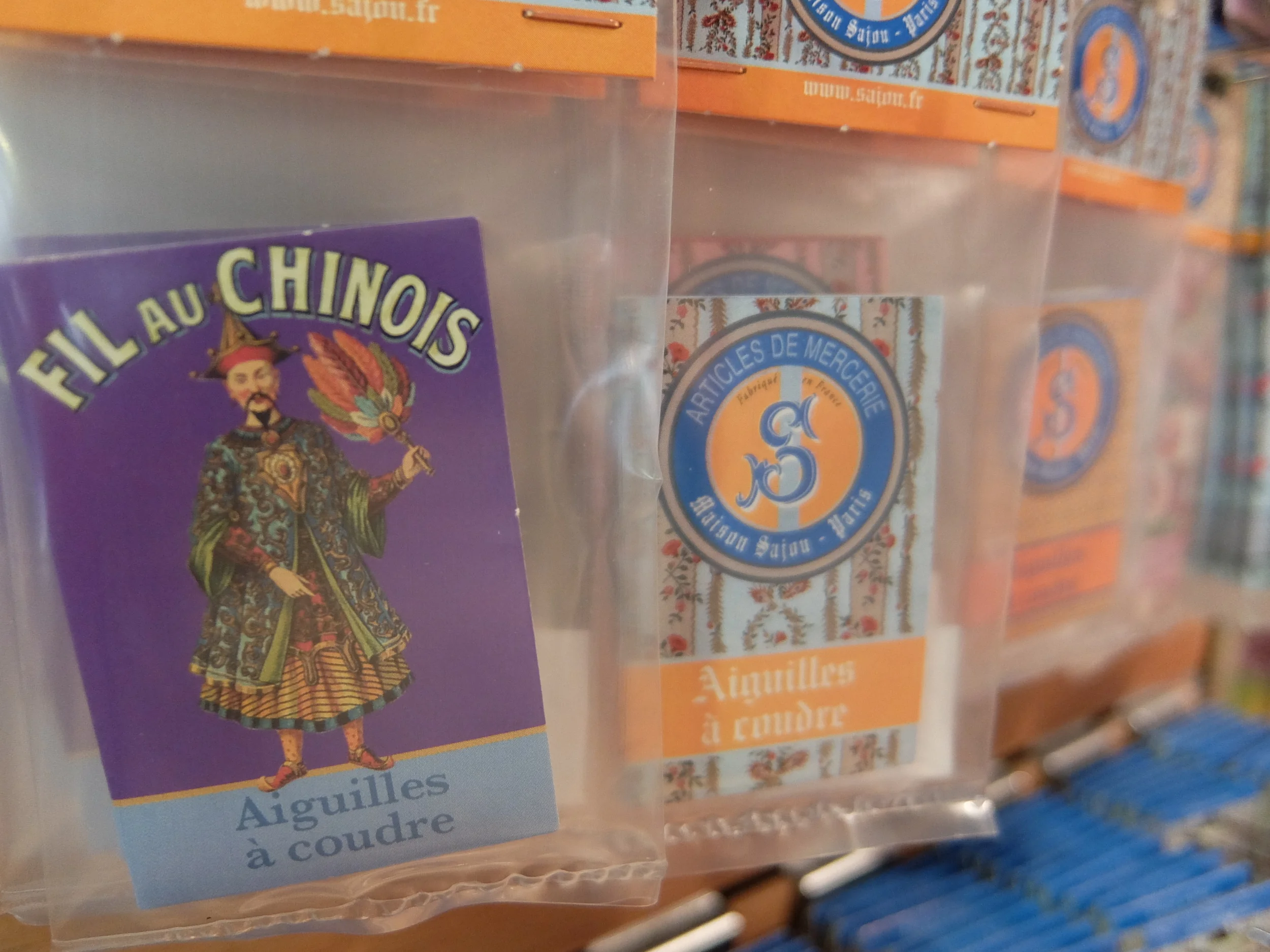
Antique wooden cabinets are lined with rows of legendary Fils au Chinois and Lebaufil threads in a wonderful array of colours. Display cases hold an assortment of the finest quality notions; needle books, needle-threaders, tins of glass-head pins, brass, wooden and porcelain thimbles, woven and wooden tape measures. Drawers are left open, enticing the curious to peer down at the pin-cushions, wooden bobbins, thread-winders and miniature spools of thread. A large glass vitrine is reserved for displaying their famously ornate scissors with gold-plated metal, tortoiseshell, ivory and mother of pearl finishes. Tables show beautiful embroidery and sewing sets in wooden and metal boxes, the smallest containing the basic supplies necessary and the largest brimming with every notion and thread imaginable. Baskets are overflowing with embroidery, cross-stitch and toile-de-jouy pattern books, patchwork and appliqué fabric swatches, linens and cottons. Rails reveal a selection of guipure, lace, cotton, and silk ribbons as well as bespoke ribbons woven on antique jacquard looms and shelves are filled with bolts of printed Indienne fabric featuring exotic floral motifs. 

View fullsize Paris (18).JPG
View fullsize Paris (29).JPG
View fullsize Paris (27).JPG
View fullsize Paris (34).JPG
View fullsize Paris (17).JPG
View fullsize Paris (19).JPG

It is no wonder that Maison Sajou has the ambiance and atmosphere of bygone years as it was re-established, so to speak, by Frederique Crestin-Billet, author of Haberdasheries of Yesteryear and an avid collector of antique haberdashery notions herself. Sajou was originally established in 1842 by Jaques-Simon Sajou and the brand became synonymous with quality haberdashery, however by 1954 it had disappeared. In resuming the name and reviving the brand, Frederique has emphasised the quality of haberdashery accoutrements historically produced in France and still available today. This enthusiasm led to her collaboration with Ets Toulemonde in 2007, who were restoring the once legendary brand of Fil Au Chinois threads. It is this passion for the French patrimony and heritage in haberdashery that makes visiting the Maison Sajou such an enjoyable and rewarding experience for textile enthusiasts from around the world and needless to say I left with my arms full of new and exciting purchases, although I can't help but covet more items to add to my collection!

View fullsize Paris (37).JPG
View fullsize Paris (24).JPG
View fullsize Paris (21).JPG
View fullsize Paris (36).JPG

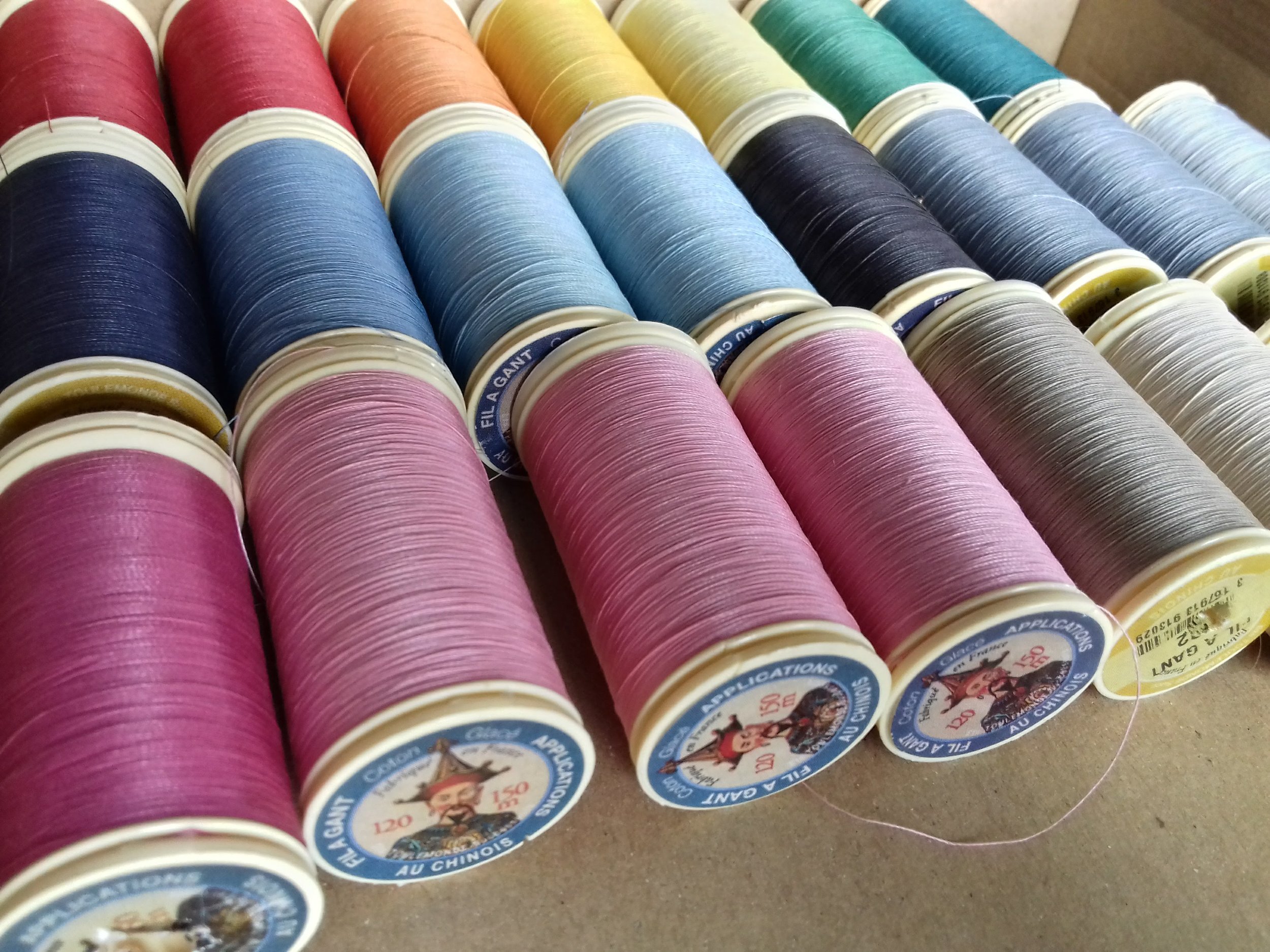
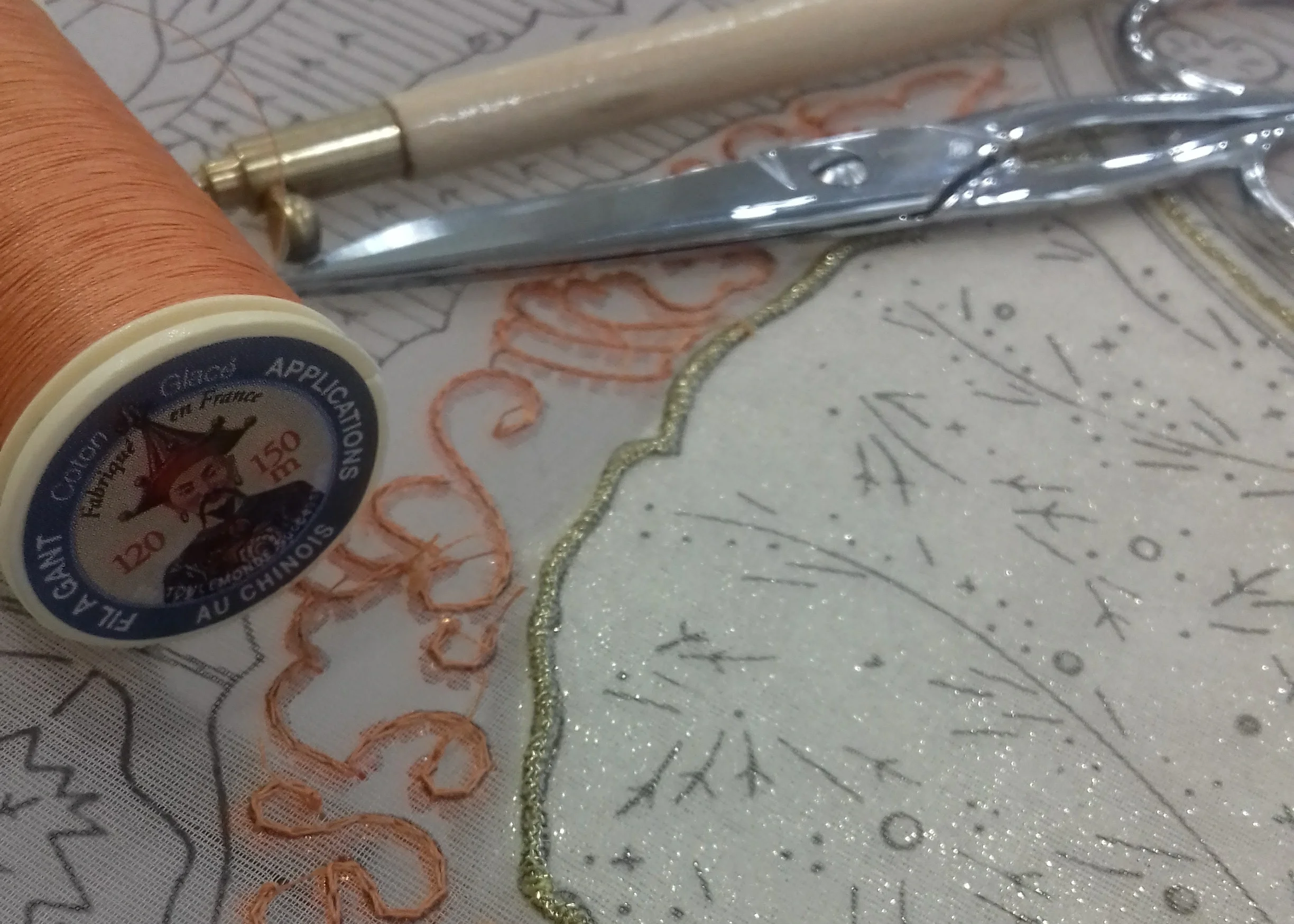
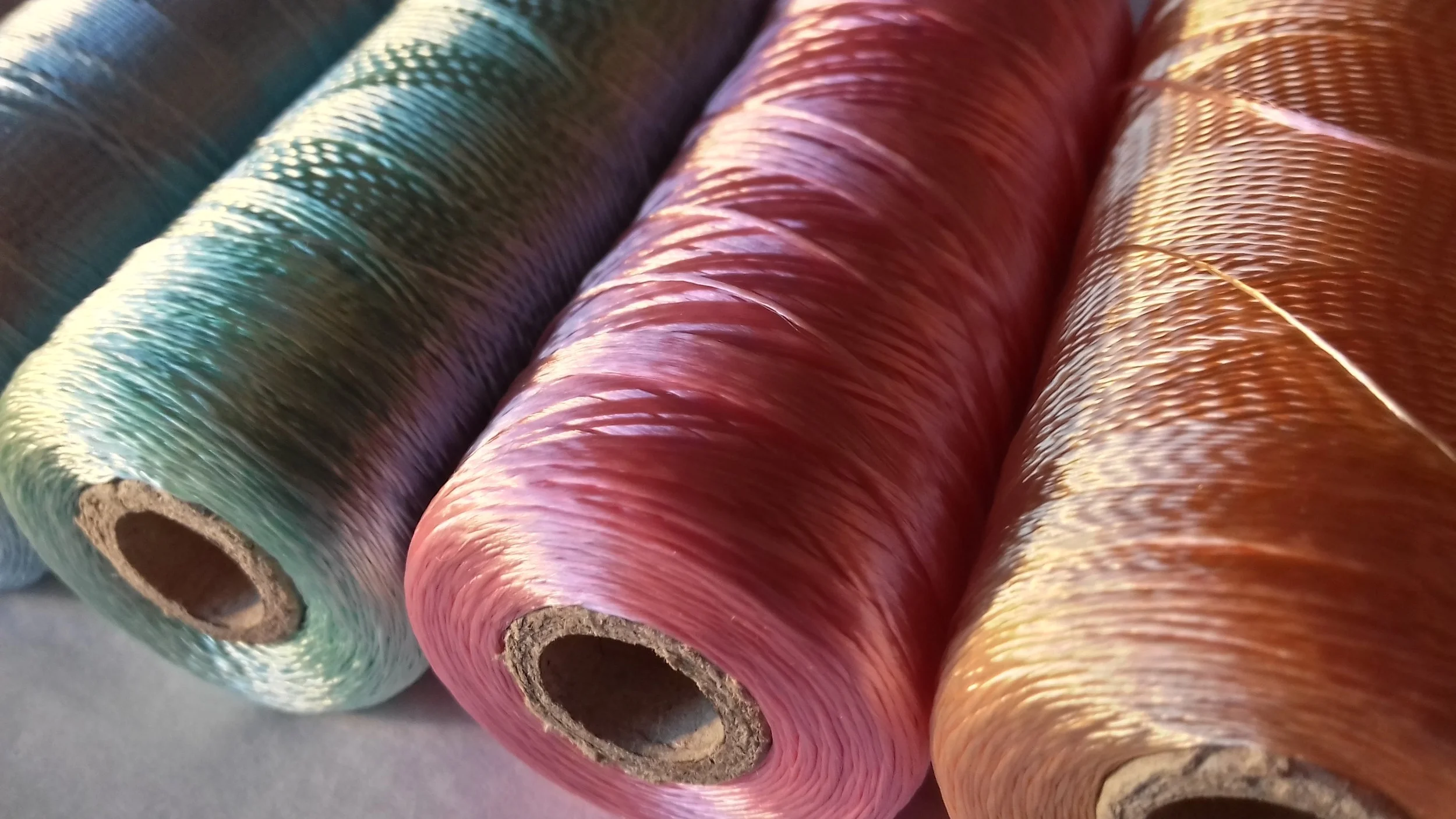
I bought my first Fil Au Chinois gold thread from the marvellous Purl Soho haberdashery in New York who stock a selection of Sajou products. I was delighted find a rainbow selection of their threads in my package of materials!

20180308_113656_Richtone(HDR).jpg

Textile Tours of Paris

Join Rebecca on a tour of Paris’ charming haberdasheries nestled deep in the winding streets of Le Sentier, the city’s historic textile and fashion district. Enjoy a Sunday morning with Rebecca on a Flea Market Tour as she guides you through the labyrinth alleys of Paris’ oldest marché-aux-puces to uncover hidden treasure troves filled with vintage lace, linen, passementerie, golden threads and gossamer lingerie. To find out more visit Textile Tours of Paris.
First Things First

March 10, 2018 Rebecca Devaney
20171025_114436_Richtone(HDR).jpg

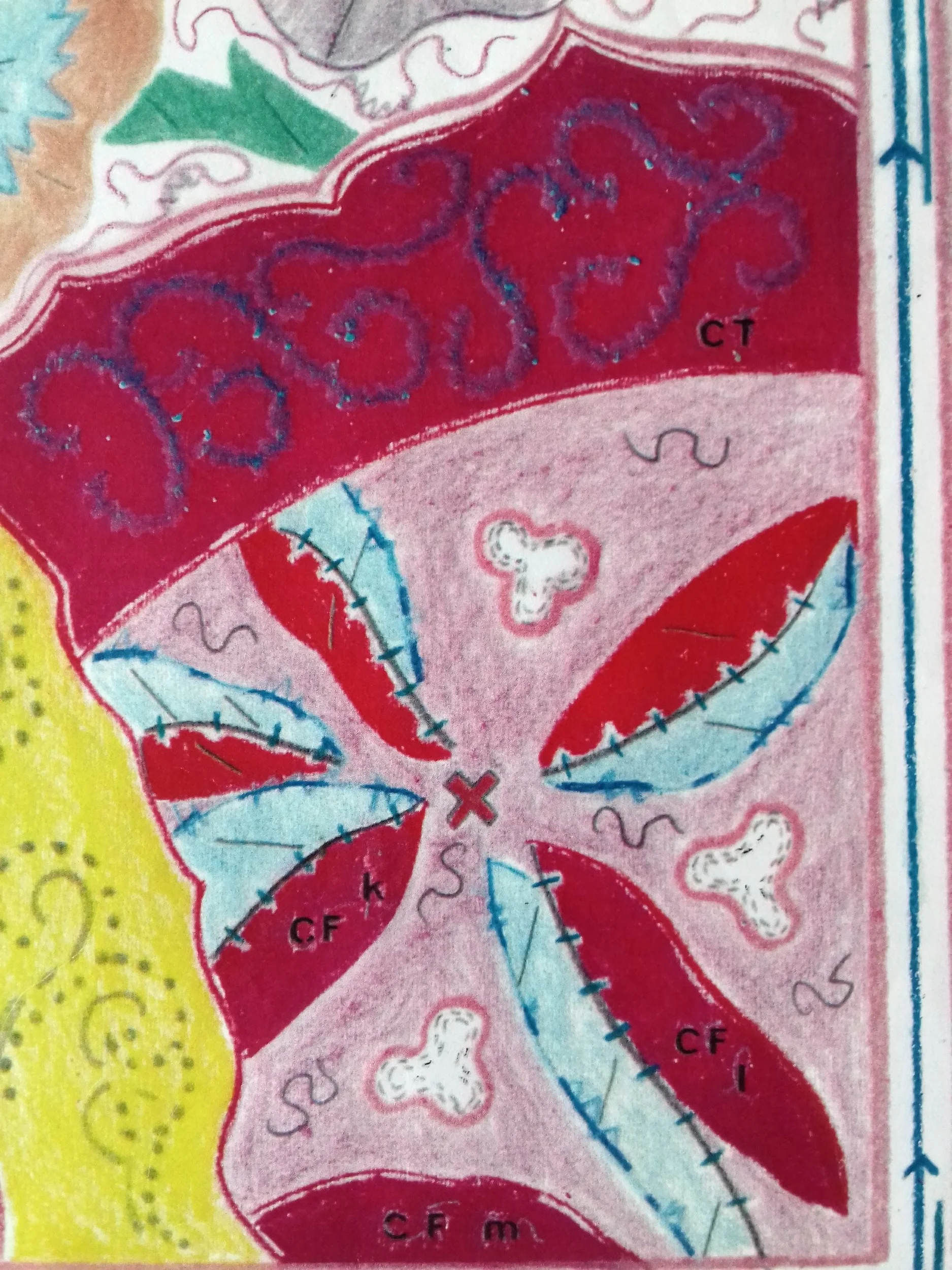
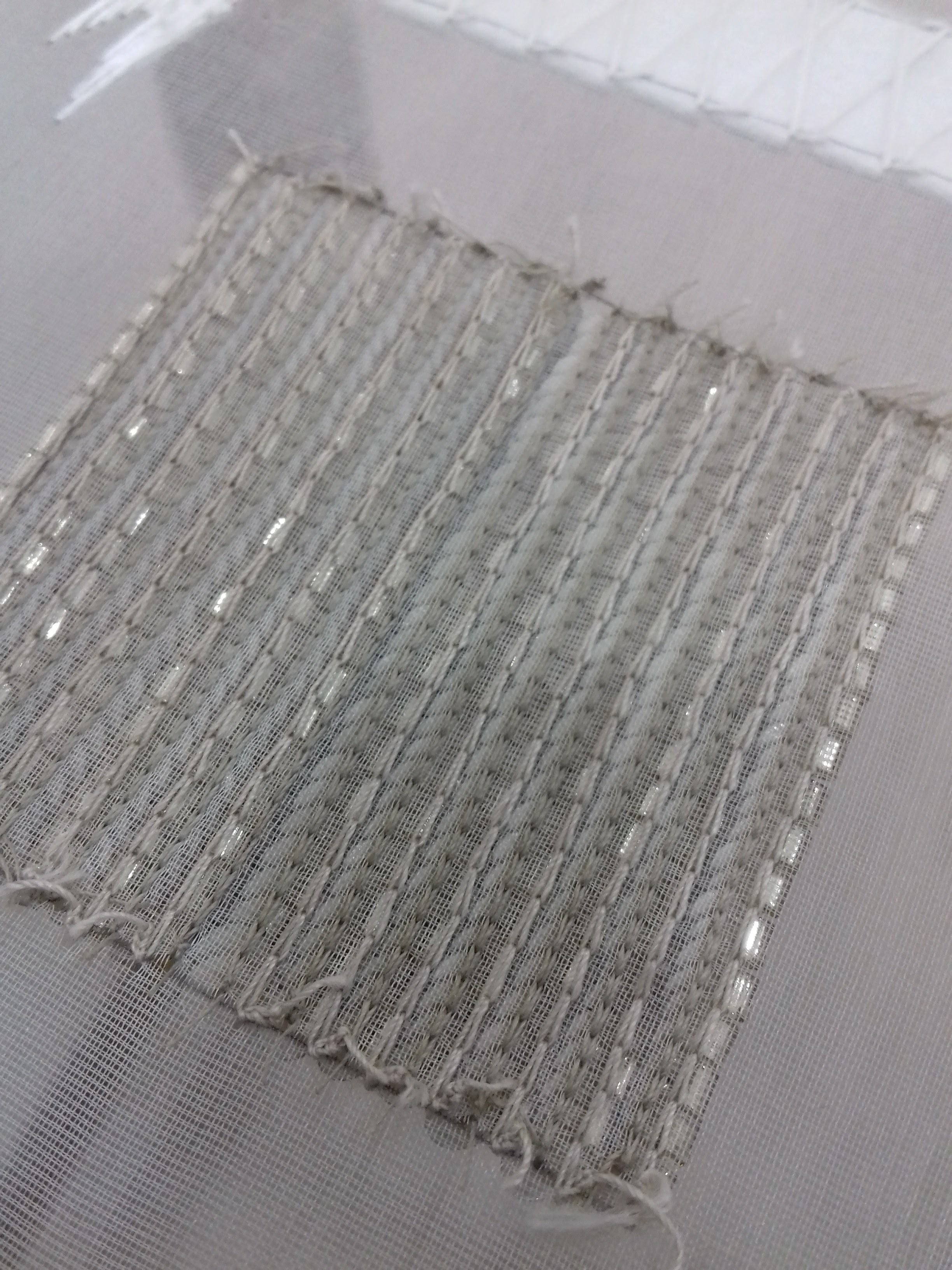
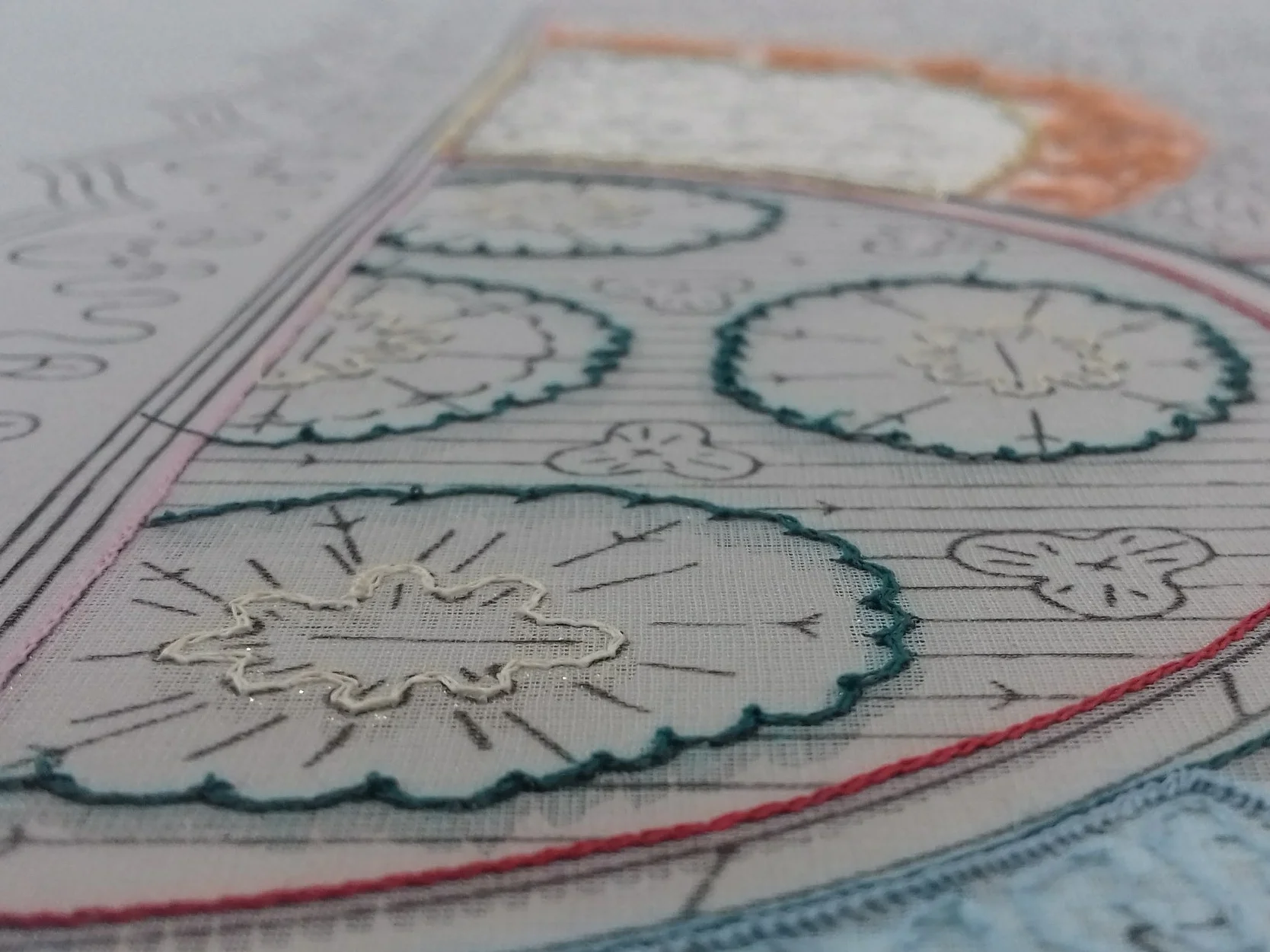
Once the embroidery frame was mounted it was time to begin and the first week or so was spent preparing the background.  There were several sections using the technique of creating linear relief with leather and another where beads were added in decorative patterns over a leather surface. The trickiest was applying sequins in vermicelli and stretching chiffon over them and then finally applying gold lamé using pointe-riche. During the classes the teachers would demonstrate the techniques in a certain section and these were usually repeated several times in the pattern. I would complete the remaining sections at home and needless to say the homework increased dramatically at this stage!  

The teachers emphasised the importance of carefully checking the pattern pages, reading the legends and preparing the materials before starting anything. Invaluable advice that I forgot frequently and sometimes found myself re-doing entire sections because I had used the wrong colour thread, sequins or beads!

Linear Relief with Leather

20180308_112720_Richtone(HDR).jpg

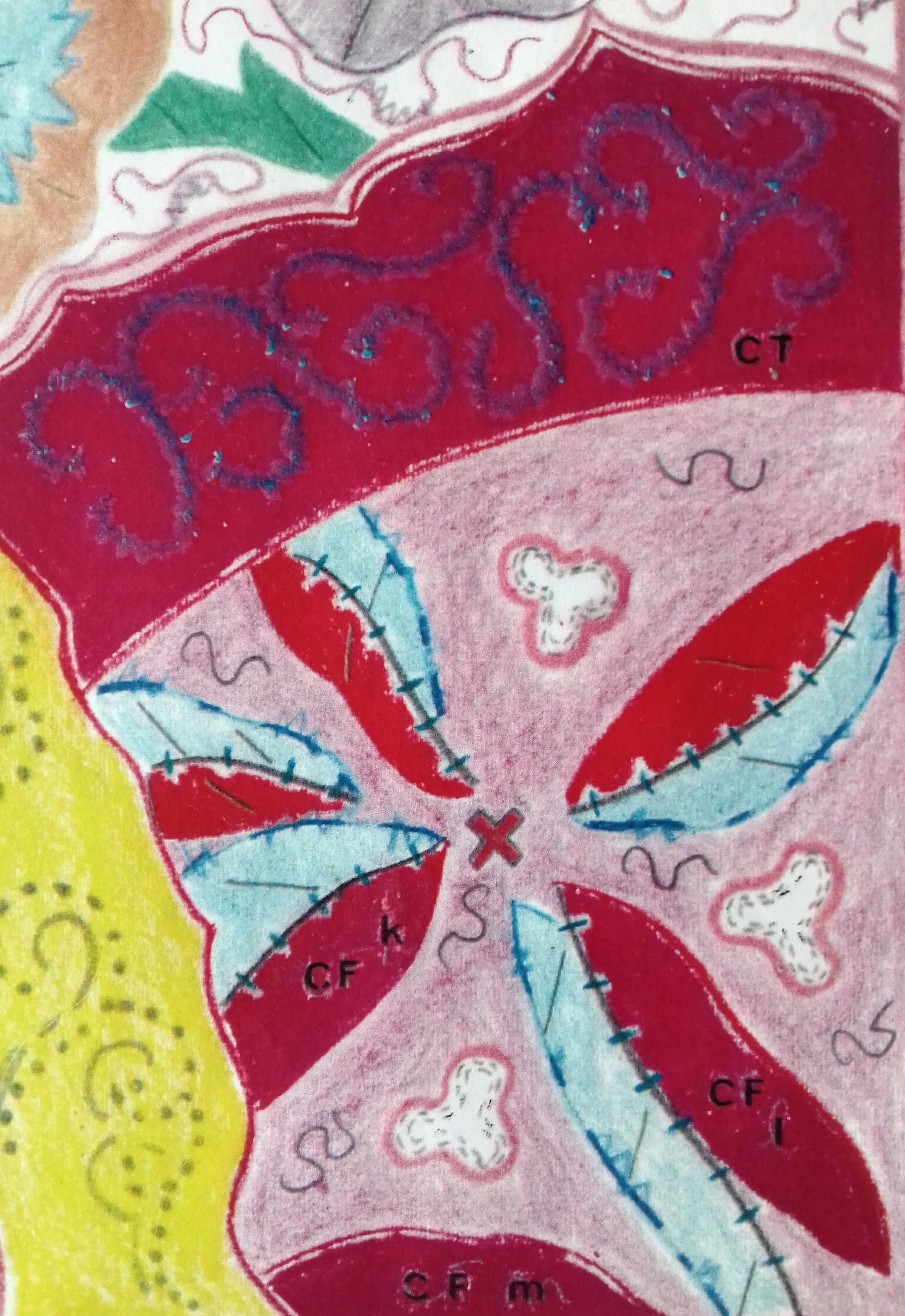
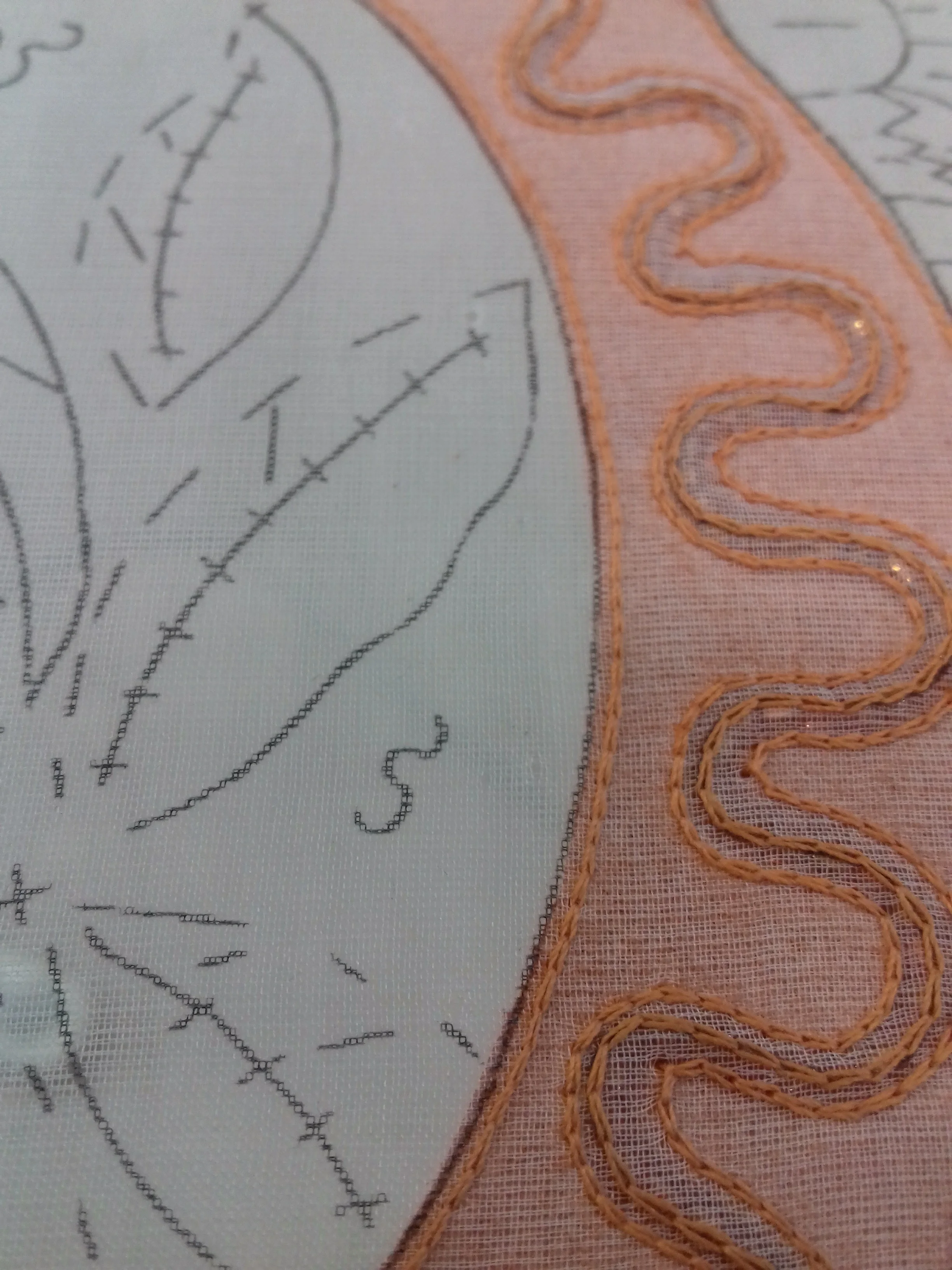
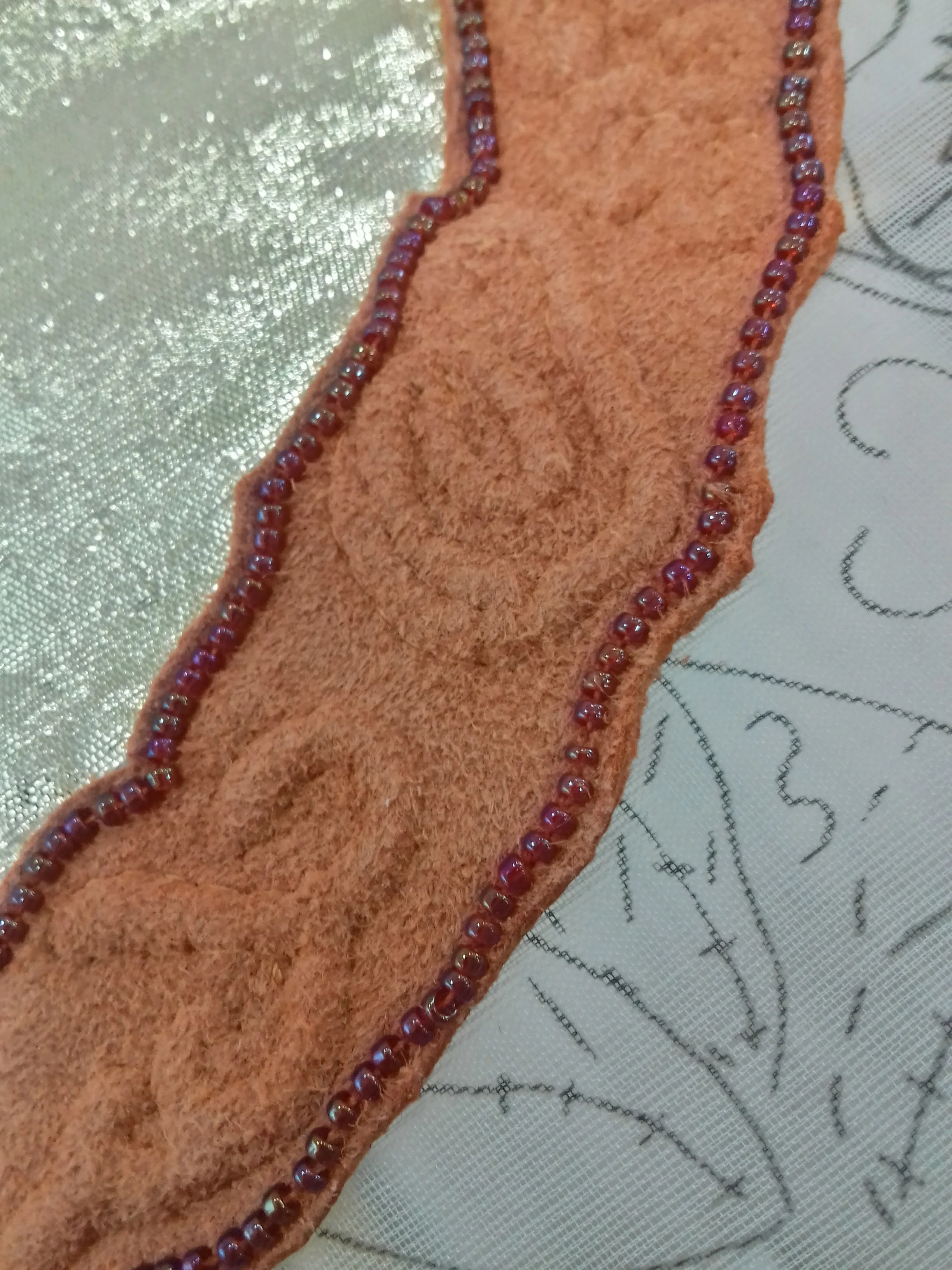
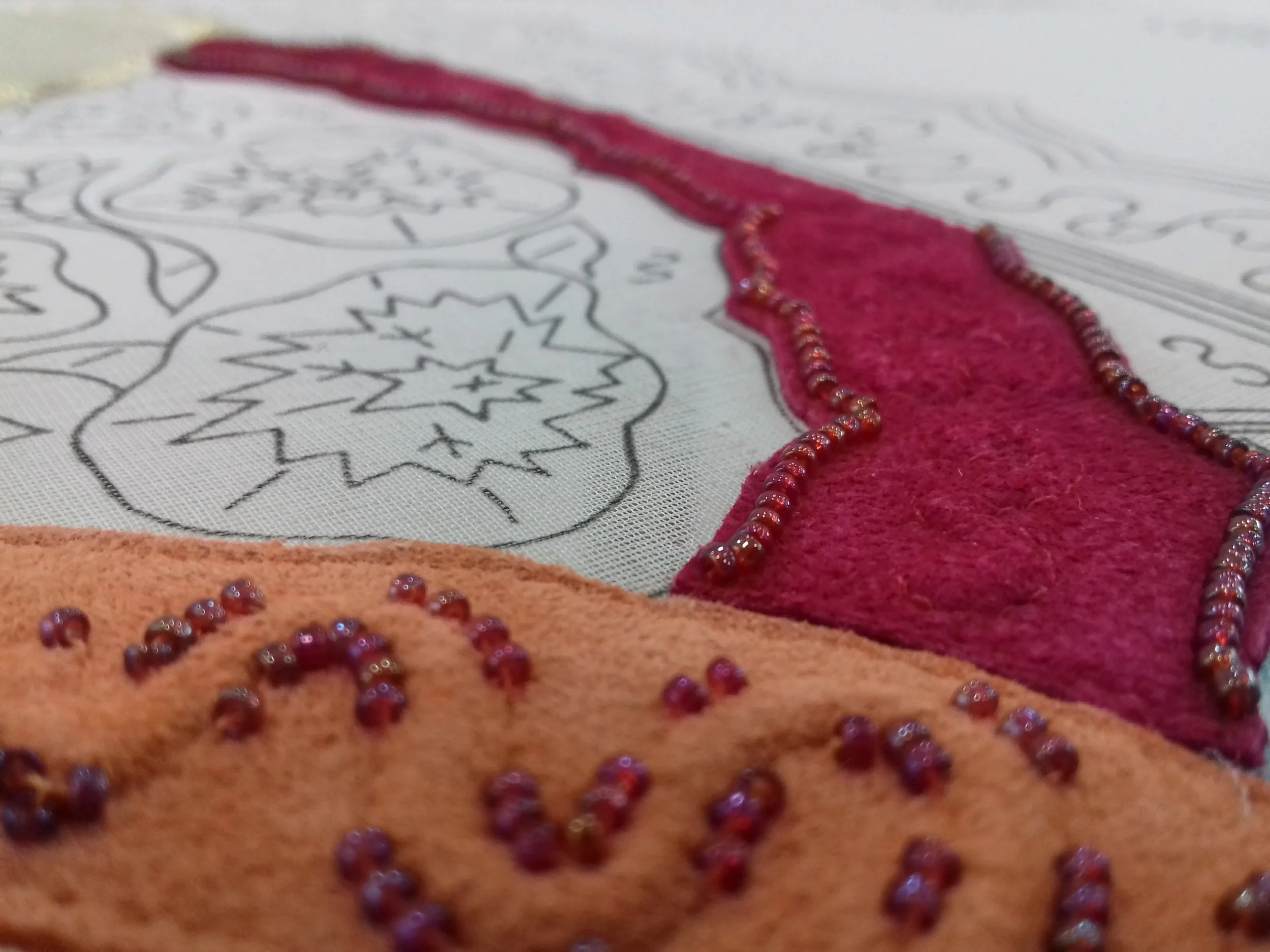
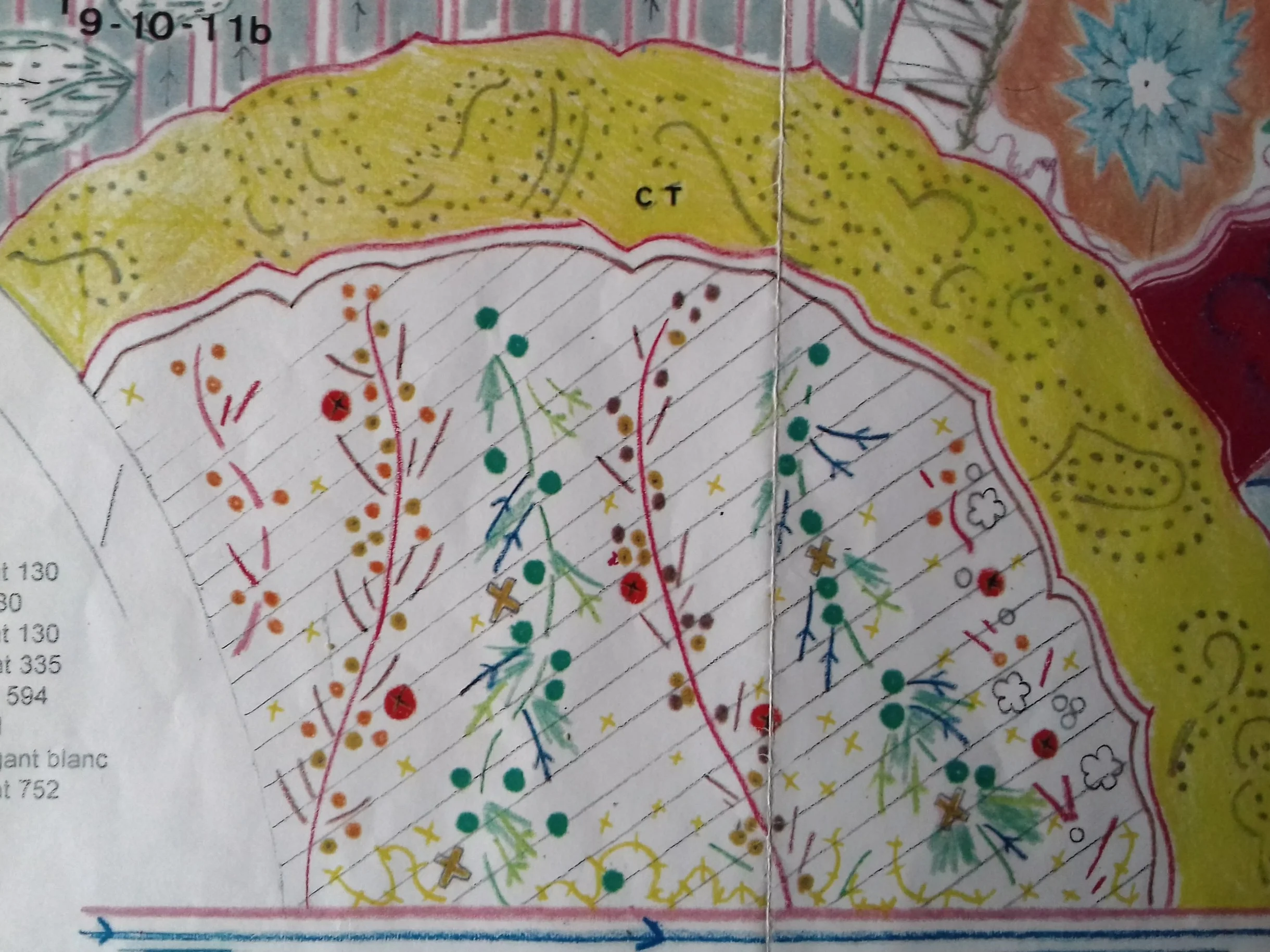
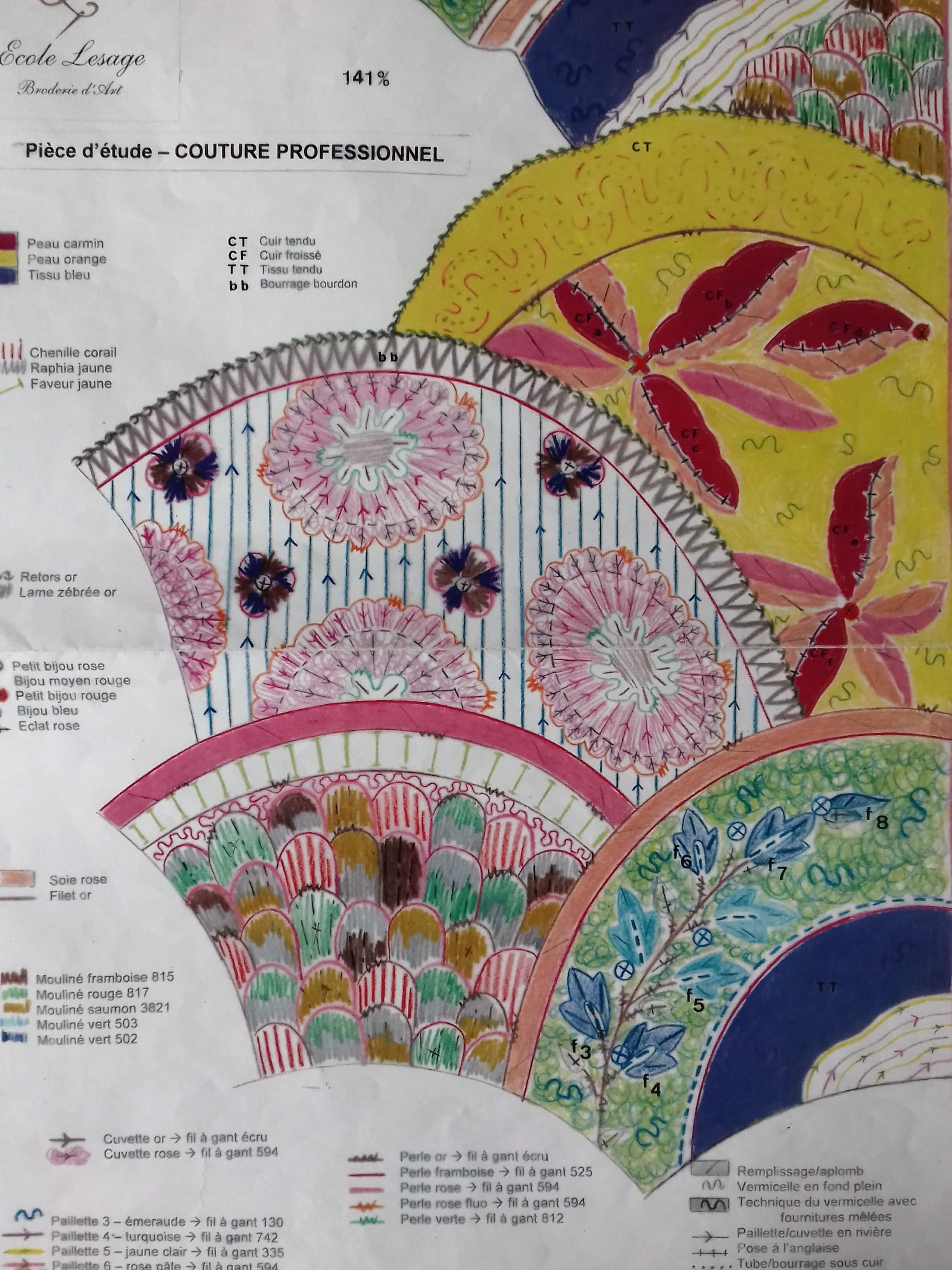
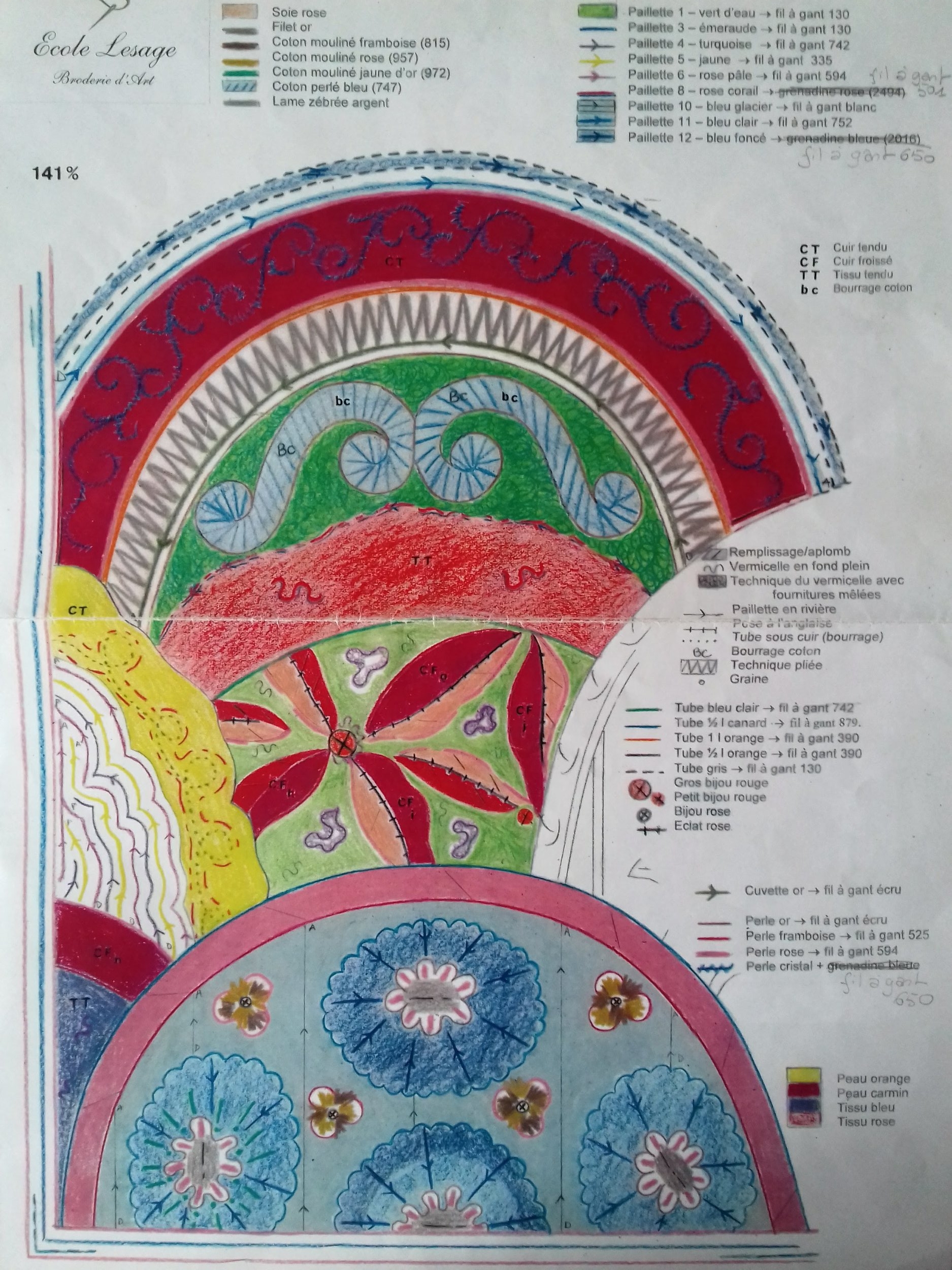
The yellow section on the left shows the pattern for applying orange tube beads in curved lines. Once these were finished the orange leather was stretched over the surface using pins. Working on the right-side of the fabric, the contour of the section was stitched through the leather and then the outline of the beads to create the relief. Gold thread was used in some curves to highlight the relief. Once this was completed the edges of the leather were pulled away from the organza fabric and using the rounded side of the scissors the leather was trimmed as close as possible to the stitched contour. I held my breath and hoped that I would not accidentally cut through the organza...

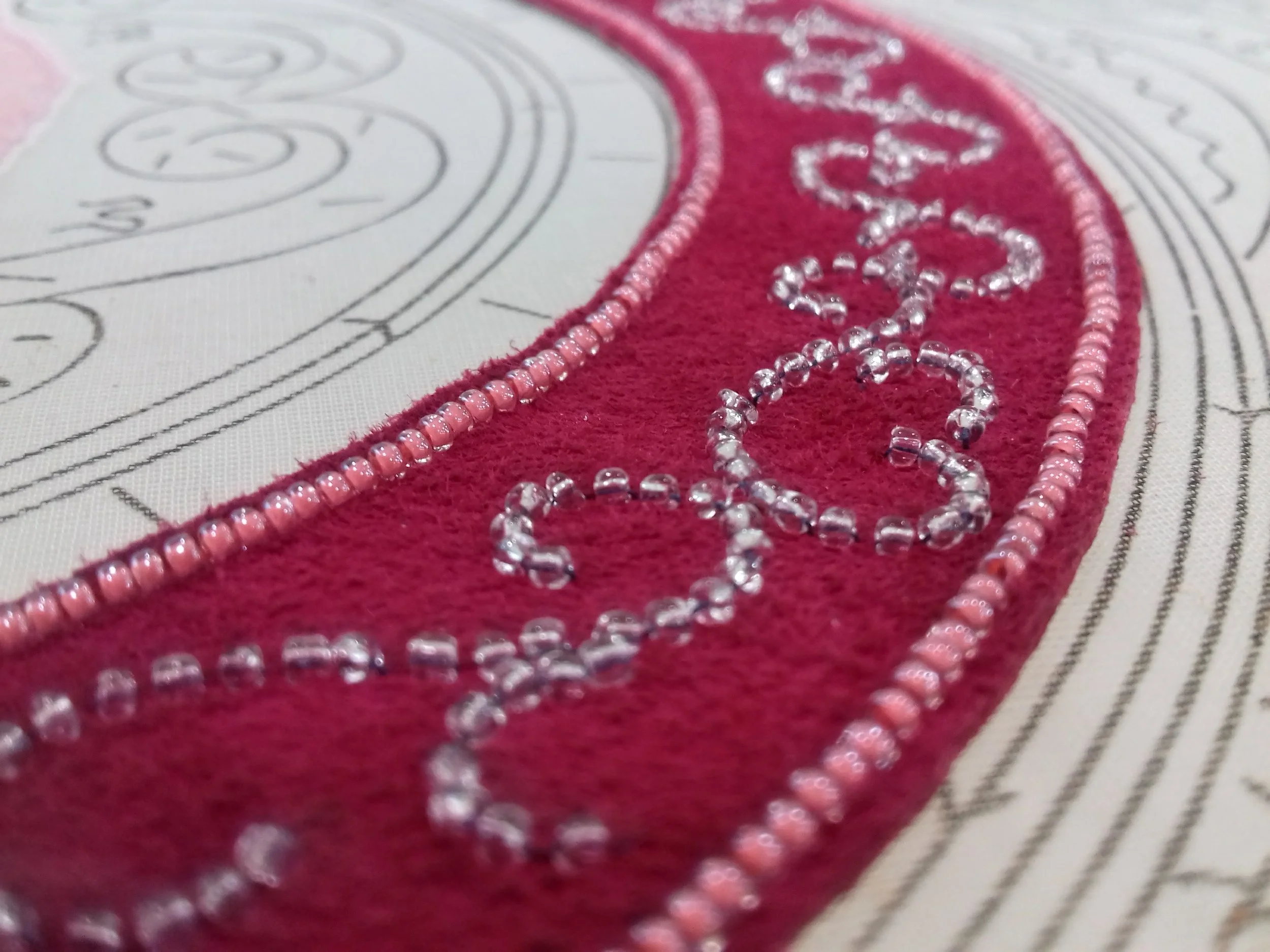
The red section above shows the pattern for applying the leather first to lay the surface. The transparent beads are applied without being able to see the surface. I learned the hard way that it is worthwhile checking your progress at regular intervals by turning the frame to see if you have accidentally added two beads or missed a bead entirely! 

View fullsize 20171027_113716_Richtone(HDR).jpg
View fullsize 20171027_113811_Richtone(HDR).jpg
View fullsize 20171103_094433_Richtone(HDR).jpg
View fullsize 20171103_094612_Richtone(HDR).jpg
View fullsize 20171103_094034_Richtone(HDR).jpg
View fullsize 20171103_094345_Richtone(HDR).jpg
View fullsize 20171103_094721_Richtone(HDR).jpg
View fullsize 20171103_094754_Richtone(HDR).jpg

Vermicelli and Chiffon

20180308_112604_Richtone(HDR).jpg

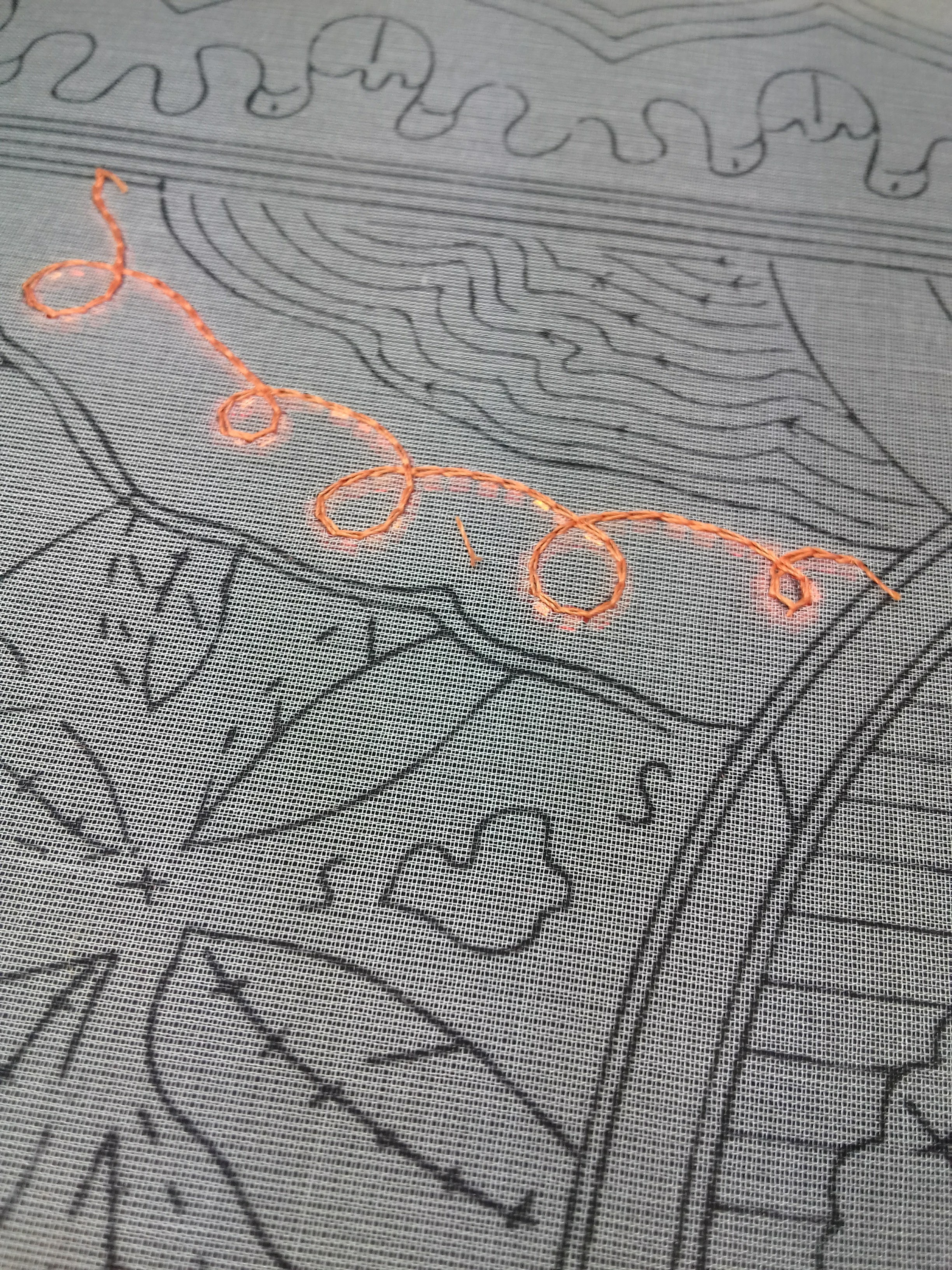
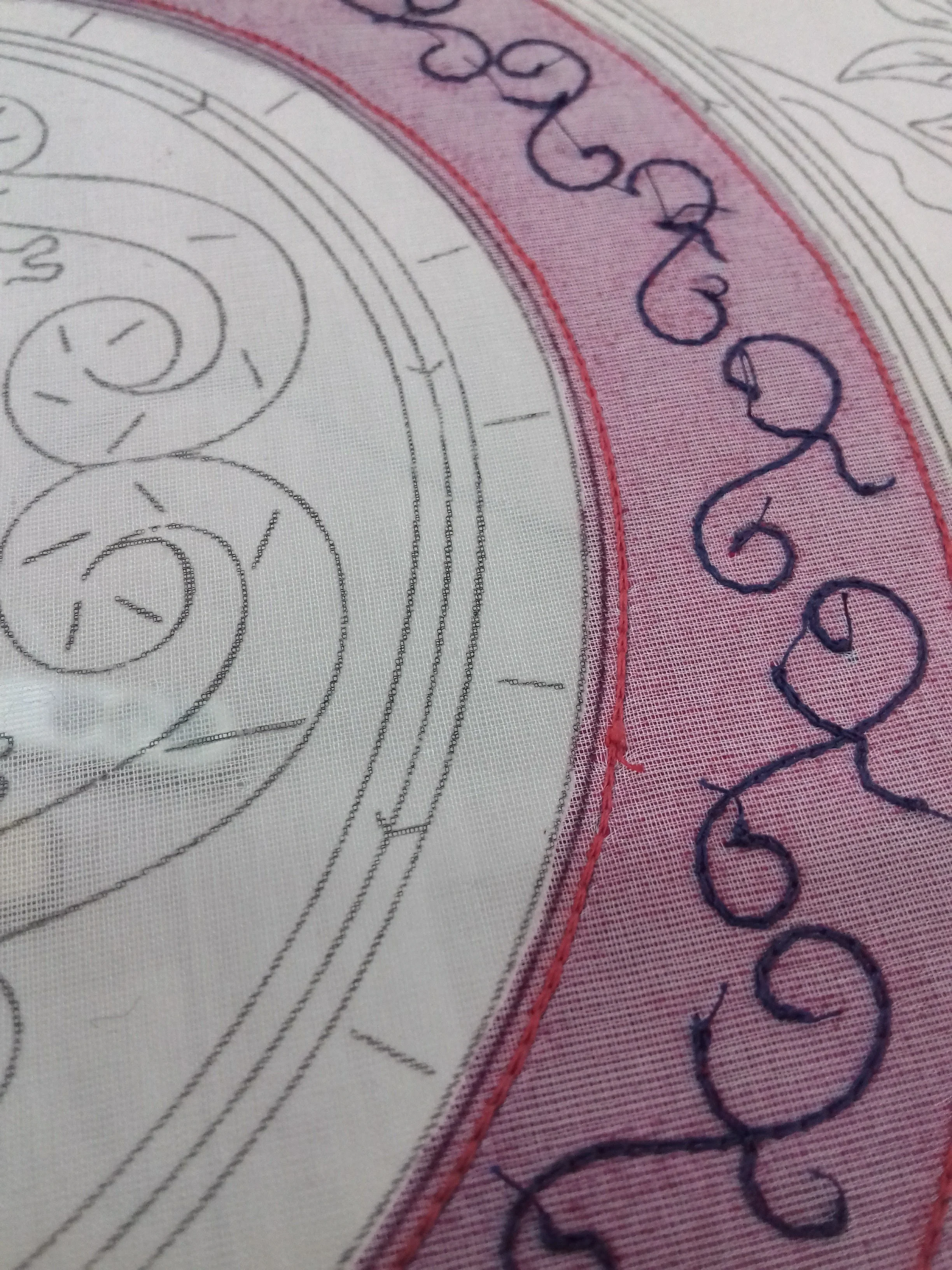
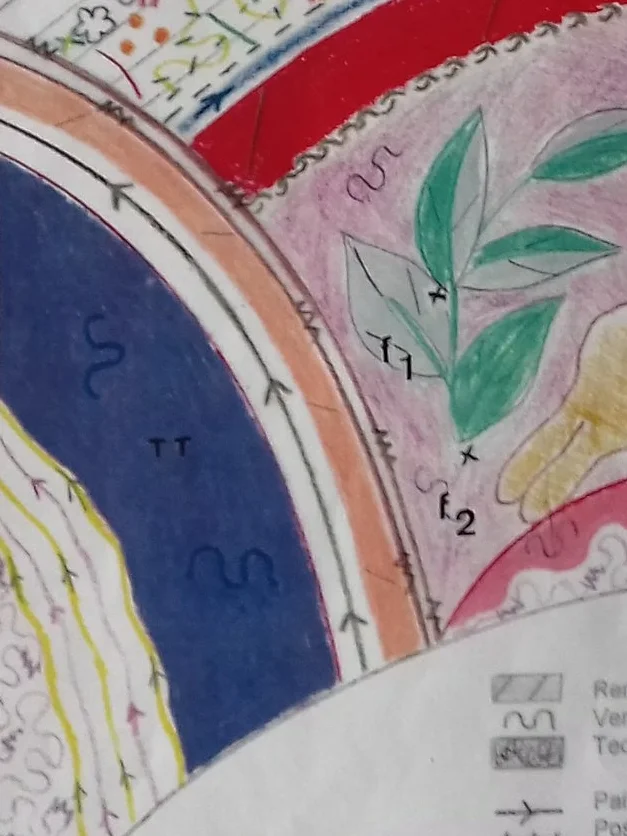
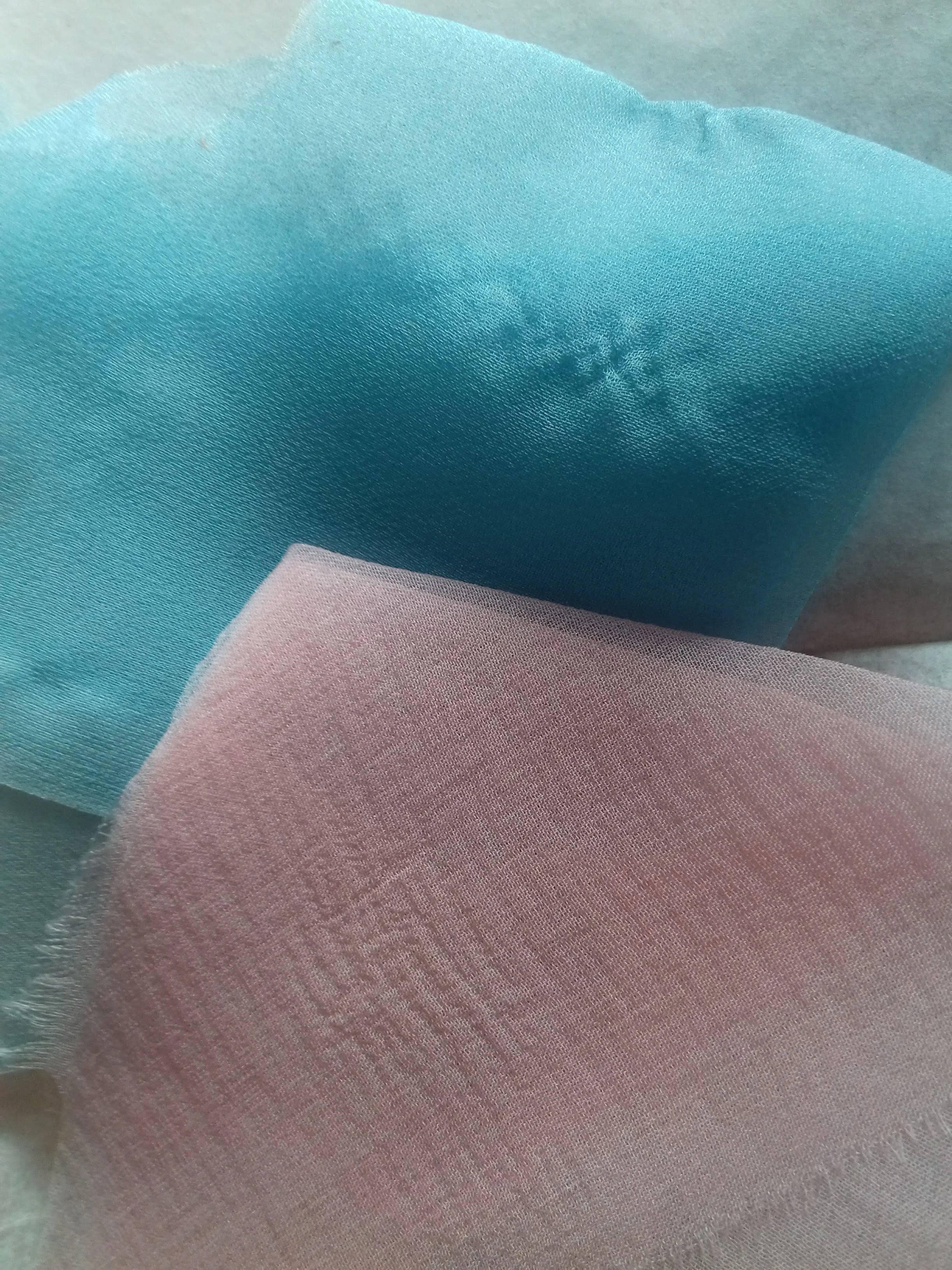
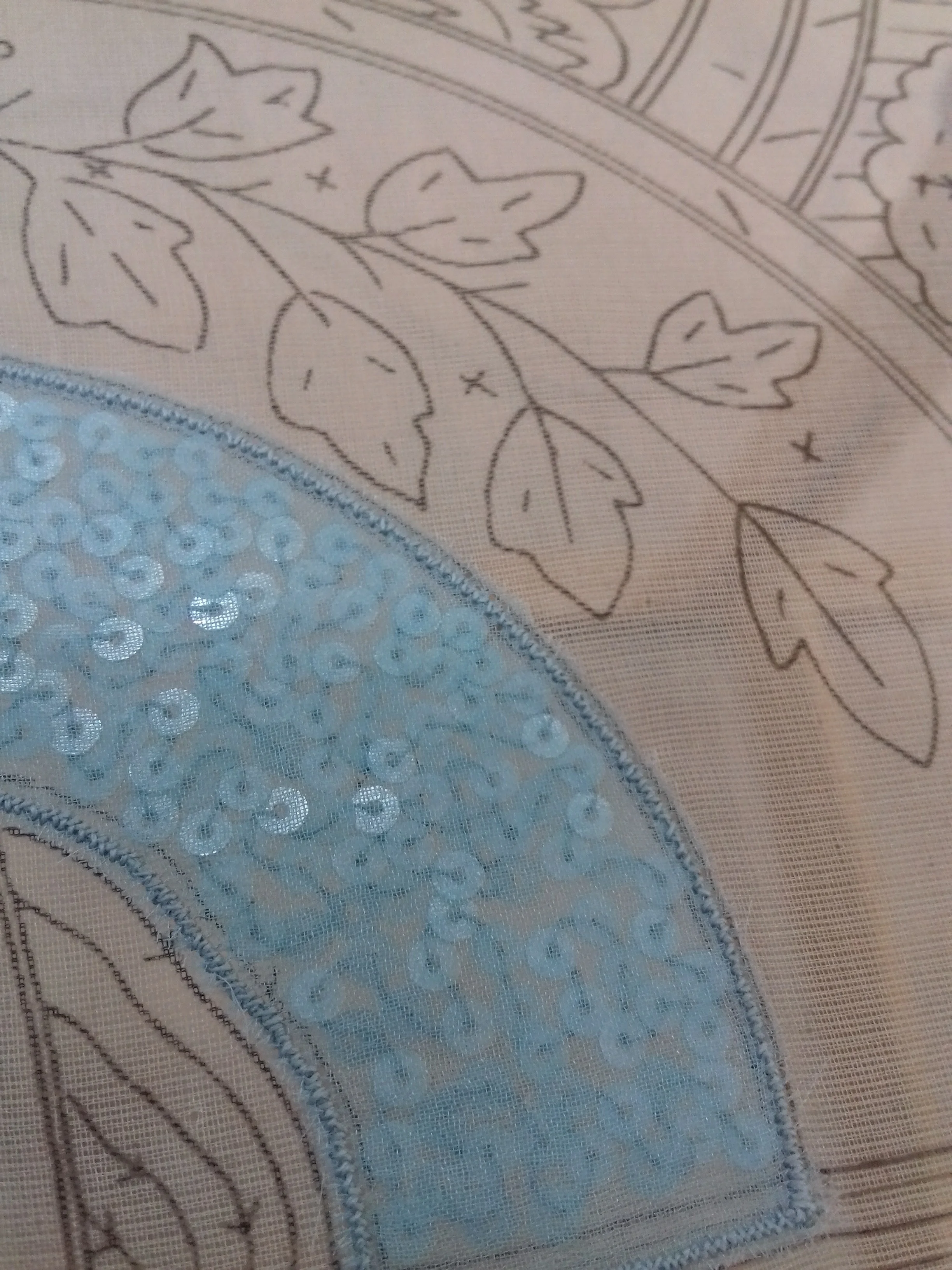
The blue arch shows the area to be filled with sequins using the vermicelli technique, this is indicated by the little squiggles and the TT stands for tissu tendu meaning stretched chiffon fabric. The sequins were the smallest I had ever seen, measuring just 3mm in diameter. They were applied first in sections of light blue, turquoise and matt coral. The matt beads were very tricky to work with as they didn't slide apart and were often stuck together. Once the sequins were finished the chiffon was stretched across the surface and applied using pointe-riche. The edges of the chiffon are pulled away from the organza and the rounded side of the scissors was used to trim away the fabric from the pointe-riche.


View fullsize 20180308_115037.jpg
View fullsize 20171103_094215_Richtone(HDR).jpg
View fullsize 20171103_094230_Richtone(HDR).jpg
View fullsize 20171103_094240_Richtone(HDR).jpg

Applying Lamé using Pointe-Riche

20180308_112706_Richtone(HDR).jpg

The diagonal lines indicate the gold lamé fabric and before it was applied transfer adhesive was ironed onto the back to prevent the fabric from warping or contracting. Pointe-riche in gold metallic thread was used to secure the fabric in place. The edges were carefully trimmed away, although thankfully not as close as the leather or chiffon!


Finally the background was prepared and I was relieved to find that while the materials had changed somewhat, the techniques had been previously covered in the sampler. I was excited to discover what would come next but in the meantime I made a little trip to Maison Sajou....

Textile Tours of Paris

Join Rebecca on a tour of Paris’ charming haberdasheries nestled deep in the winding streets of Le Sentier, the city’s historic textile and fashion district. Enjoy a Sunday morning with Rebecca on a Flea Market Tour as she guides you through the labyrinth alleys of Paris’ oldest marché-aux-puces to uncover hidden treasure troves filled with vintage lace, linen, passementerie, golden threads and gossamer lingerie. To find out more visit Textile Tours of Paris.
On y va!

March 10, 2018 Rebecca Devaney
Lesage Professional Haute Couture Training

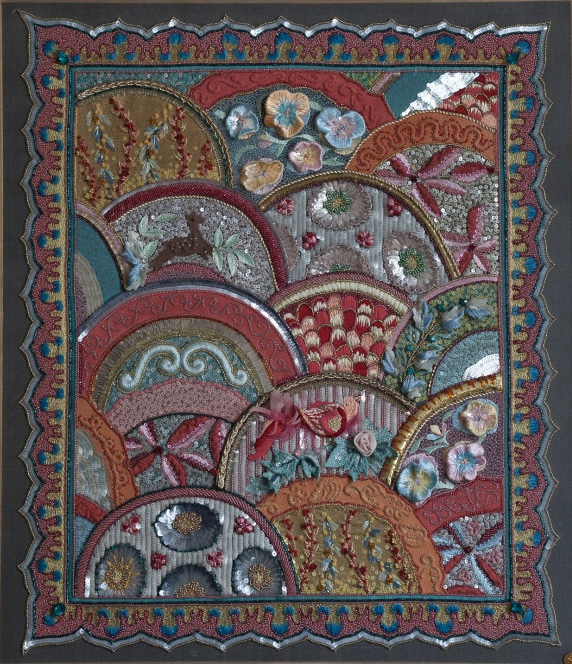
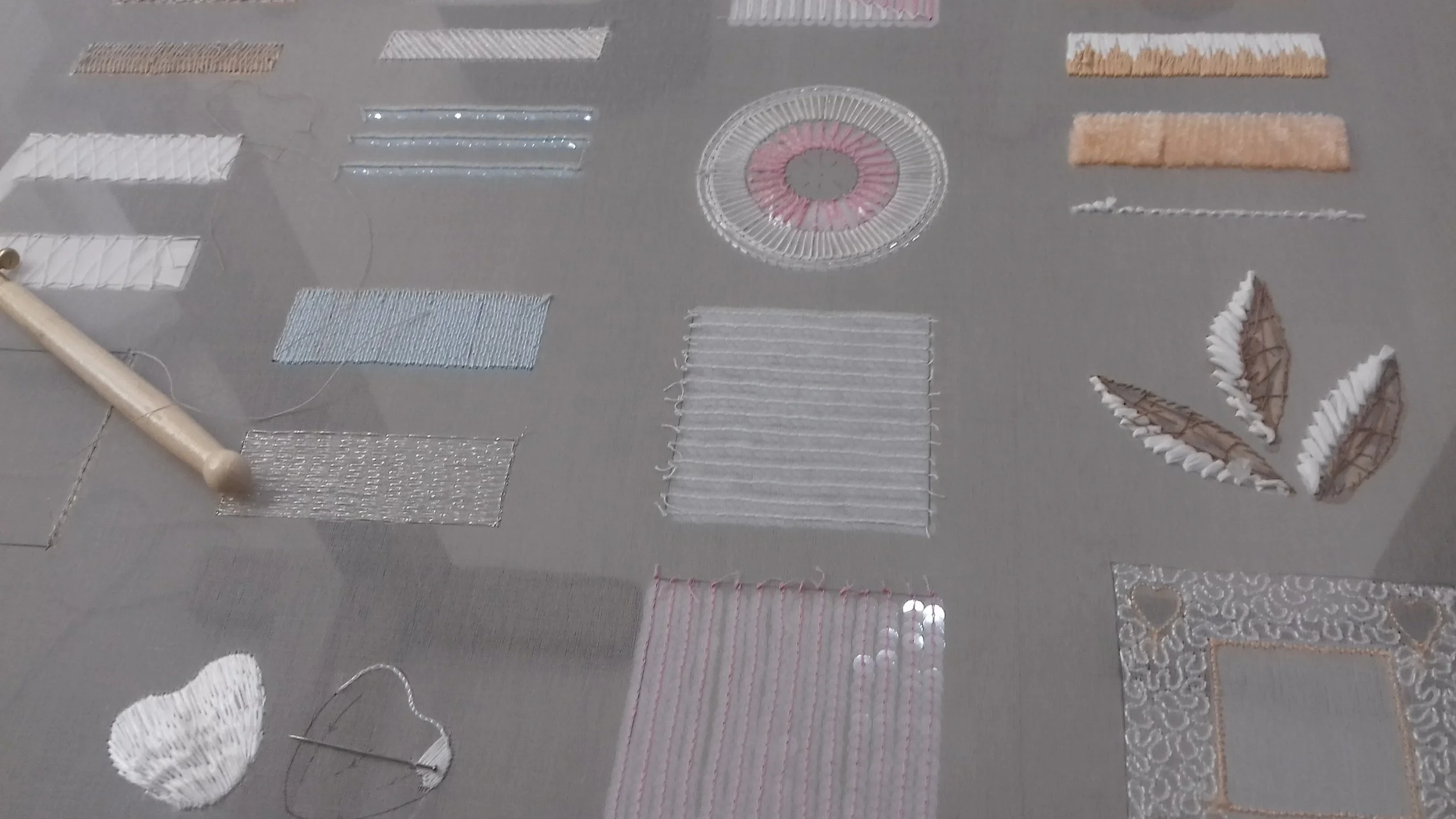
The design for the final piece comes from the Lesage archives and was originally a sample created by Maison Lesage for Yves Saint Laurent. It featured decorative plates in whites, beiges, creams and ecru that overlapped each other on a dresser display. To make the design for the course the colours were changed and the border was added, with careful attention being paid to the techniques and materials included in each section. The finished piece is approximately 40cm by 50cm.

20171023_094036_Richtone(HDR).jpg

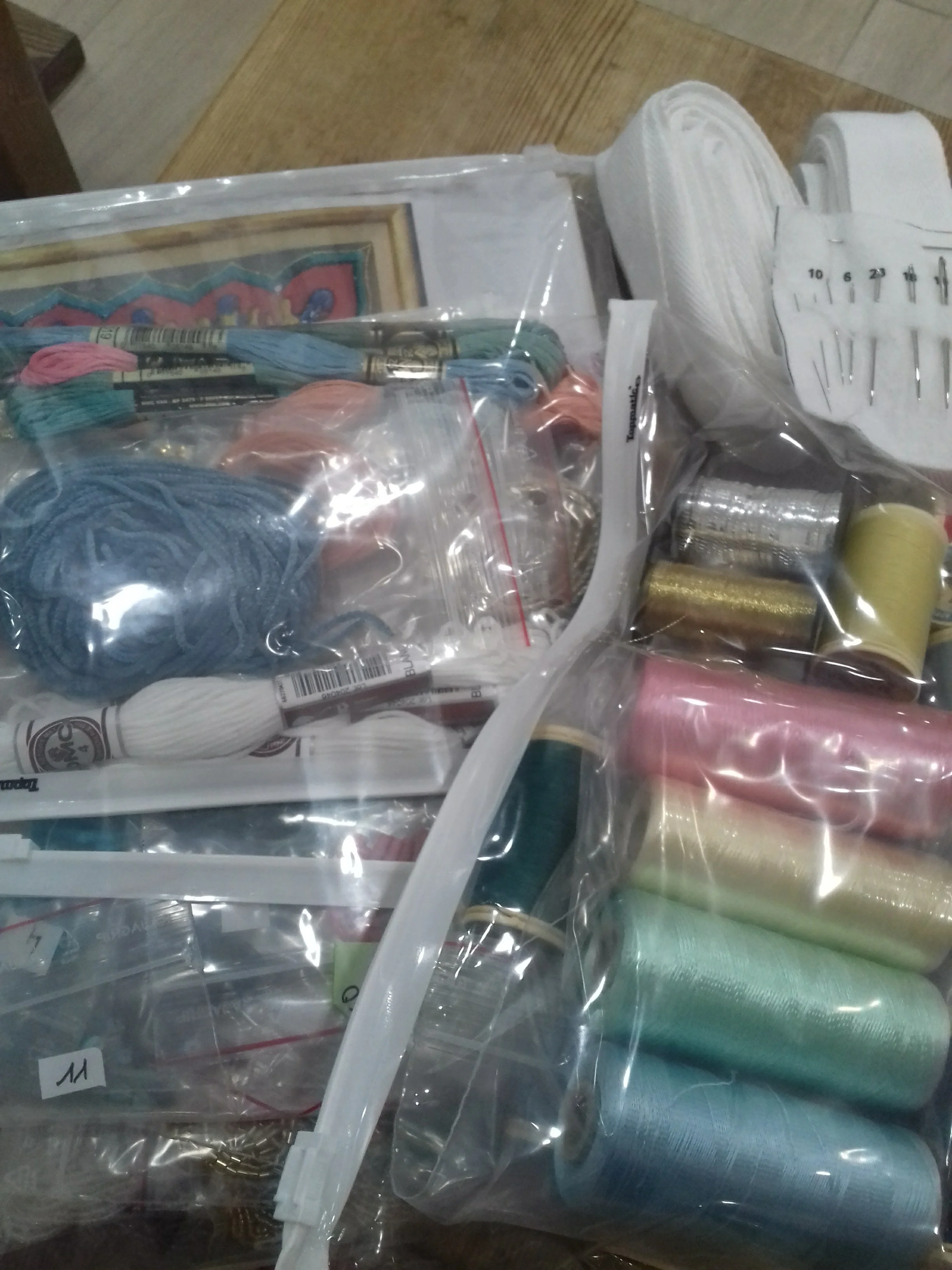
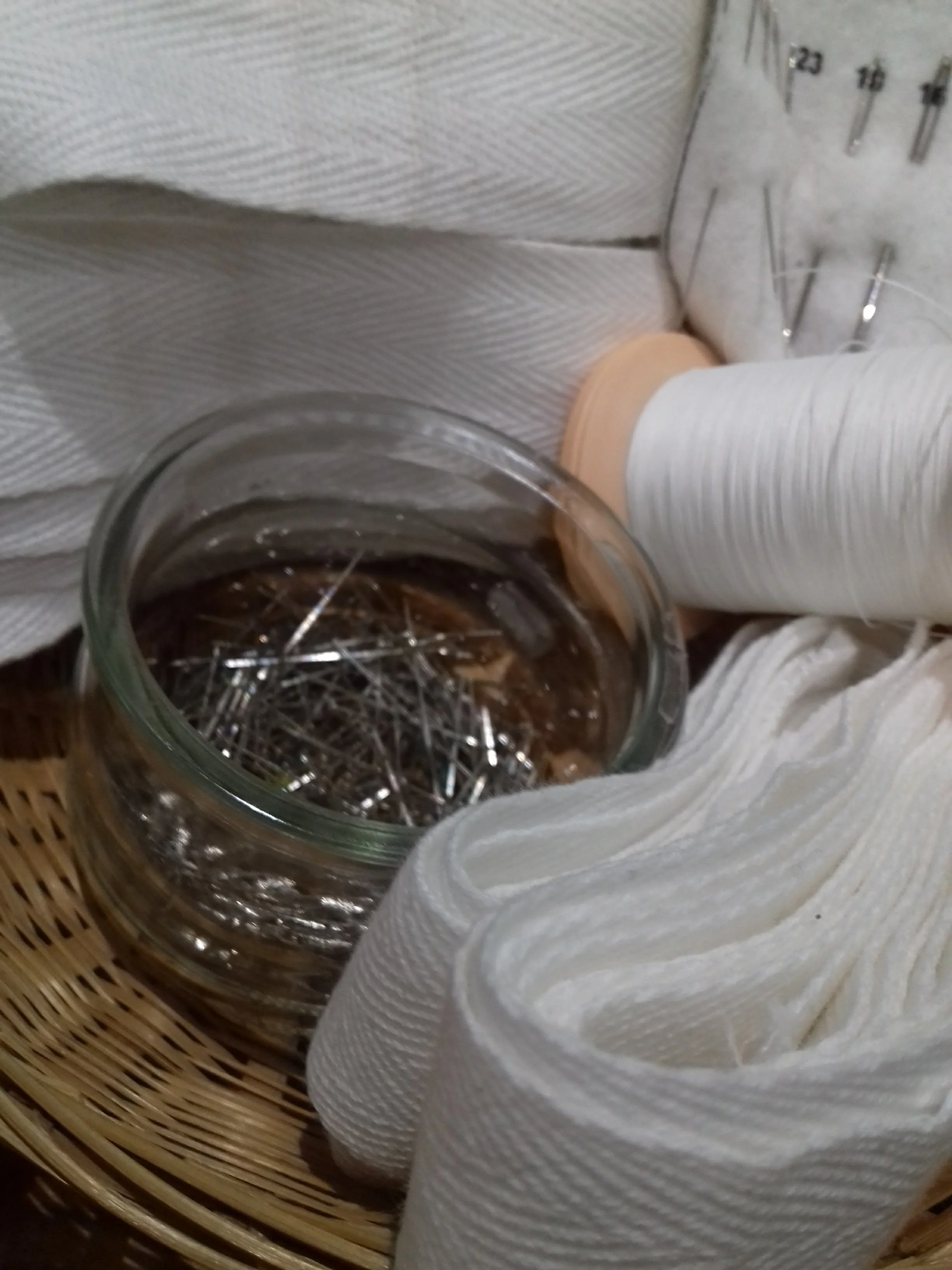
I was given a heavy package of materials that included spools of pastel coloured silk thread, a rainbow selection of cotton threads, embroidery floss, chenille and velvet thread, ribbons, gold and silver metallic thread and foil. There were swatches of gold lamé and raspberry red, orange and brown leather folded in silk paper. Twelve tiny plastic pockets of sequins in turquoise, blue, grey, pink, coral, red, yellow, silver, gold and transparent colours. And beads in pink, raspberry red, gold, orange, turquoise and crystal. Tiny jewels sparkled in ice-blue, green, turquoise, red, crystal and coffee colours. Gold braid trimmings were neatly coiled and beautiful feathers were carefully tucked into pockets.

View fullsize 20180308_112221_Richtone(HDR).jpg
View fullsize 20180308_112233_Richtone(HDR).jpg
View fullsize 20180308_112653_Richtone(HDR).jpg
View fullsize 20180308_112720_Richtone(HDR).jpg
View fullsize 20180308_112305_Richtone(HDR).jpg
View fullsize 20180308_112431_Richtone(HDR).jpg
View fullsize 20180308_112243_Richtone(HDR).jpg
View fullsize 20180308_112604_Richtone(HDR).jpg

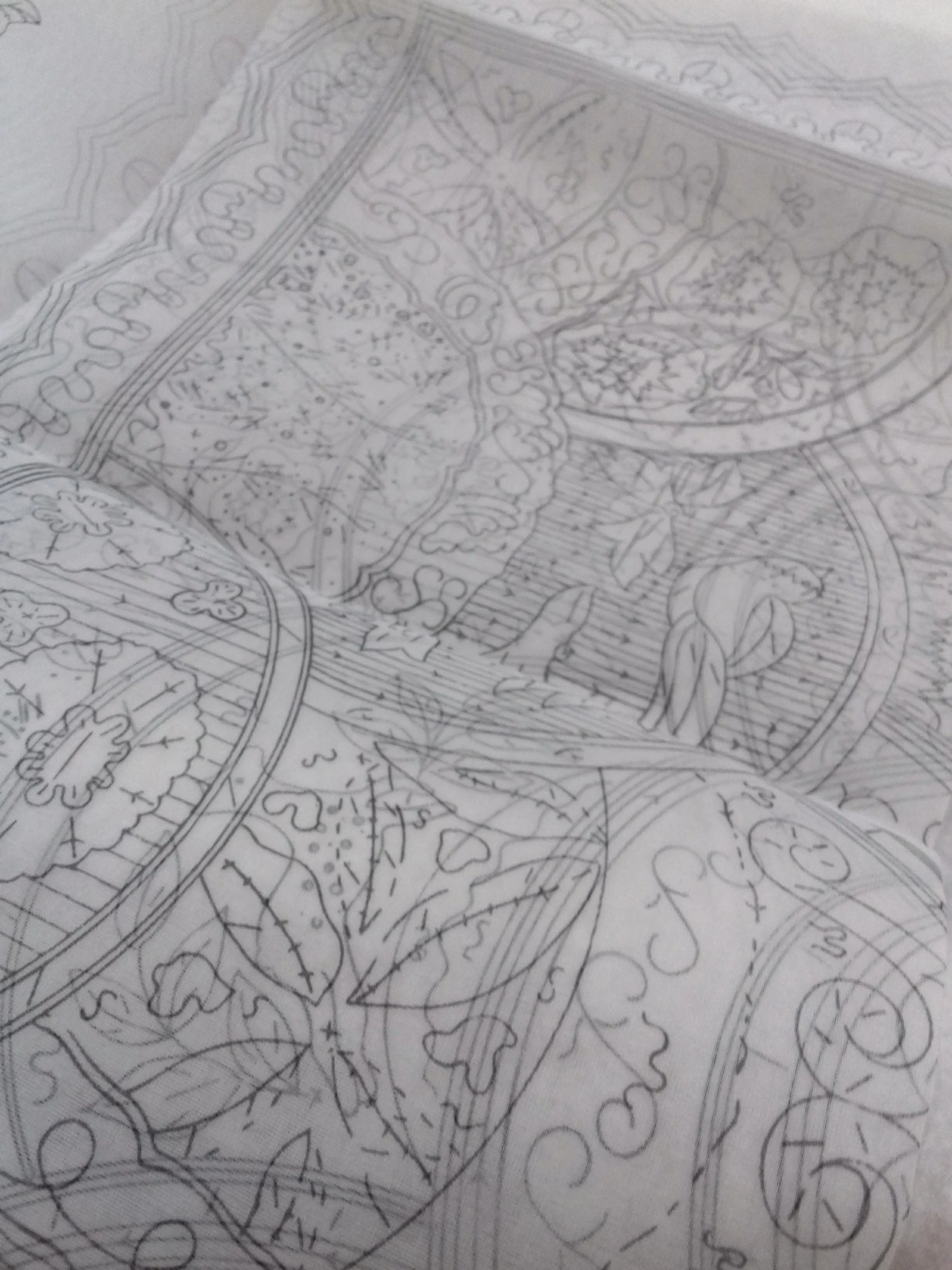
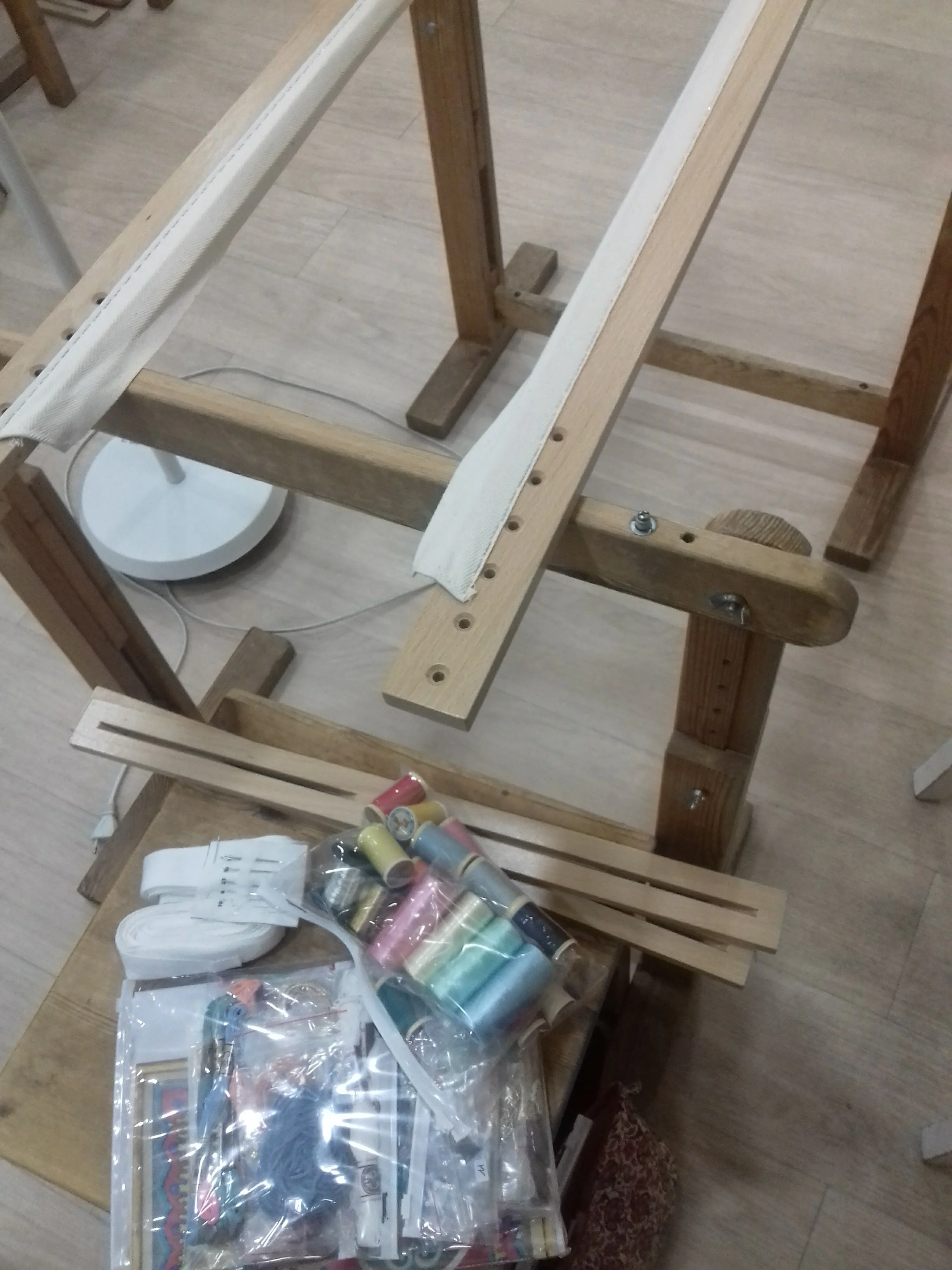
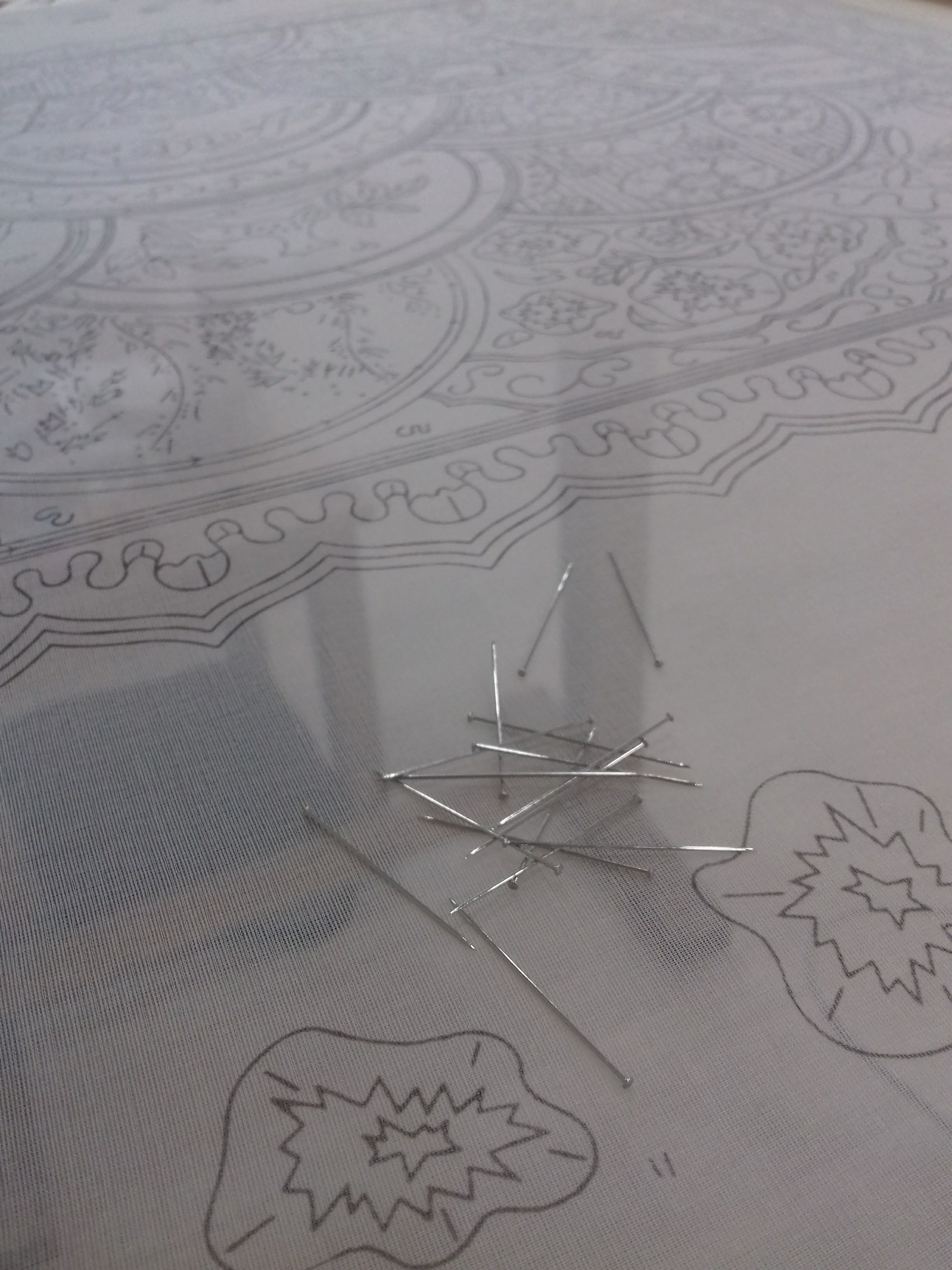
I opened the folder containing the pattern and marvelled at the cheerful drawings initially but I became overwhelmed as more and more brightly illustrated pages emerged. As the piece is so large and detailed the pattern is displayed on 14 A3 pages that show the front and reverse view. The legend seemed incomprehensible and just as I was beginning to panic the teacher came over and we began to mount the frame. A hundred questions, doubts and worries were darting through my head at lightning speed but they were soon silenced as I concentrated on trying to remember how to mount the frame...

20180125_103818.jpg
20171023_094454_Richtone(HDR).jpg
20171023_094142_Richtone(HDR).jpg
20171023_111932.jpg

Textile Tours of Paris

Join Rebecca on a tour of Paris’ charming haberdasheries nestled deep in the winding streets of Le Sentier, the city’s historic textile and fashion district. Enjoy a Sunday morning with Rebecca on a Flea Market Tour as she guides you through the labyrinth alleys of Paris’ oldest marché-aux-puces to uncover hidden treasure troves filled with vintage lace, linen, passementerie, golden threads and gossamer lingerie. To find out more visit Textile Tours of Paris.
Saving the Best for Last

December 19, 2017 Rebecca Devaney
20171016_123915.jpg

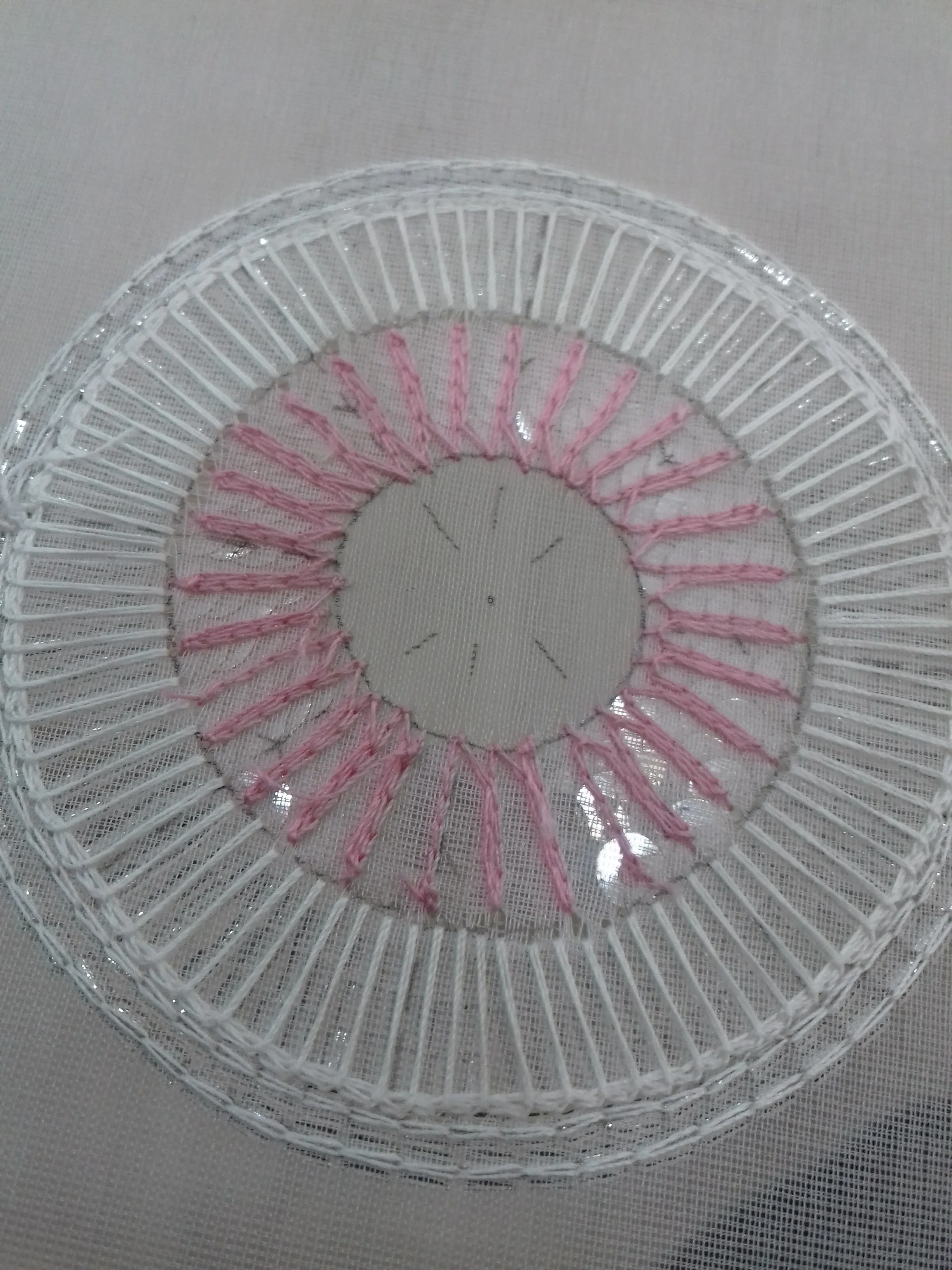
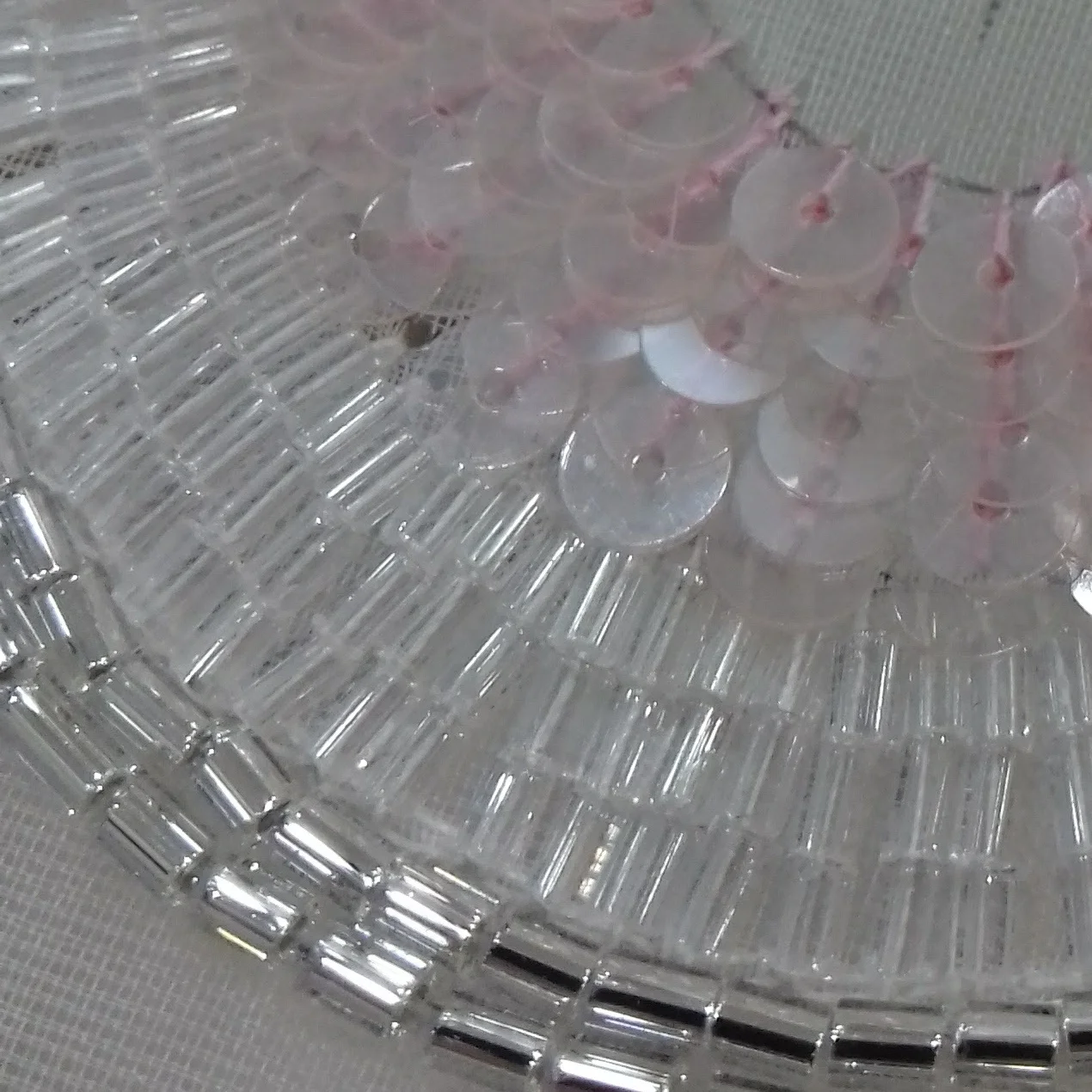
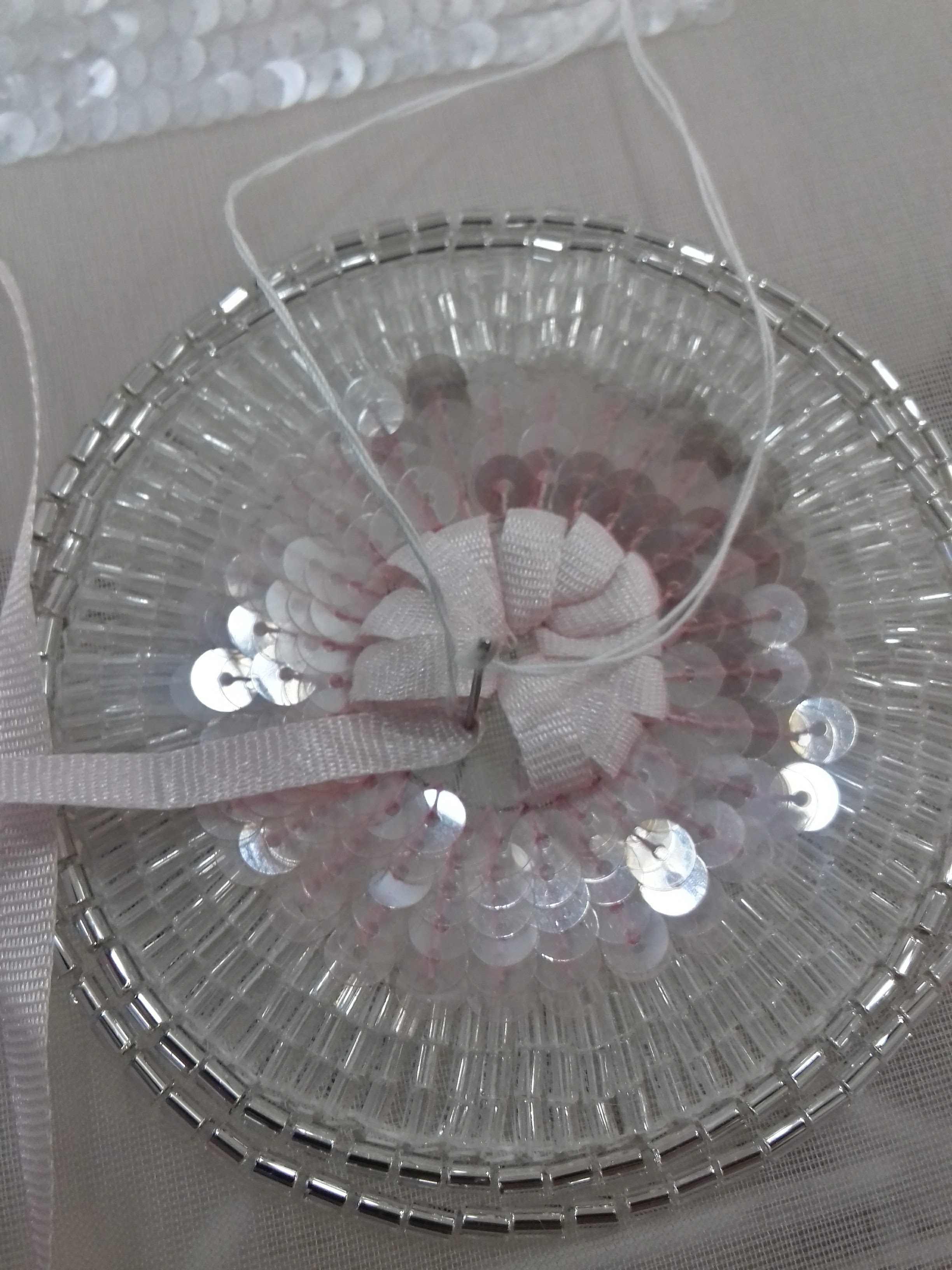
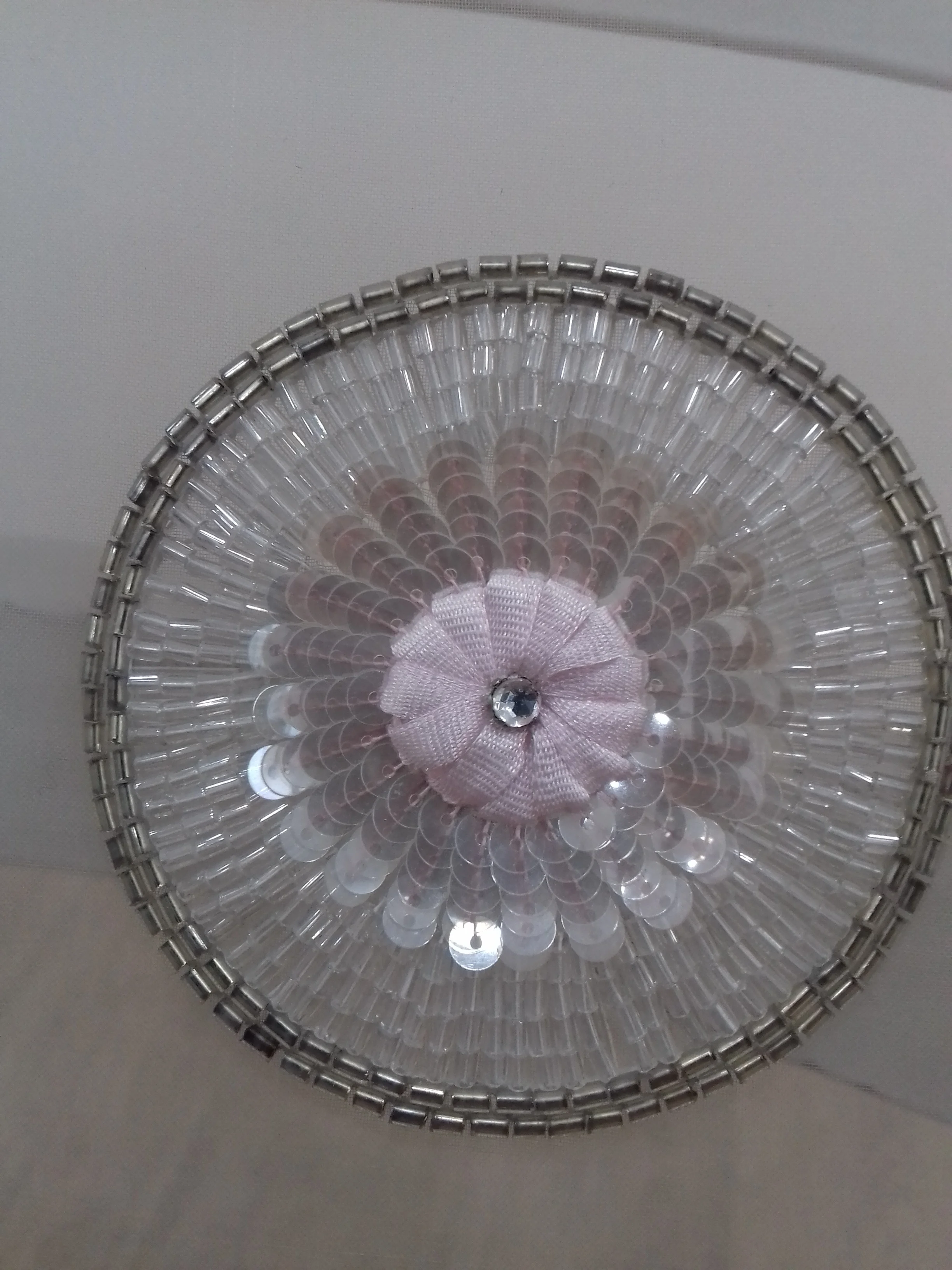
This was the final week of my sampler and some of the most interesting techniques had been saved until last such as painting with silk thread, rolling and overlapping ribbon in a circular design and using the chain stitch to fill an oval motif. Creating relief was really enjoyable and there were two techniques shown for this one with tube beads and leather and the other with sequins and beads. 

Painting with Silk Thread

An outline of the shape to be filled is created and then rows are marked using a loose chain stitch. Next the pulling stitch is used to fill in the areas and as each row is completed the stitches of the following row are inserted into the stitches of the previous row. This creates an overlapping or blended effect, as if you were painting with the stitches.

View fullsize 20171016_095202.jpg
View fullsize 20171016_095128.jpg

Rolling and Overlapping Ribbon

This was the final part of an exercise that began with applying tube beads in concentric circles, followed by applying tube beads in tapered rows using the point-tiré and adding sequins in a river. I found it tricky to roll and overlap the ribbon with even tension but most of the mistakes were hidden by the jewel that was added at the end!

View fullsize Sampler54.jpg
View fullsize Sampler63.jpg
View fullsize Sampler67.jpg
View fullsize 20171020_093637_Richtone(HDR).jpg
View fullsize 20171020_094707_Richtone(HDR).jpg
View fullsize 20171020_093645_Richtone(HDR).jpg
View fullsize 20171020_110309_Richtone(HDR).jpg
View fullsize Sampler62.jpg

Creating Relief with Sequins and Beads

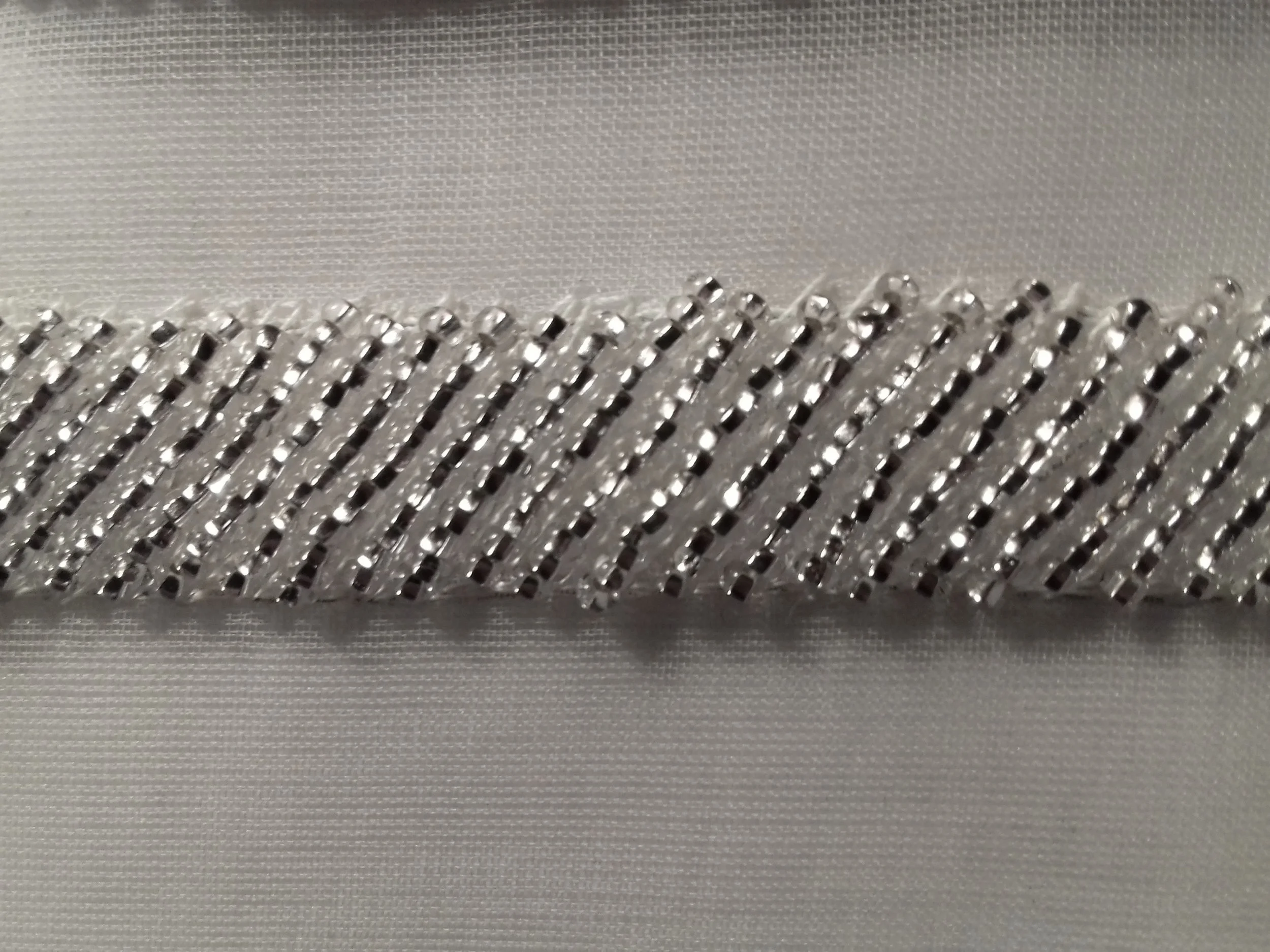
With this technique a row of beads is applied first and then a row of tightly spaced sequins are applied much closer than normal, around 2mm distance. This forces the beads to rest on their side instead of flat and the next row of beads holds them in position. I loved this technique as it wasn't too difficult and if the sequins didn't sit upright I could coax them into position using a pin afterwards! I thought the technique would give beautiful effects and was excited to use it in the future... 

View fullsize 20171016_121442.jpg
View fullsize 20171020_094641_Richtone(HDR).jpg
View fullsize 20171020_093630_Richtone(HDR).jpg
View fullsize 20171020_093602_Richtone(HDR).jpg

Creating Relief with Tube Beads and Leather

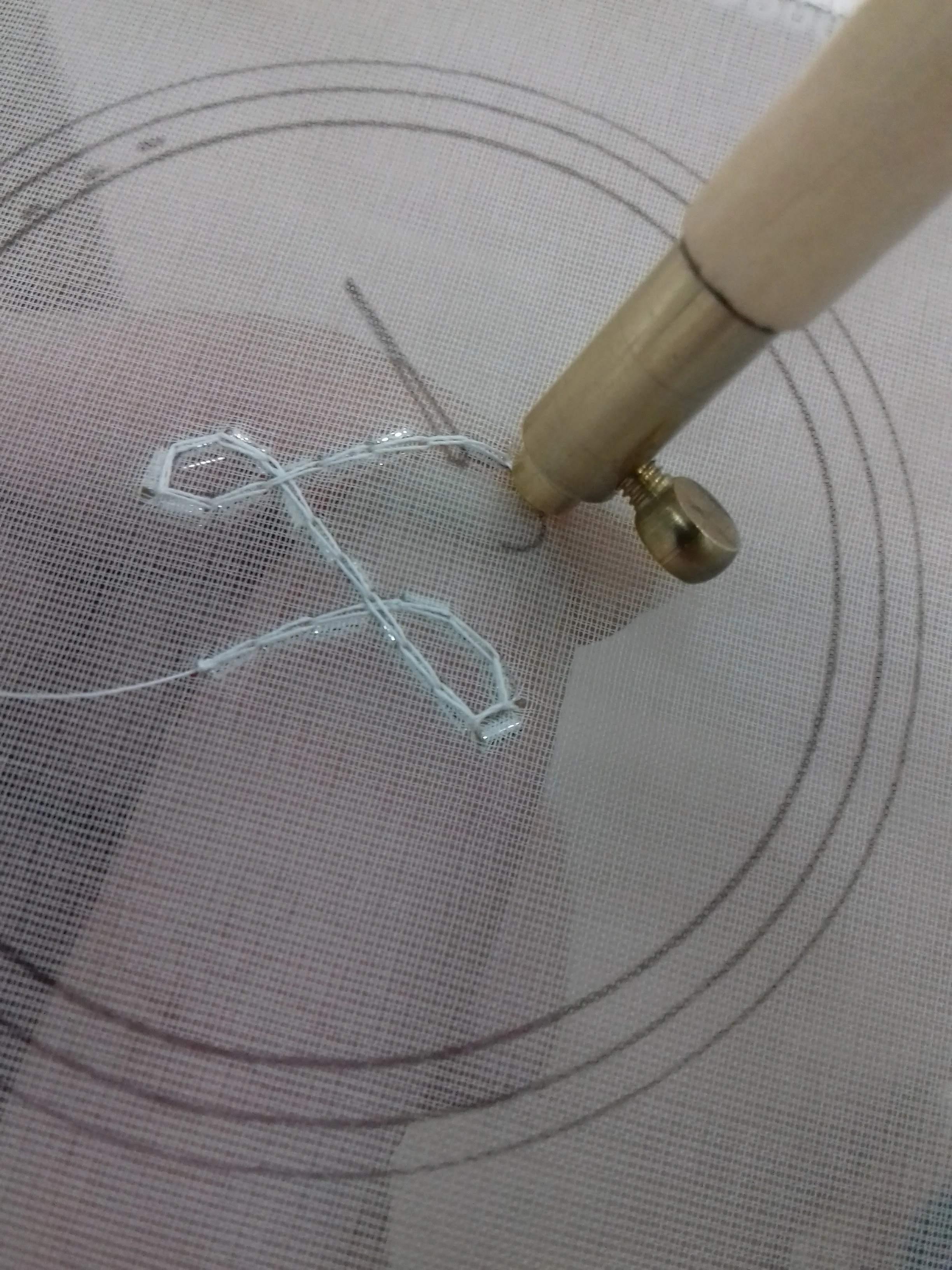
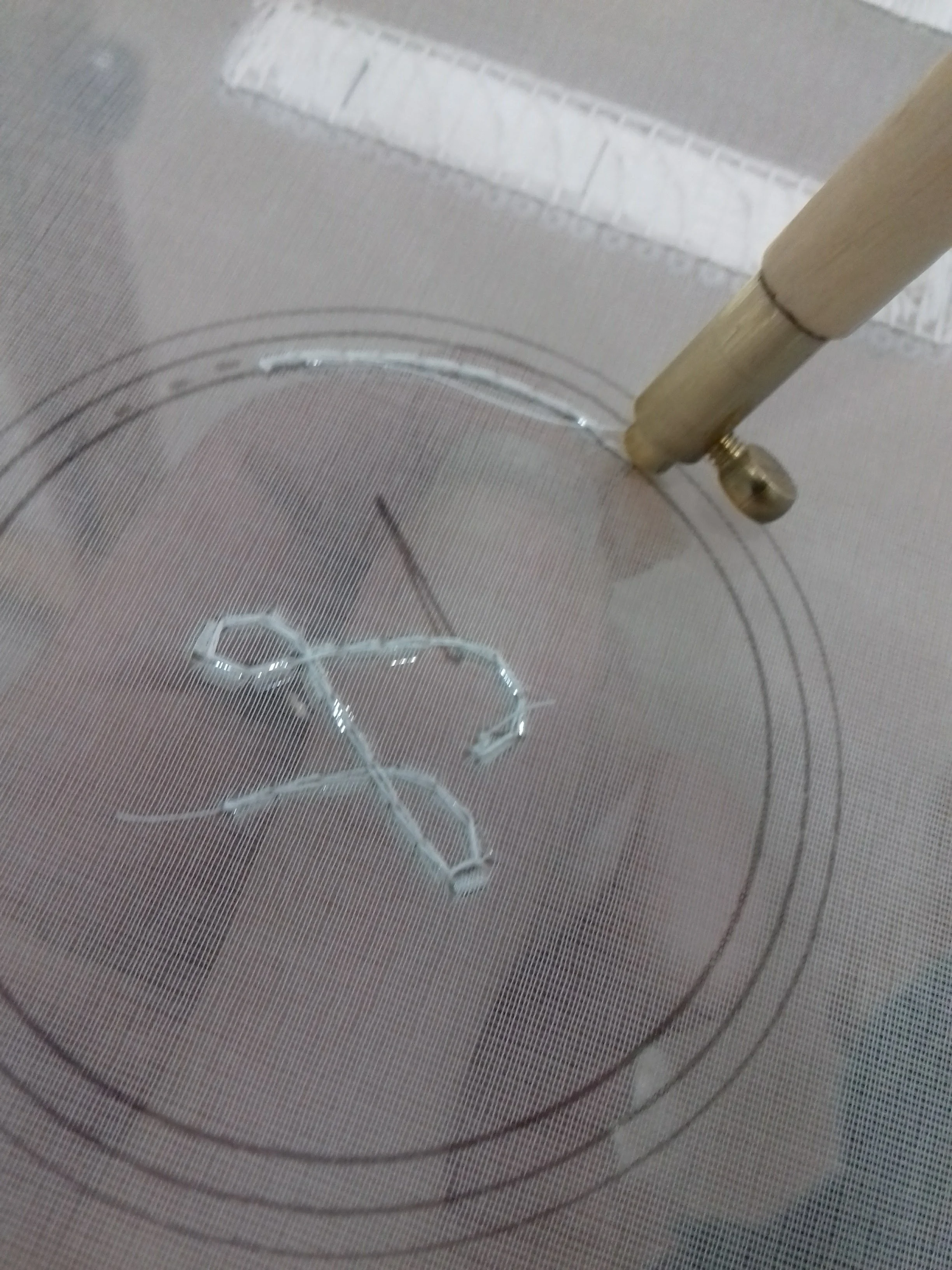
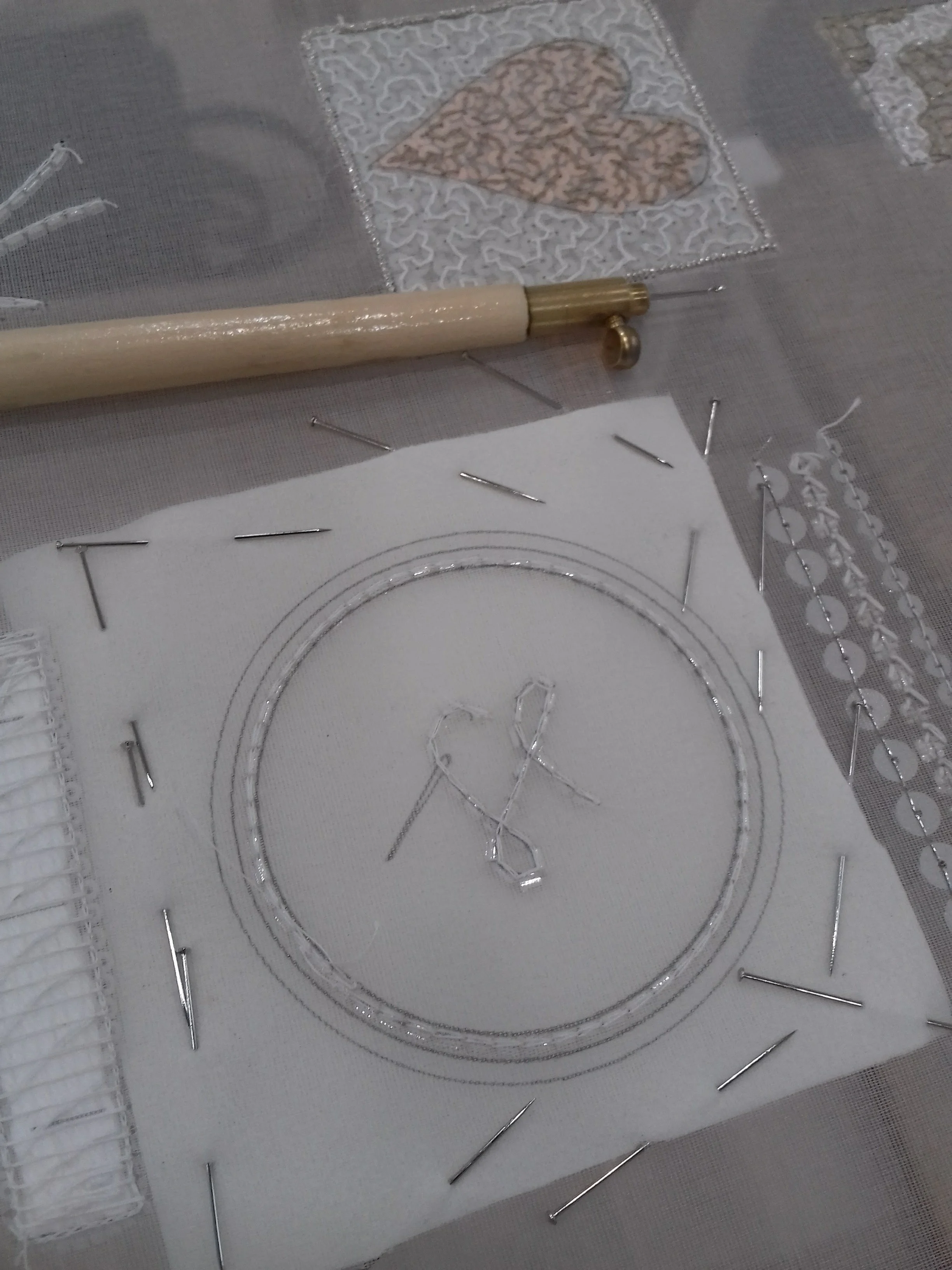
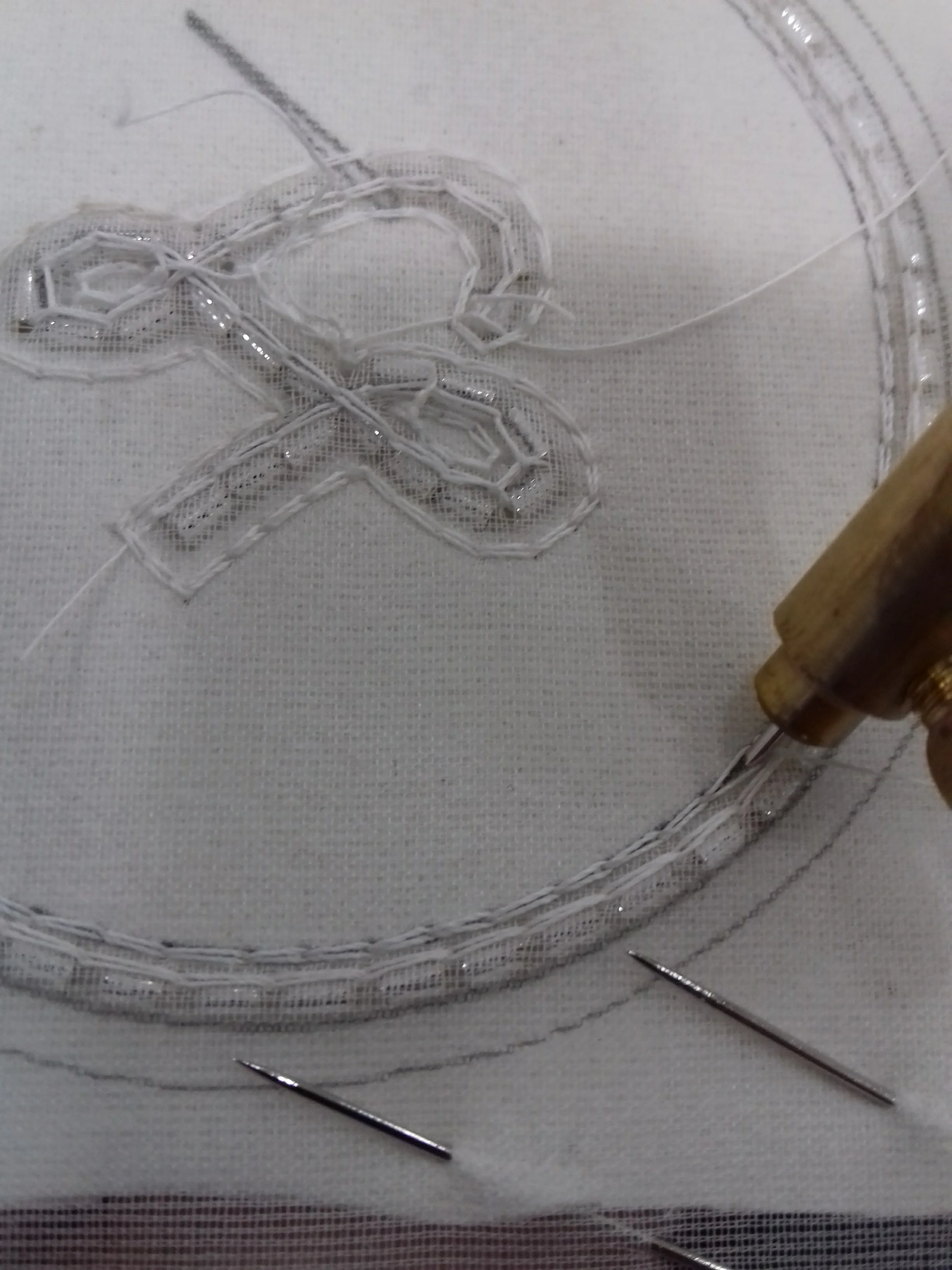
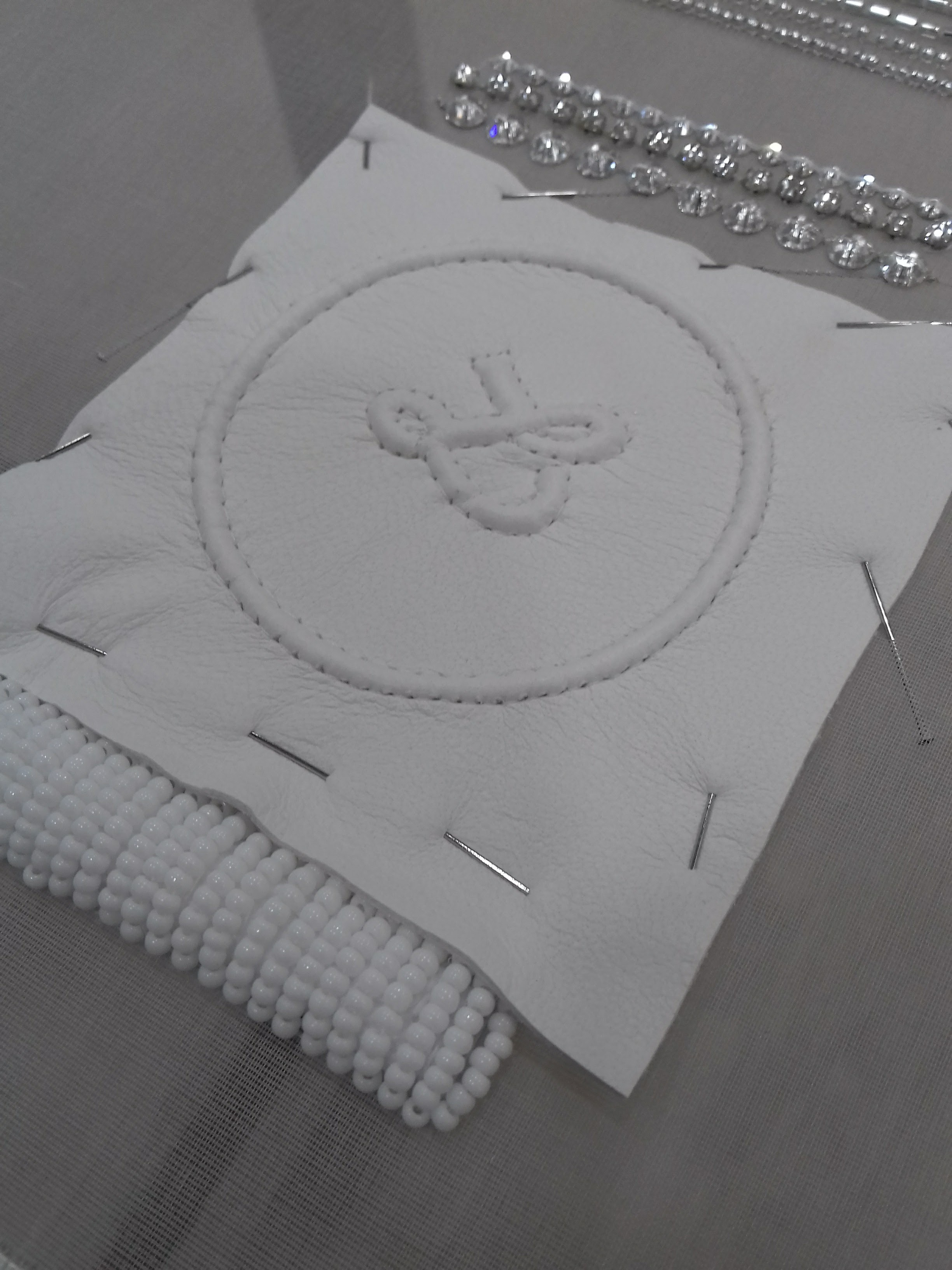
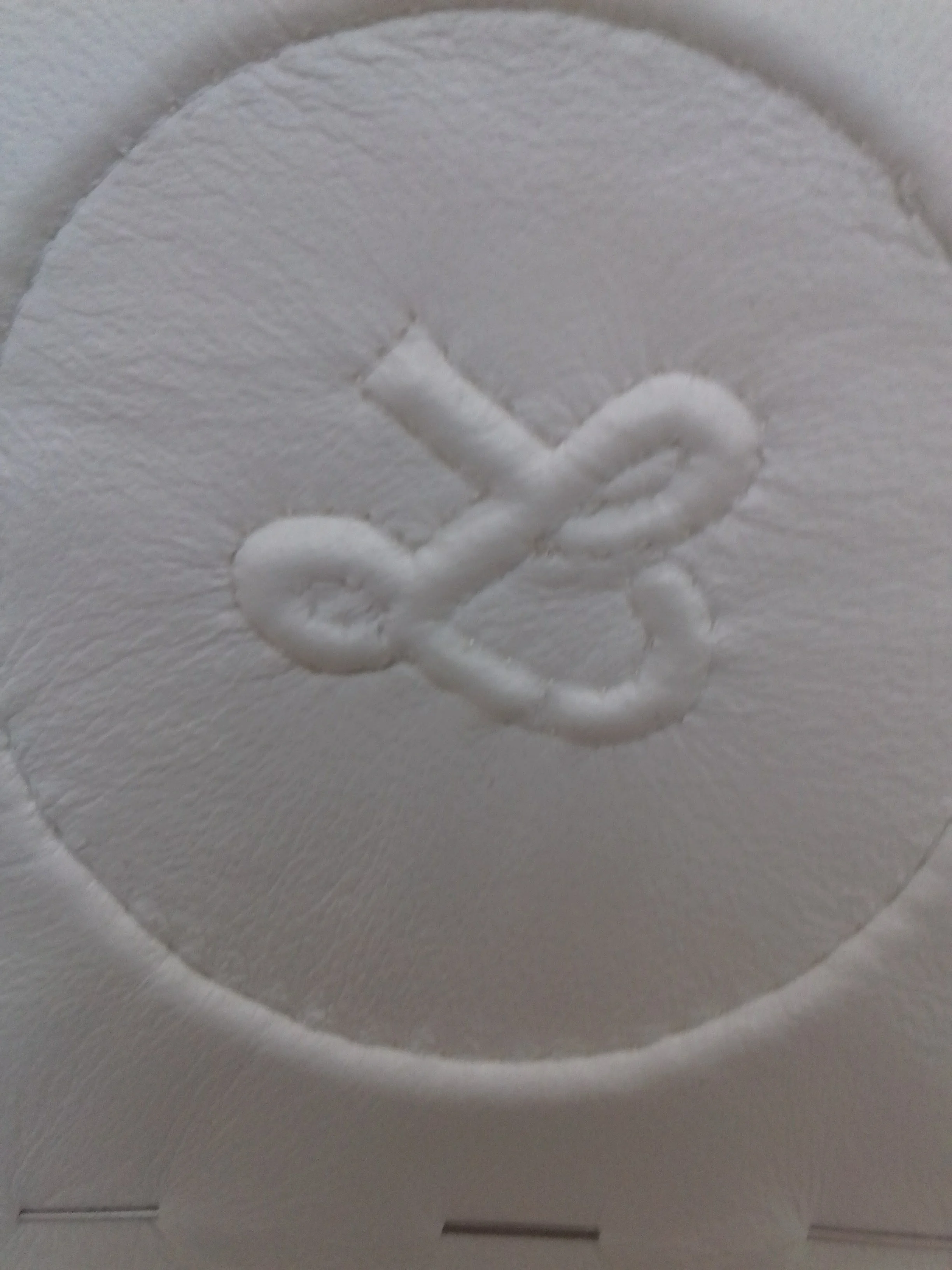
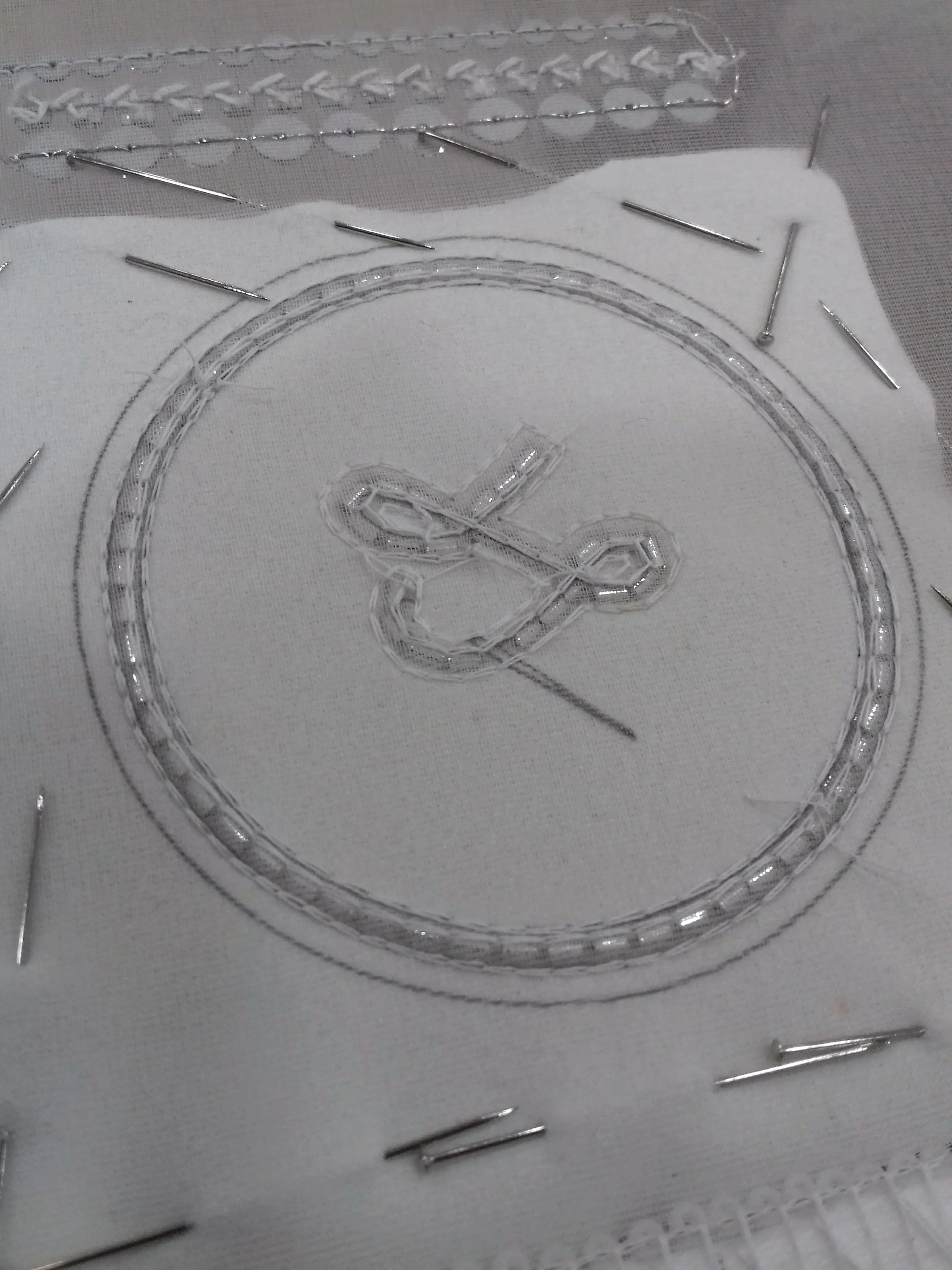
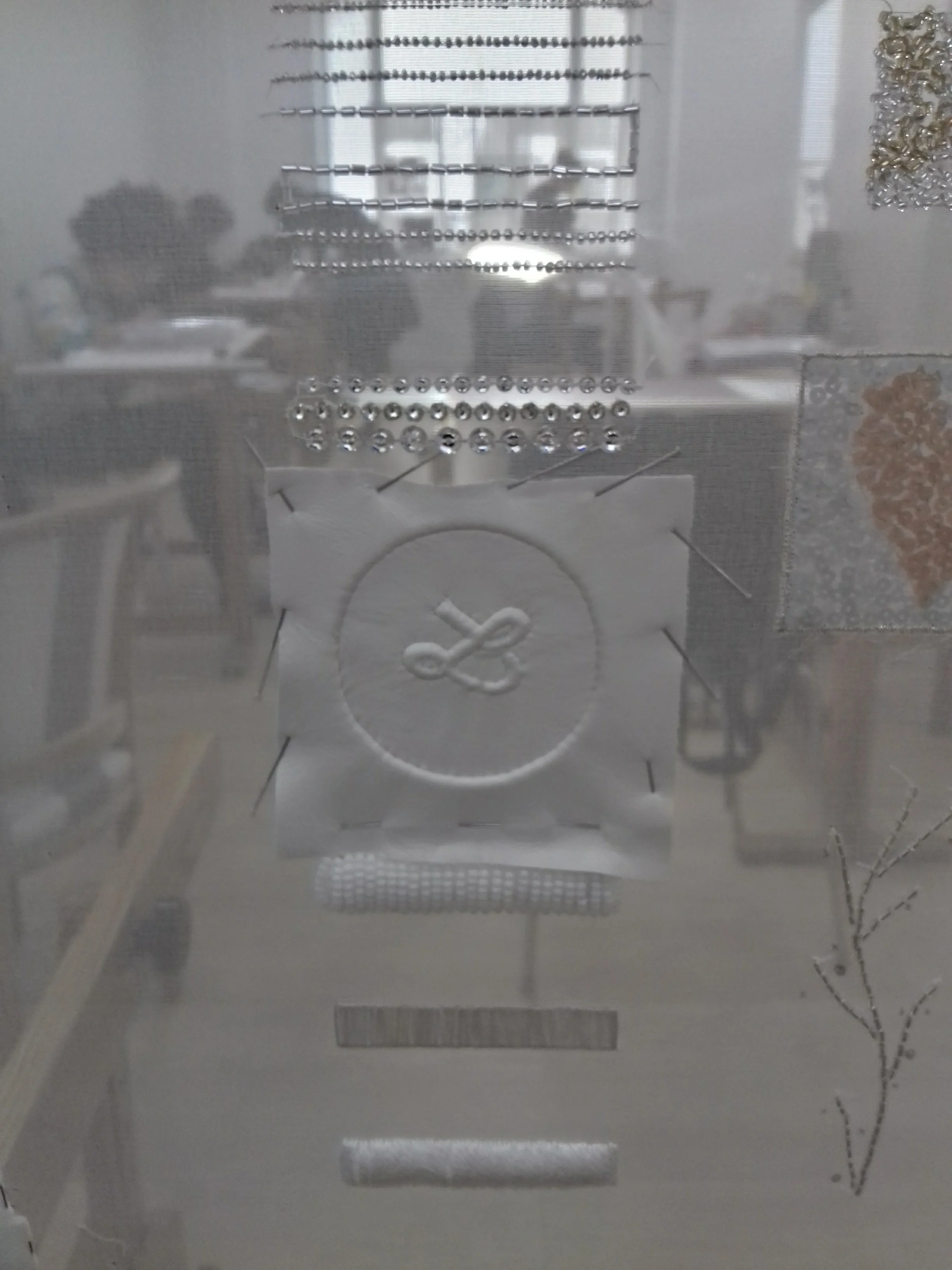
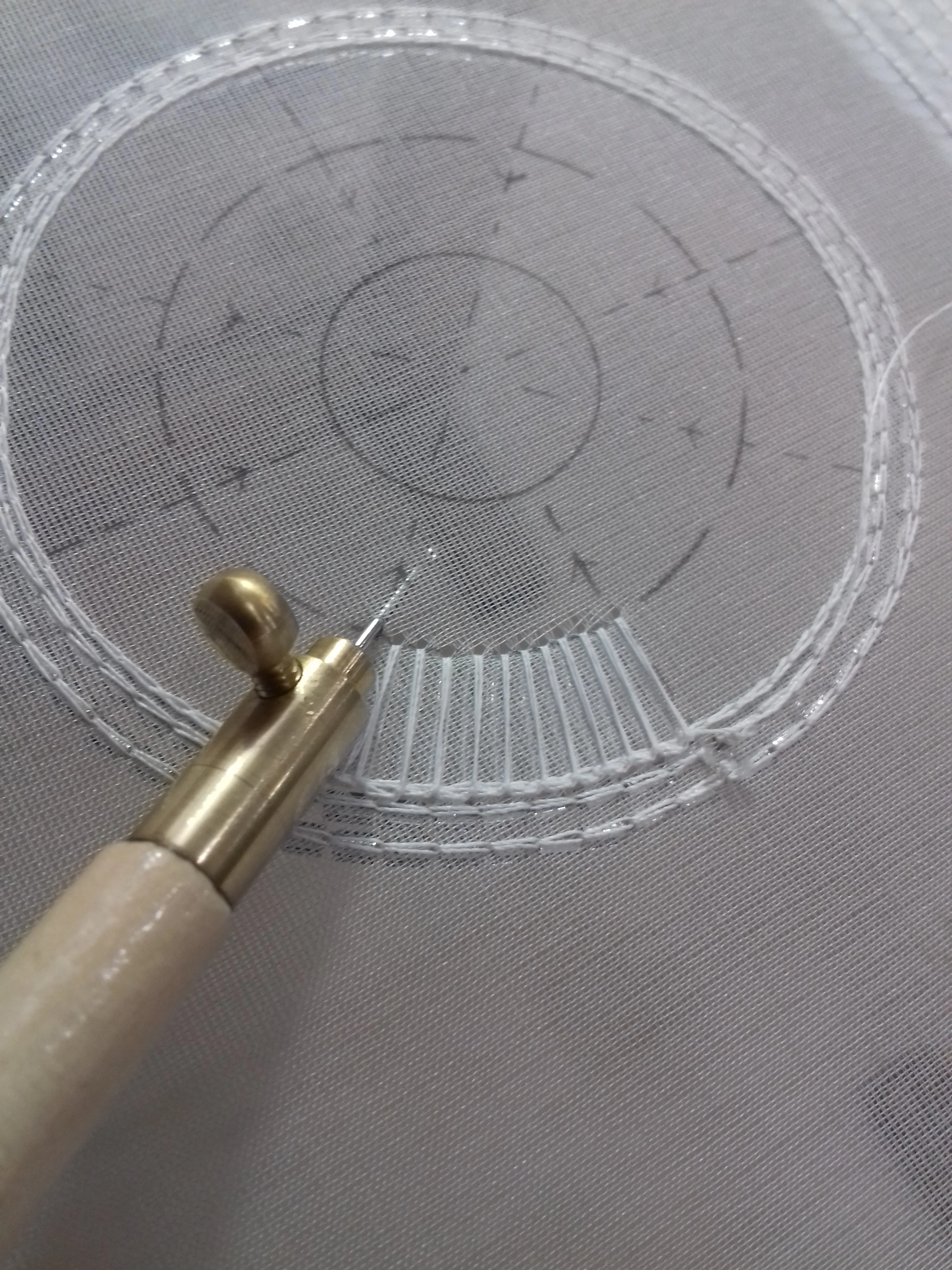
The areas to be in relief are marked by applying tube beads, in this case it was a circular outline and the signature letter of the Lesage logo. White leather as soft as butter was stretched tightly across the surface using pins. I was given a number 70 hook which has a thinner needle or hook than the number 80 I had been using. I was cautioned several times about the sharpness of the needle and how easy it was to accidentally puncture yourself. A chain stitch was traced around the outline of the circle and the letter as well as the negative spaces. In the absolute silence of the atelier I felt like I was making a raucous disturbance each time my hook punctured the leather! Decorative chain stitches were added afterward using gold metallic thread to highlight the letter and draw the tiny needle included in the logo. An outline of transparent tube beads finished the piece.

20171018_111537.jpg
20171018_112204.jpg
20171018_114635.jpg
20171018_121438.jpg
20171020_093704_Richtone(HDR).jpg
20171018_122957.jpg
20171020_094723_Richtone(HDR).jpg
20171018_123047_Richtone(HDR).jpg

Filling Chain Stitch

This is used to fill mainly oval or circular shapes and the chain stitch is started on the outside and then traces the outline to the inside. A tiny point-tiré is used to create a corner in a teardrop motif as you continue towards the inside. Working on the right-side, when the shape is filled you use the stopping stitch and then pull the little thread to the wrong-side using the hook. 

20171020_094653_Richtone(HDR).jpg
20171020_093546_Richtone(HDR).jpg

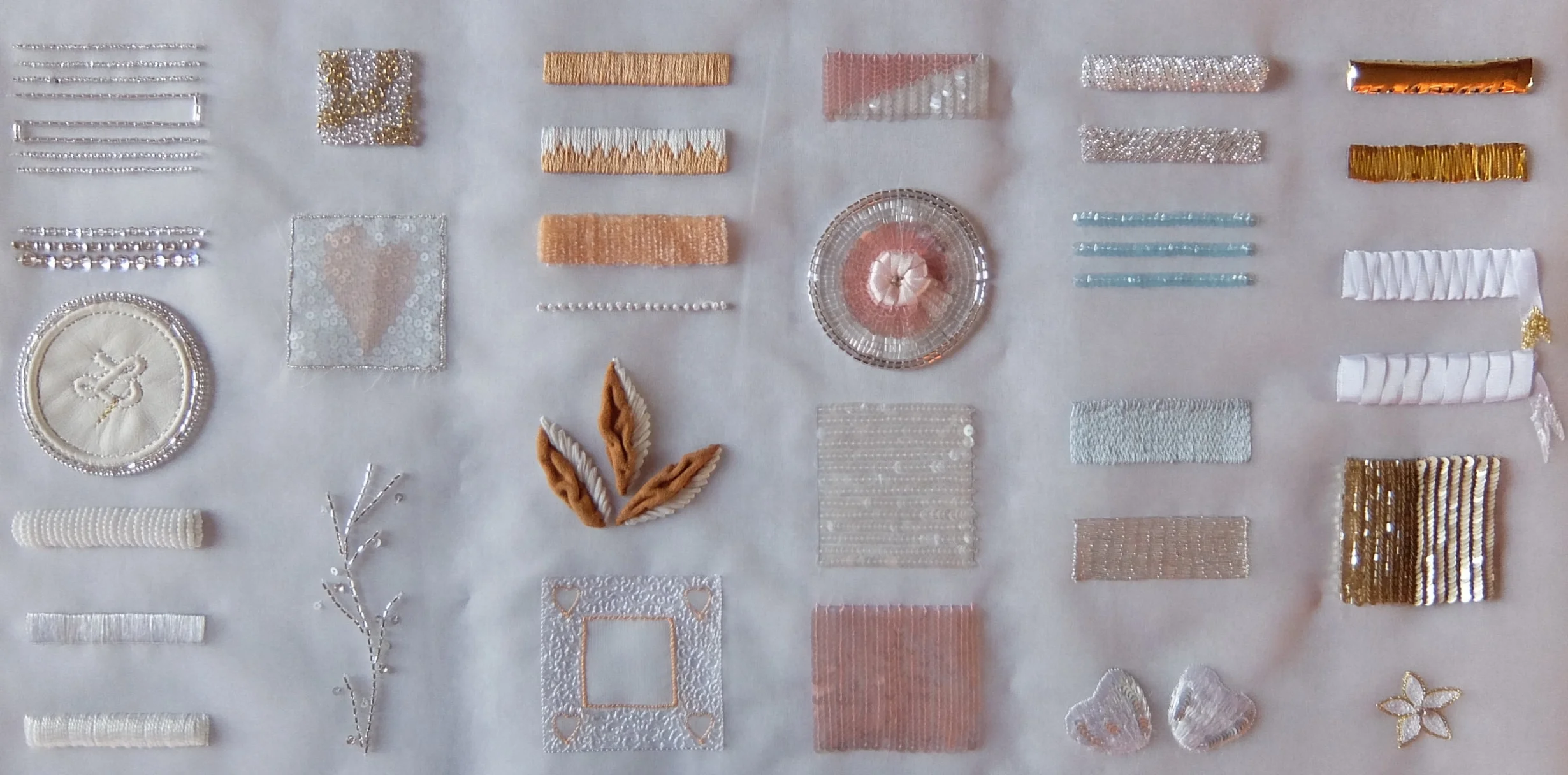
Completed Sampler of Techniques

I had finally finished the sampler of techniques after four weeks of classes and homework! As I gazed lovingly at my work I almost couldn't believe how much I had learned. The teacher brought over a damp tea-towel and an iron on a very low heat and she steamed the sampler from underneath as I was too nervous to do it. She got a jar of gum arabic and spread the mixture onto her hands. Using quick strokes she covered the underneath of the sampler with the paste which gave firmness as well as fixing all the tiny finishing threads.

I was delighted with myself and was so excited to see how the techniques would be applied to the final design... 

RD - Sampler of Tambour Embroidery Techniques .JPG

Textile Tours of Paris

Join Rebecca on a tour of Paris’ charming haberdasheries nestled deep in the winding streets of Le Sentier, the city’s historic textile and fashion district. Enjoy a Sunday morning with Rebecca on a Flea Market Tour as she guides you through the labyrinth alleys of Paris’ oldest marché-aux-puces to uncover hidden treasure troves filled with vintage lace, linen, passementerie, golden threads and gossamer lingerie. To find out more visit Textile Tours of Paris.
Pulling my hair out!

December 3, 2017 Rebecca Devaney
20171218_150236_Richtone(HDR).jpg

This week got off to a shaky start with the point-tiré but improved with learning how to add straight and diagonal rows of beads on flat and relief surfaces, creating corners and confluent lines with beads, applying jewels and french knots...

Point-tiré

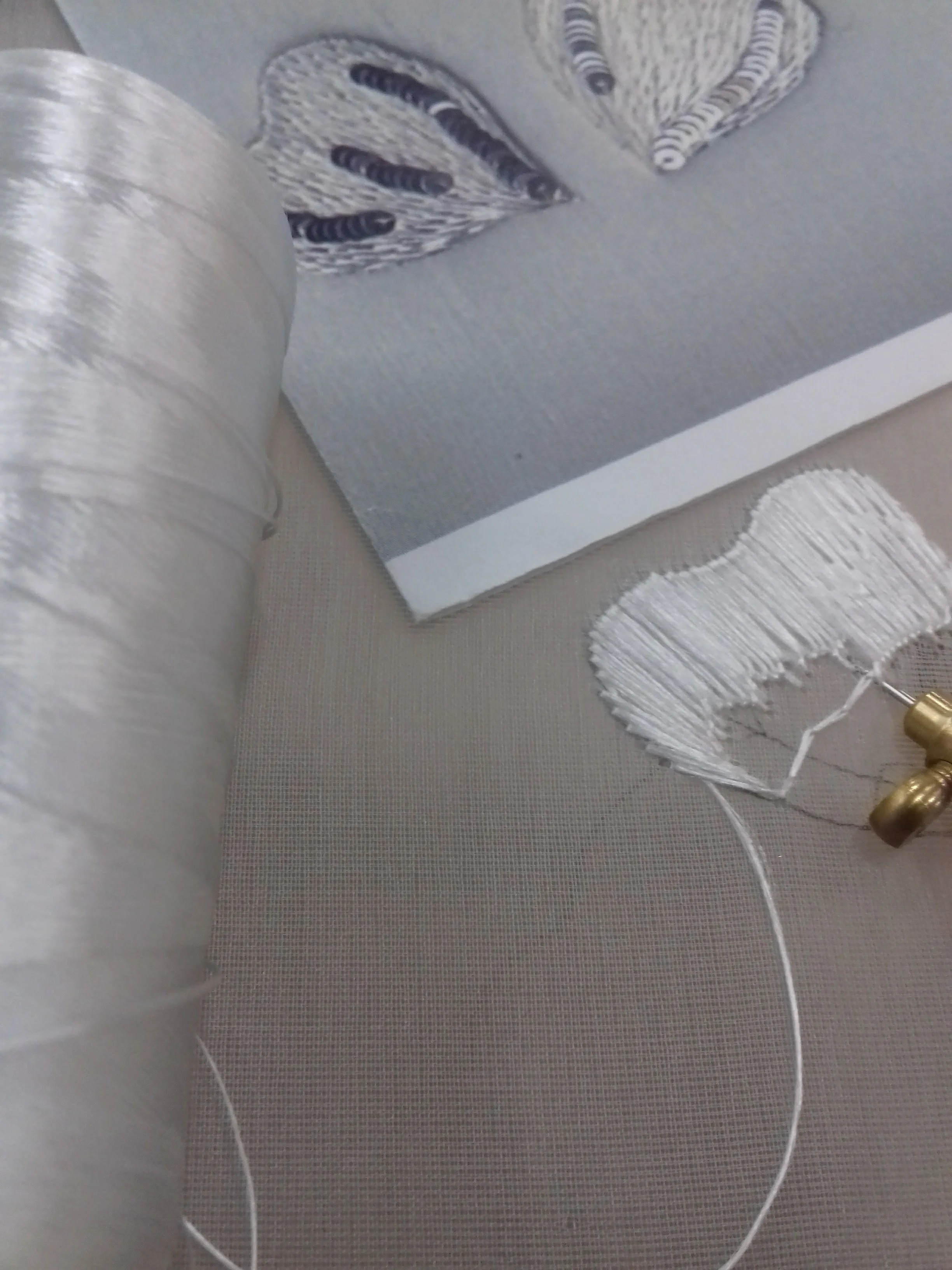
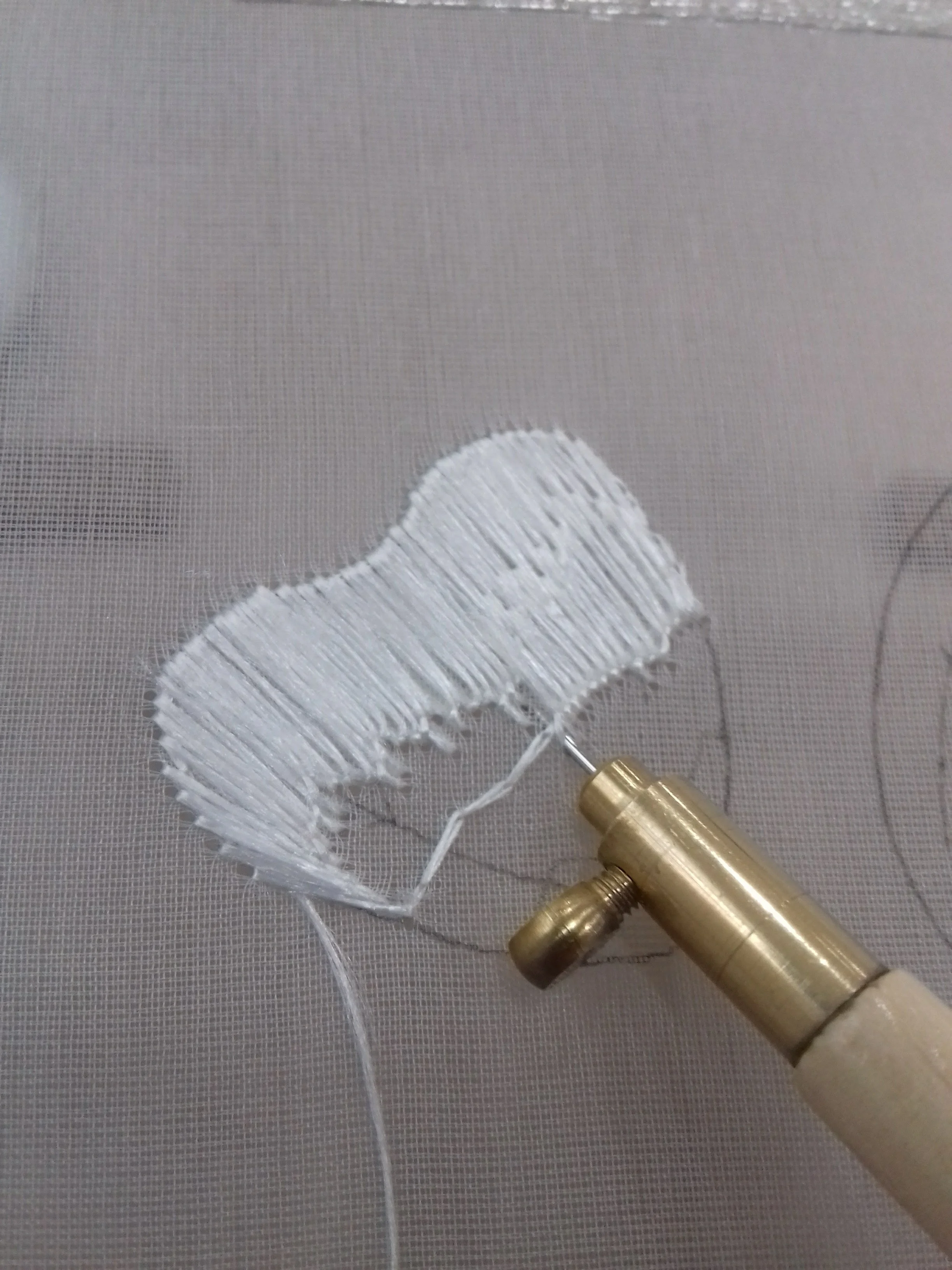
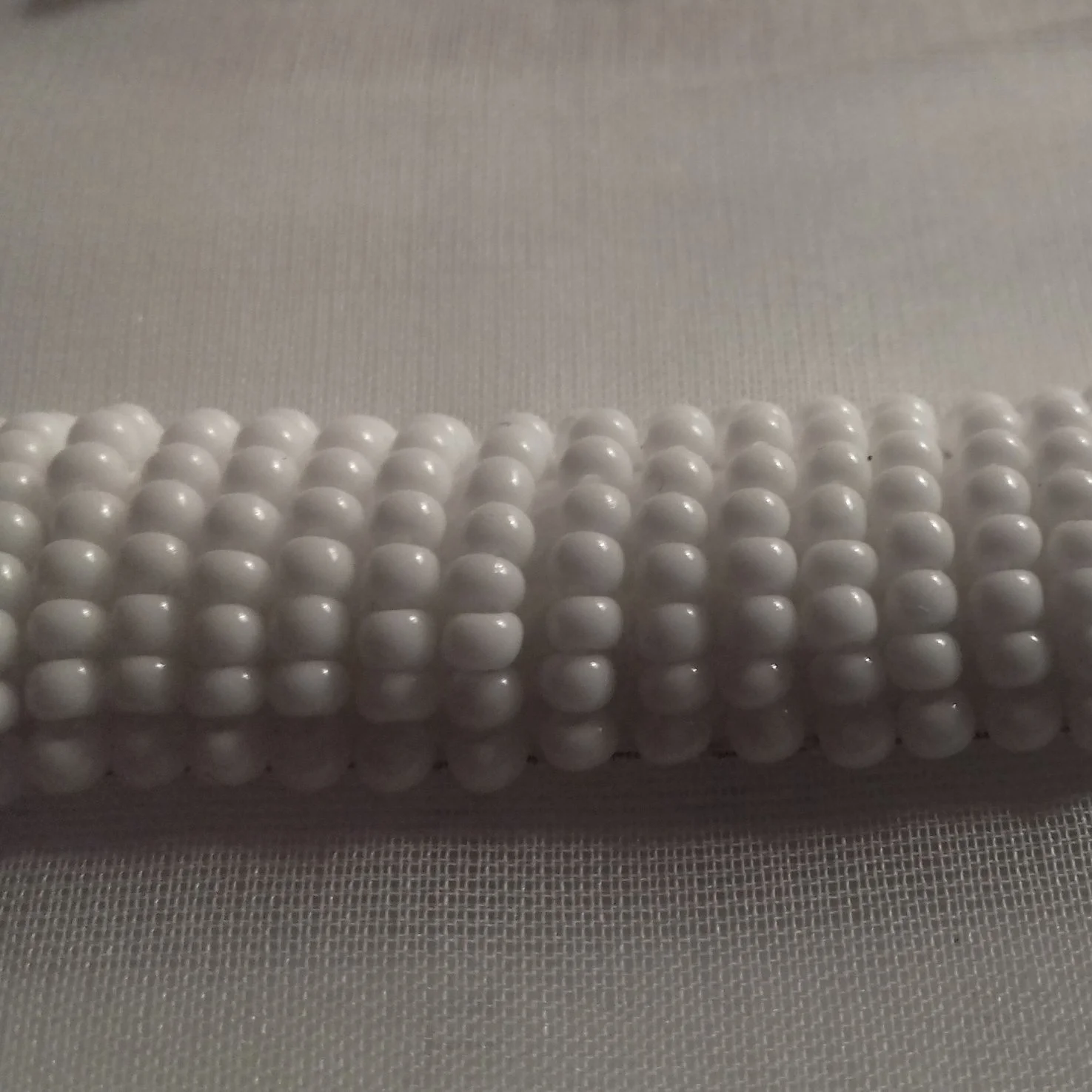
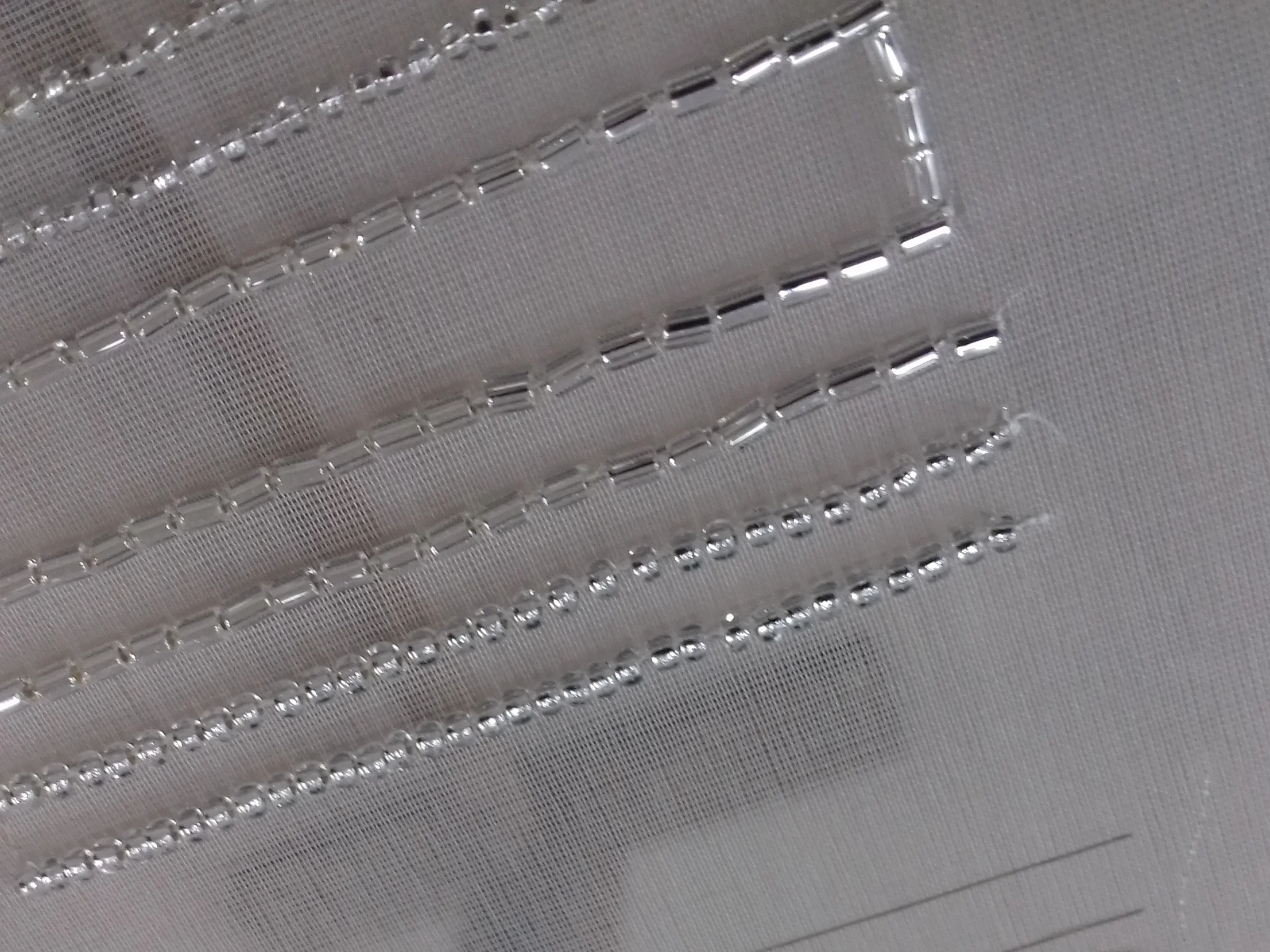
The Point-tiré or pulling stitch can be used to apply several beads at a time in straight or diagonal rows as the tension created by pulling the thread keeps the beads flat. Once you count the number of beads that can be added without forming a bridge, it is relatively easy. It is also used to add beads onto a padded surface...

View fullsize Sampler64.jpg
View fullsize Sampler67.jpg
Point-tire

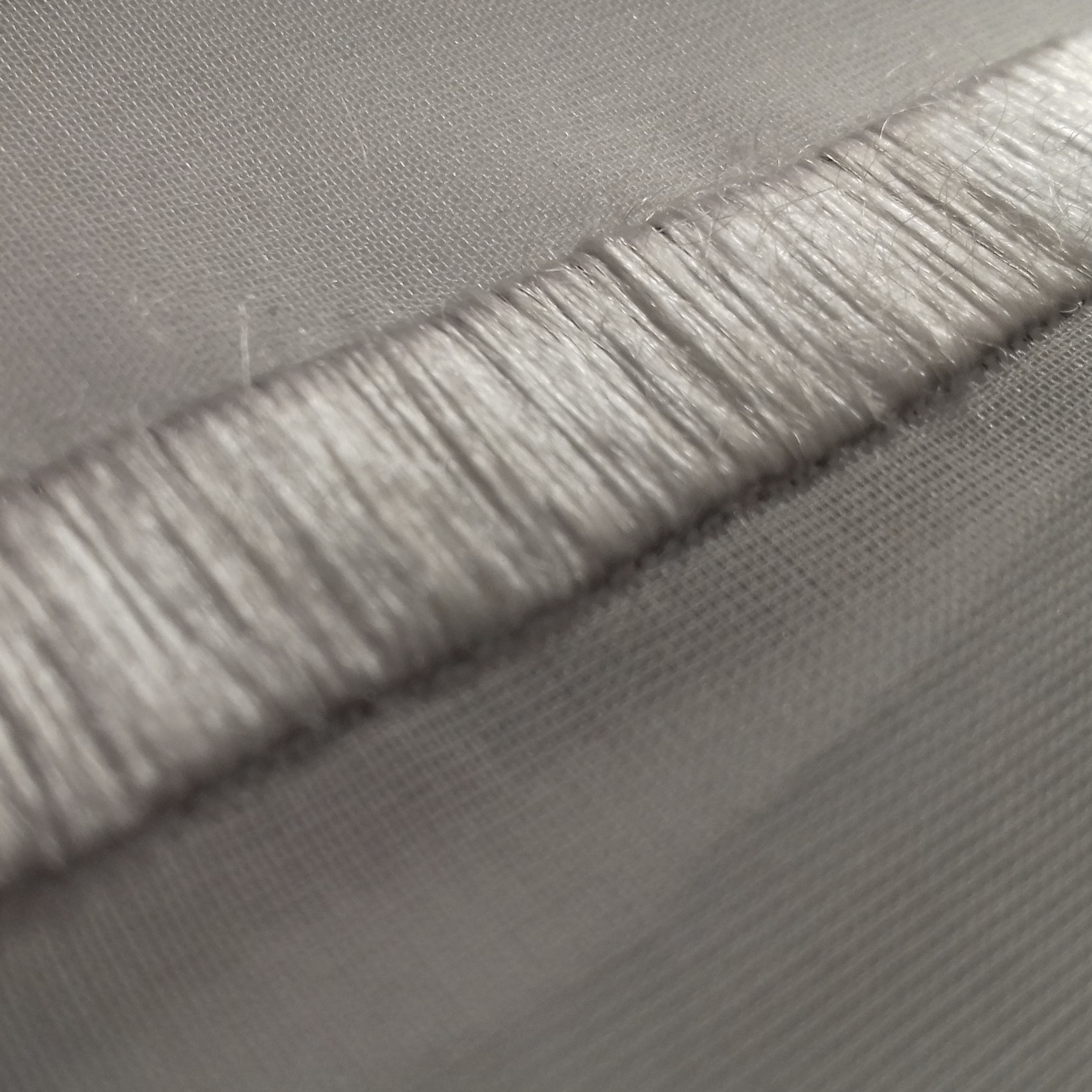
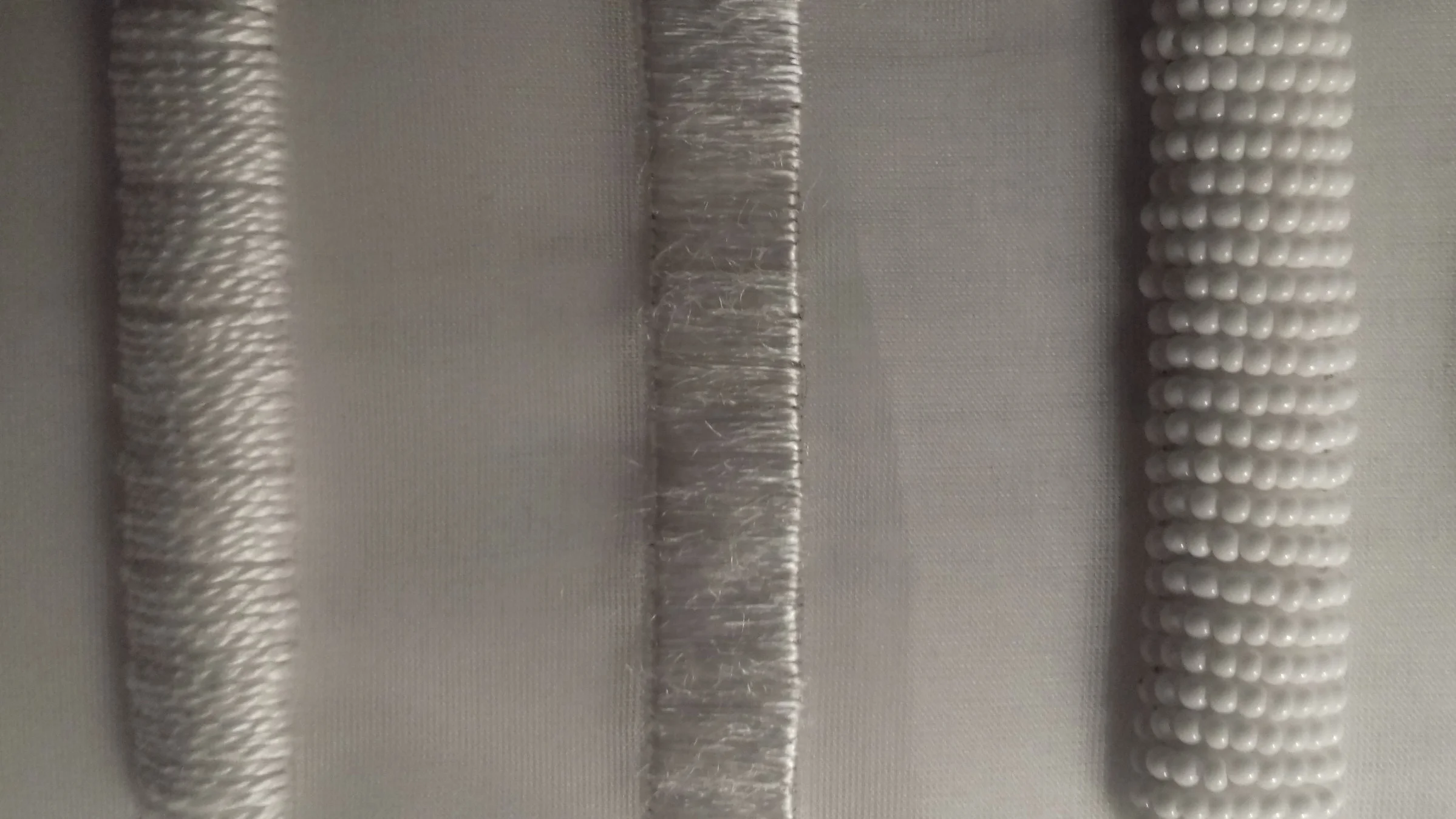
It is used as a decorative filling stitch with silk or rayon silk threads to create a beautiful flat surface with lustre. This is much trickier than expected as the silk thread is made of minuscule filaments that are twisted together but if they catch or unravel with the hook they separate into tiny fly-away hairs that can become nests of angry knots. To avoid this you can gently stroke and gather the thread with your hand between each stitch and ensure that the entire thread is caught in the hook. The impossible part comes when you turn the hook to bring it to the surface and the thread slips out, catches under the fabric, unravels into a dense knot and the hook returns empty. The frustration of these knots and the vain attempts to resolve them, the repeated stroking and brushing of the thread to avoid them and the act of pulling the tension on the rare successful stitch all combine to make your hands sweat. The initially shining, lustrous silk thread becomes a damp, frayed and limp string and you feel like pulling your own hair out! 

View fullsize 20171203_082500.jpg
View fullsize 20171203_082452.jpg
View fullsize 20171203_082318_Richtone(HDR).jpg
20171203_082547.jpg

Corners and Confluences with Beads

Sketches11.jpg

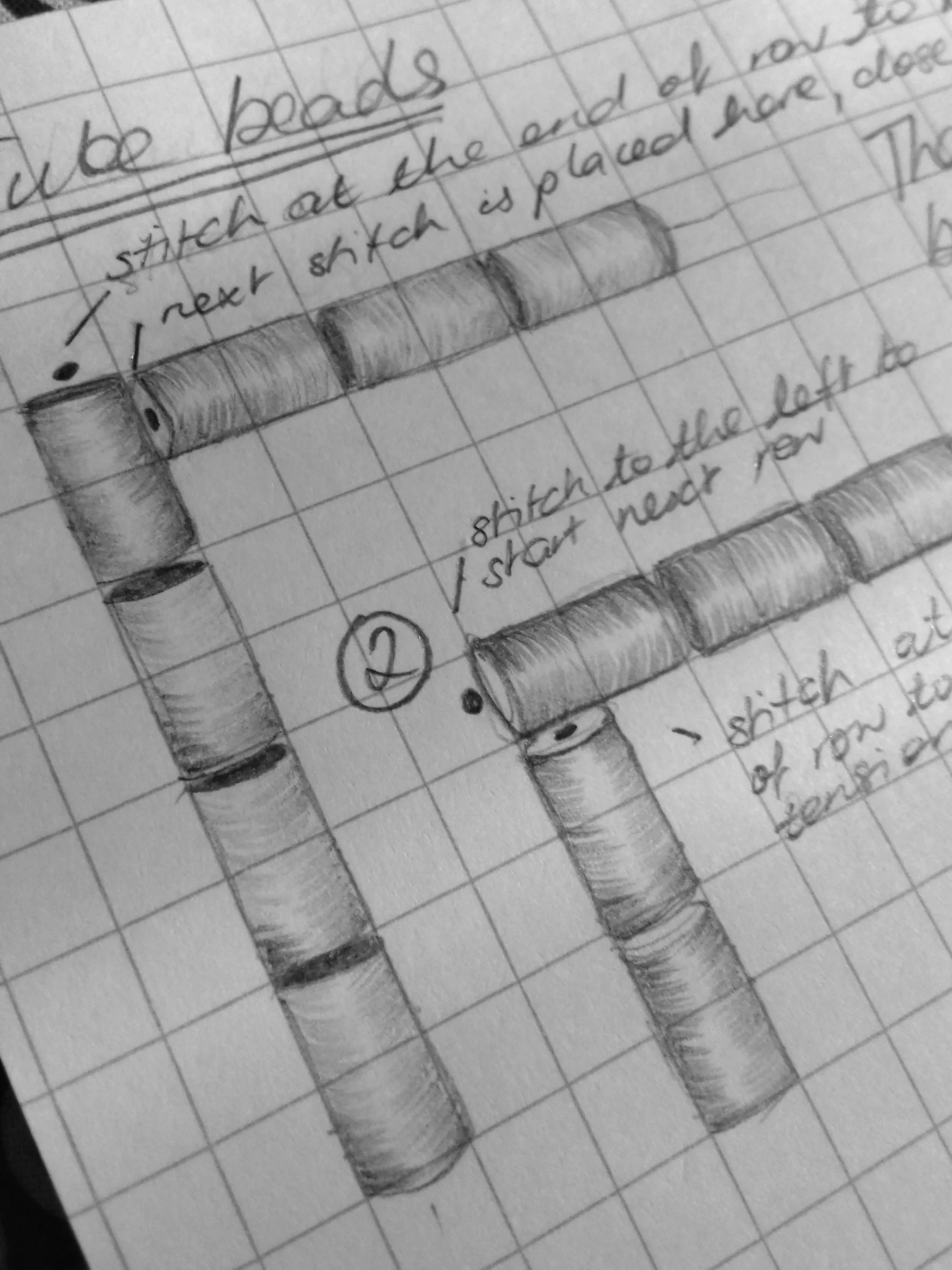
When creating a corner or a confluence with beads it is necessary to block the tension on the row you are finishing with a tiny stitch. This helps to keep the beads in place and the row straight.

Depending on where the first bead of the perpendicular row will be placed, you do the next stitch along the middle of the last bead or outside the last row. This stitch is very important as it will determine whether the corner is exactly perpendicular, which it must be. 

When doing a confluent row of beads, you begin at the adjoining row. The starting stitch must be right beside the chain stitch of the row you are going and this will avoid any gaps in the merging rows. But you must be careful not to go too close as this can push the first row of beads out of line.

View fullsize Sampler70.jpg
View fullsize 20171203_082601.jpg
View fullsize Sampler42.jpg
View fullsize 20171203_082658.jpg

Adding Jewels

Jewels can be added in two different ways depending on how they are made. The first is À la Puce or from the flea and it is used when the jewel has one hole in the centre. Surprisingly, the hook is used to stitch the jewels into a tight chain stitch, leaving a 5mm space between each one.

Jewels with a claw fixture have two tunnels forming a cross beneath the surface and the needle is used to stitch them in place securely.


View fullsize 20171203_082628.jpg

Textile Tours of Paris

Join Rebecca on a tour of Paris’ charming haberdasheries nestled deep in the winding streets of Le Sentier, the city’s historic textile and fashion district. Enjoy a Sunday morning with Rebecca on a Flea Market Tour as she guides you through the labyrinth alleys of Paris’ oldest marché-aux-puces to uncover hidden treasure troves filled with vintage lace, linen, passementerie, golden threads and gossamer lingerie. To find out more visit Textile Tours of Paris.
Bibliothèque Forney

December 3, 2017 Rebecca Devaney
20171012_180611_Richtone(HDR).jpg

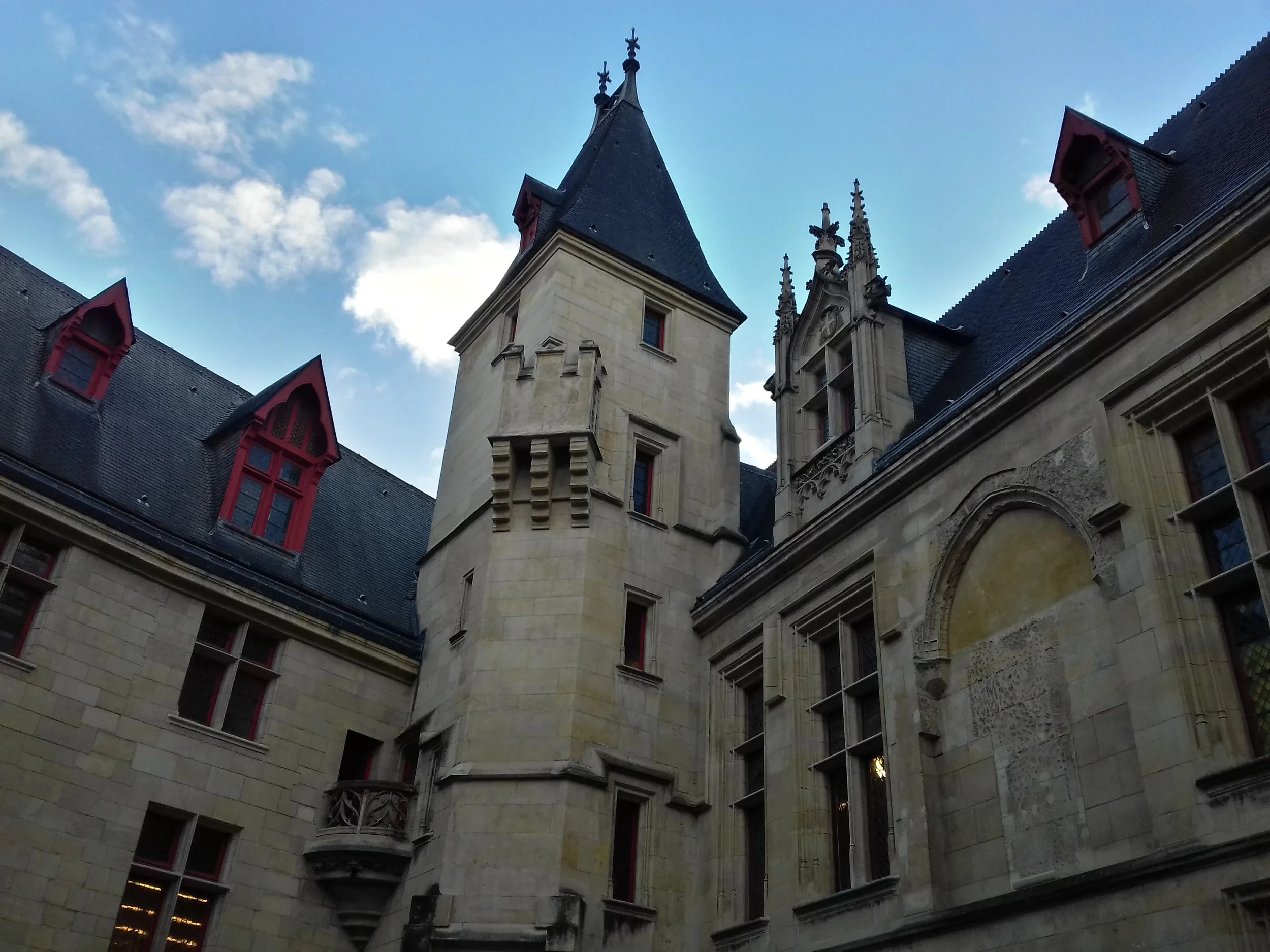
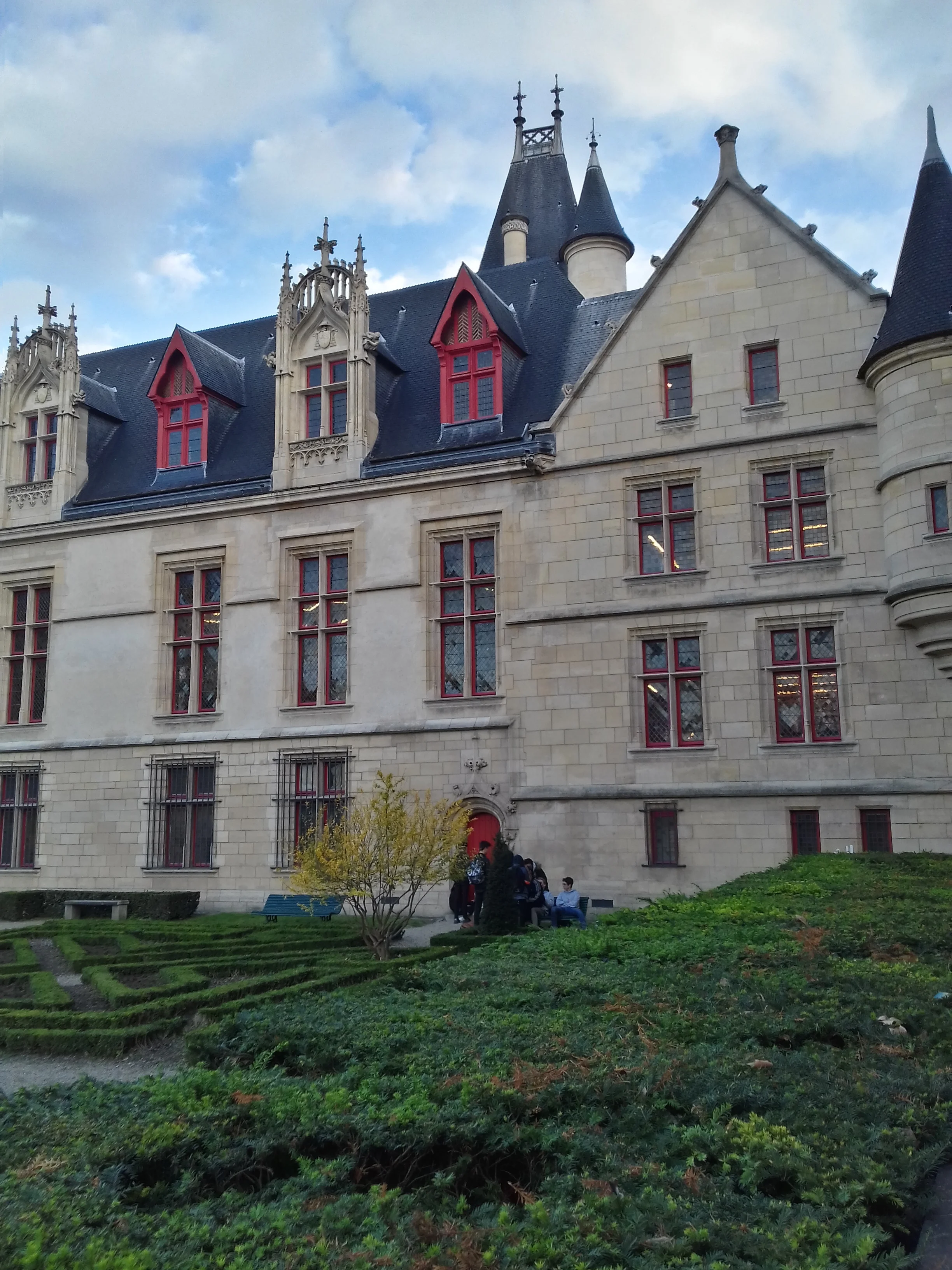
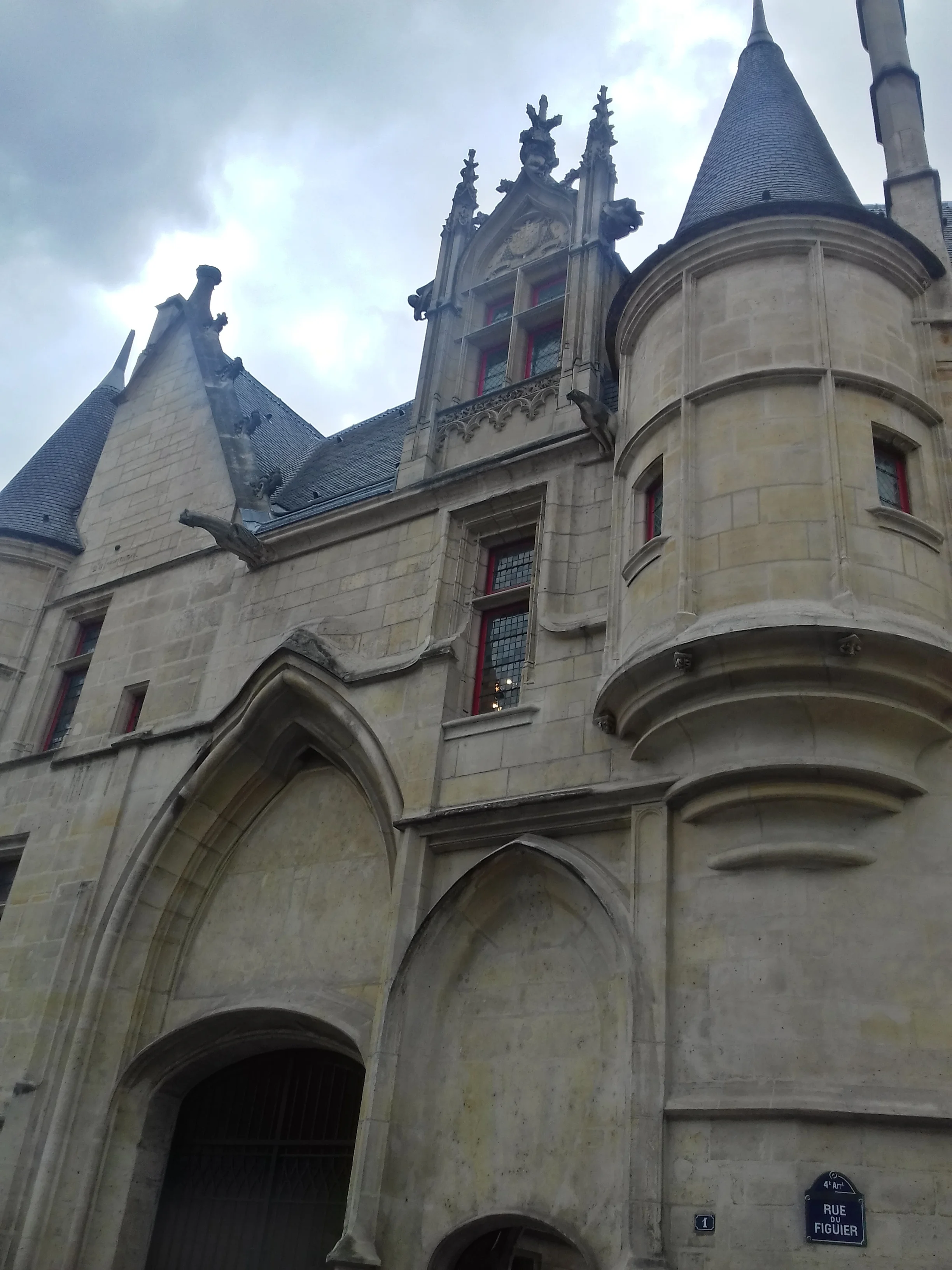
The Bibliothèque Forney is housed in the refurbished mansion Hotel de Sens, a magnificent example of Medieval architecture originally constructed in 1478. It is home to a collection of over 23,000 books that are dedicated to the education of craftspeople, designers and artists in Paris. 

20171012_180829_Richtone(HDR).jpg
20171010_164647_Richtone(HDR).jpg

I entered the courtyard through the old iron gates and climbed the wide stone staircase to find the reception where I was given a guided tour by a friendly member of staff. We walked past shelves stacked with books on decorative arts, the art and craft professions and their techniques, fine arts and graphic arts, as well as fashion, advertising and design. I explained my area of interest and the librarian brought me to the section filled with books on embroidery, lace, and costume. I was in heaven but the tour wasn't over. In a long medieval hall lit by mullioned windows, oversized volumes lined the shelves along the walls. People sat with their heads bent at the large tables, reading, writing, typing, sketching and daydreaming. Under the watchful eye of the little gargoyles set between the banisters, we tip-toed up another stone staircase to a mezzanine area for magazines and journals specialising in decorative and fine arts.

DSCF5603.JPG

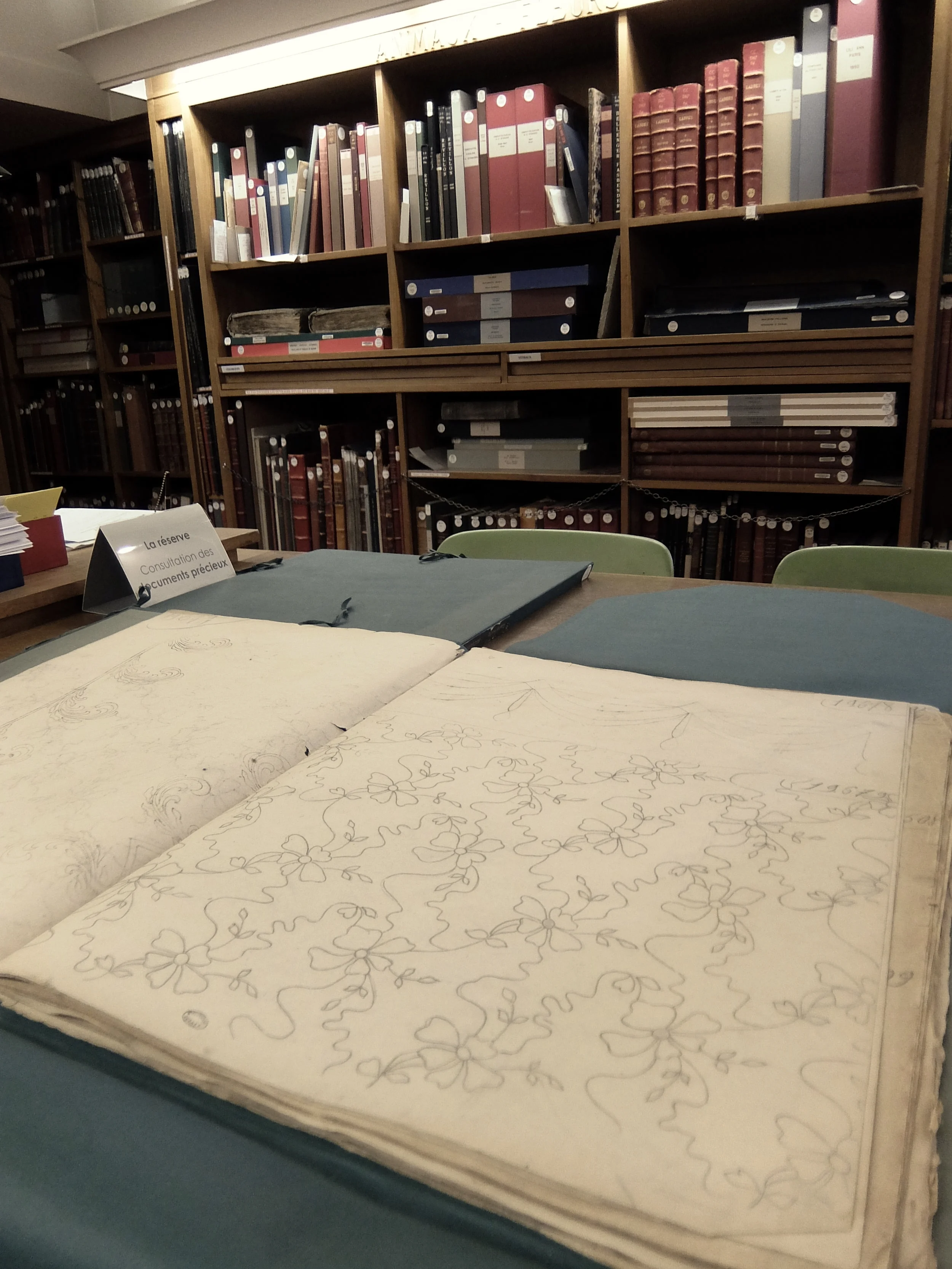
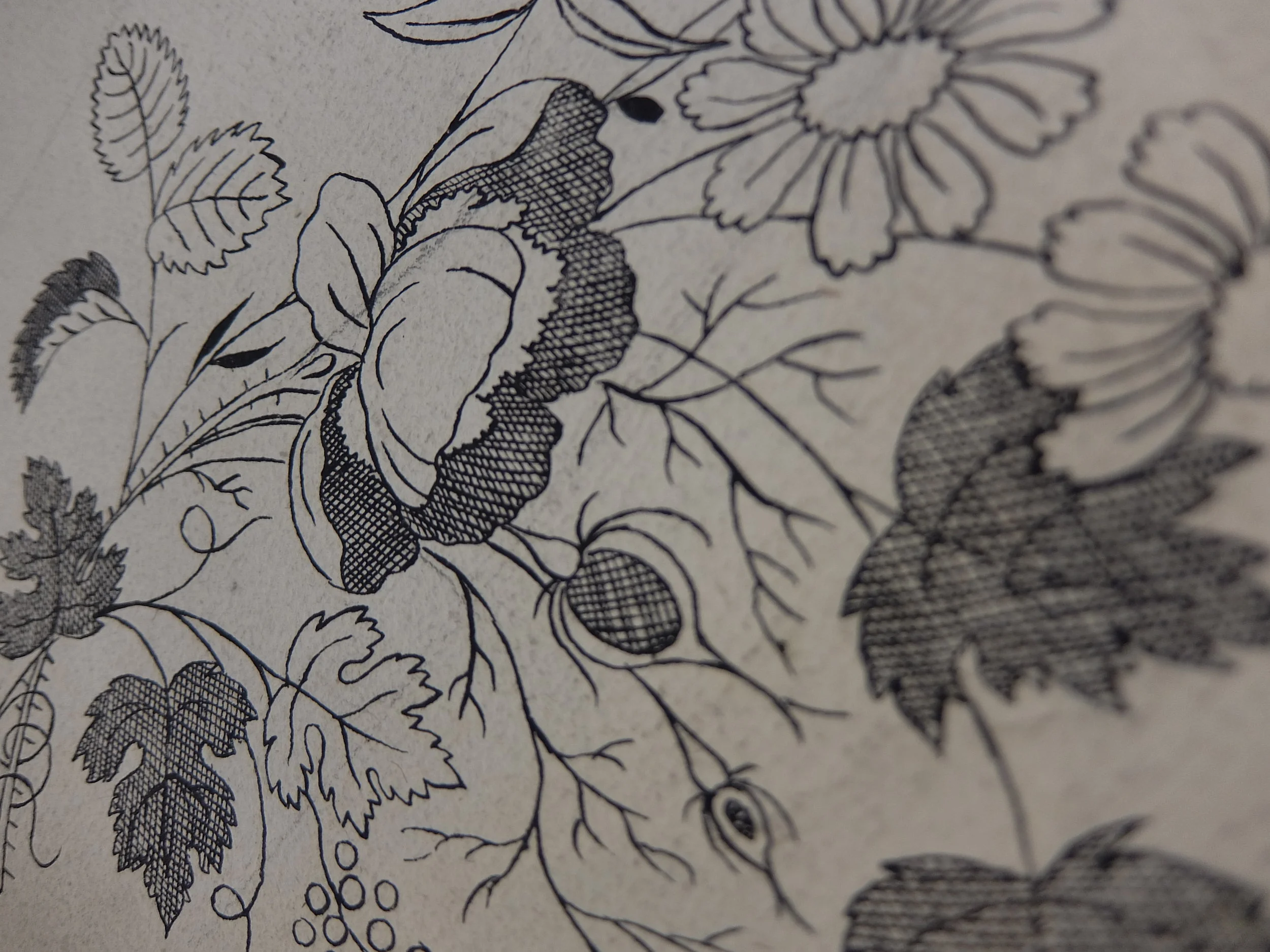
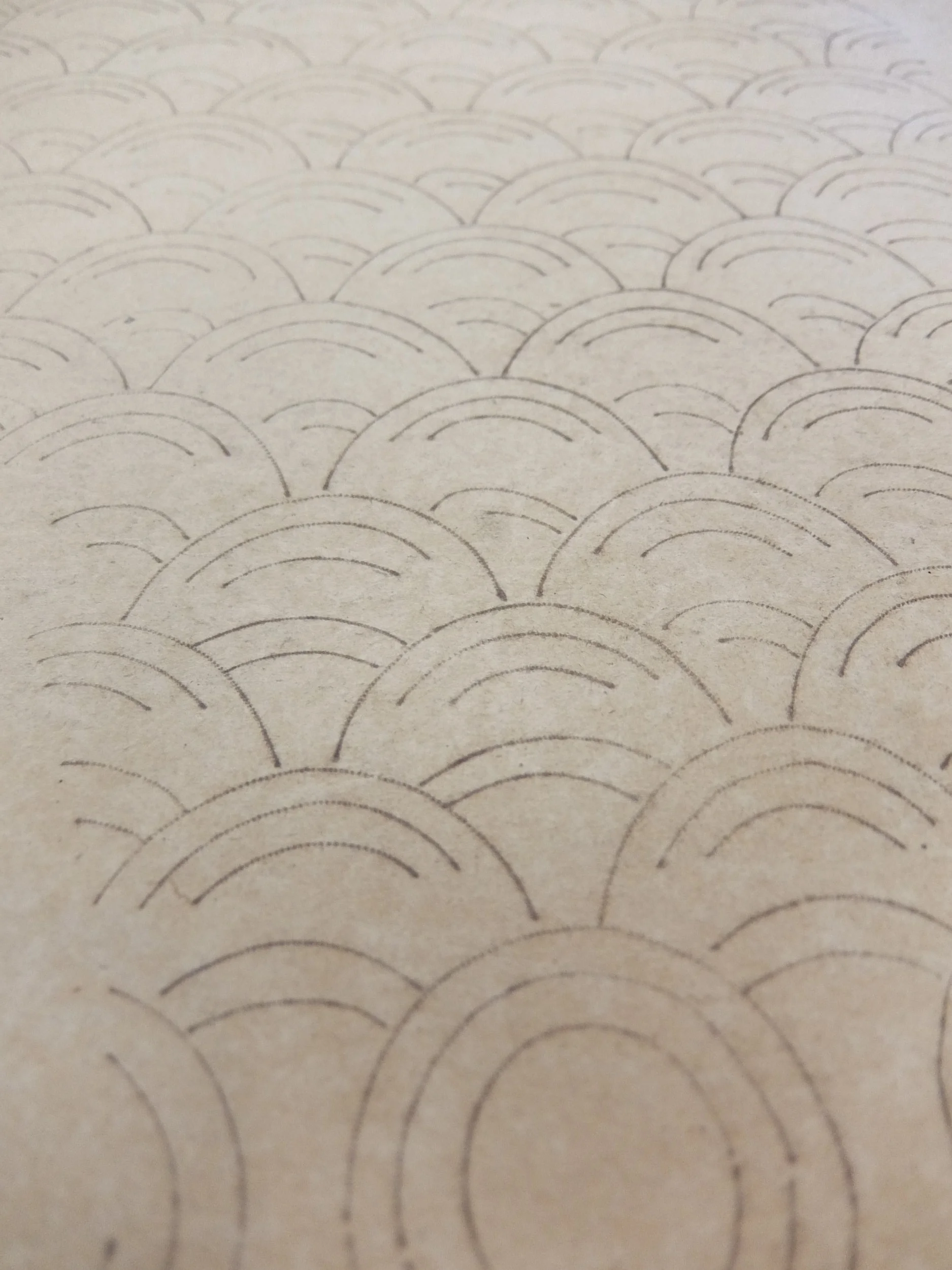
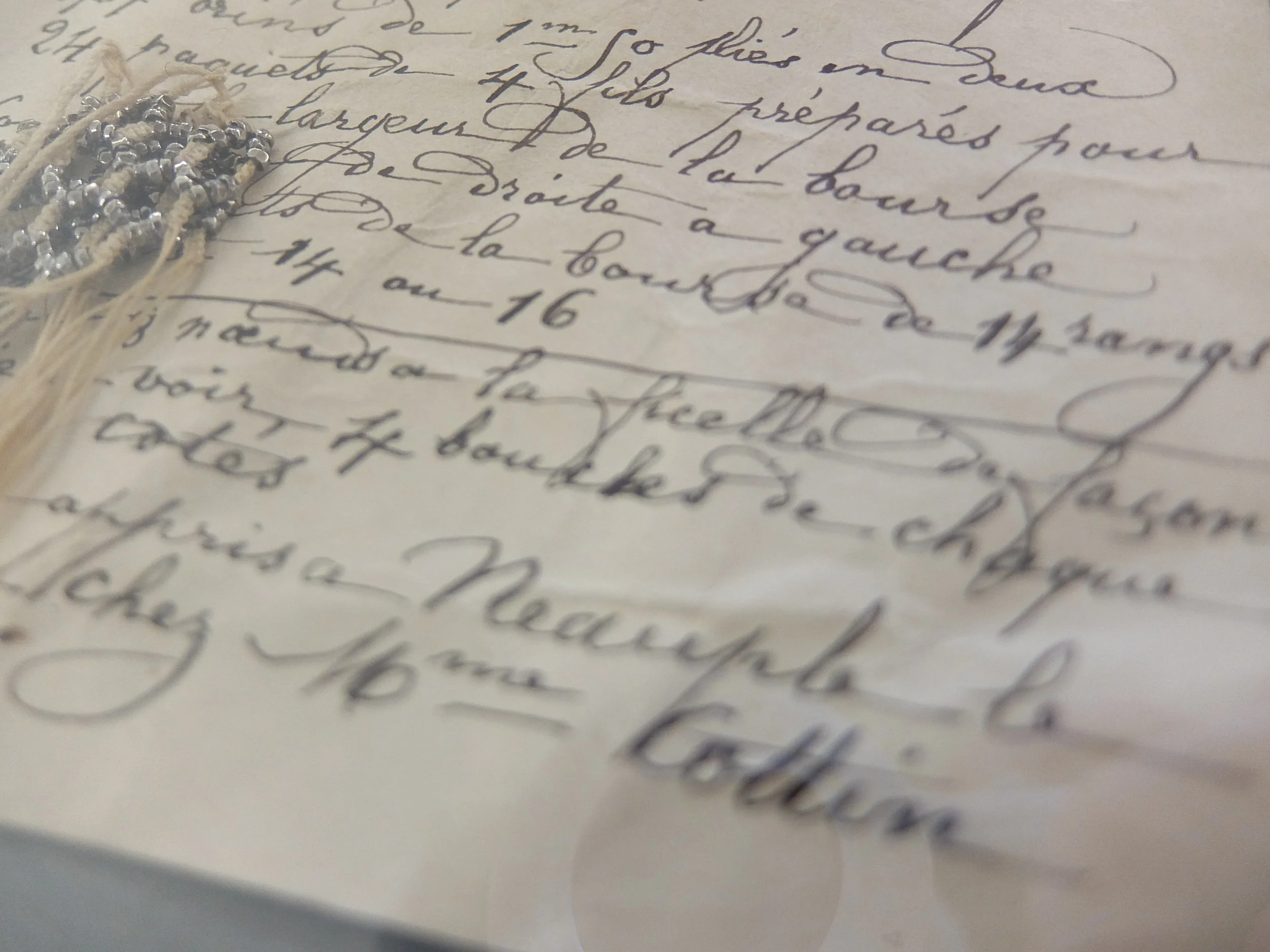
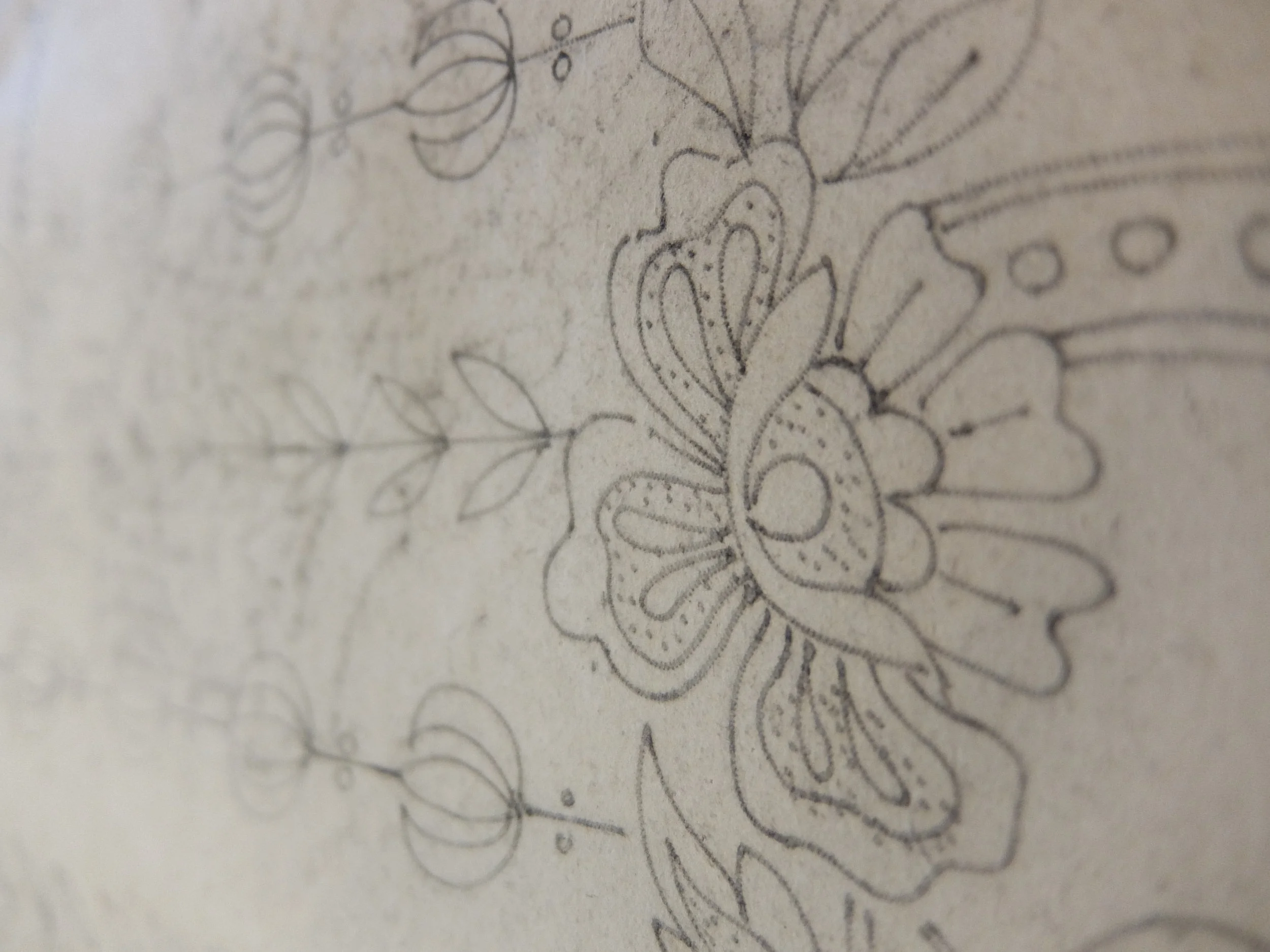
A steep and narrow spiral stairwell led us huffing and puffing to the top floor to find the archive section. There are thousands of exhibition catalogues, magazines, rare books, fashion catalogues and plates, posters, postcards and even menus from the 19th century. It also has a remarkable collection of 9,000 samples of wallpaper, printed textiles, lace, embroidery and original designs from the 18th and 19th centuries. These were donated by the Parisienne craftspeople who used the library including the Rusterholtz embroidery atelier...


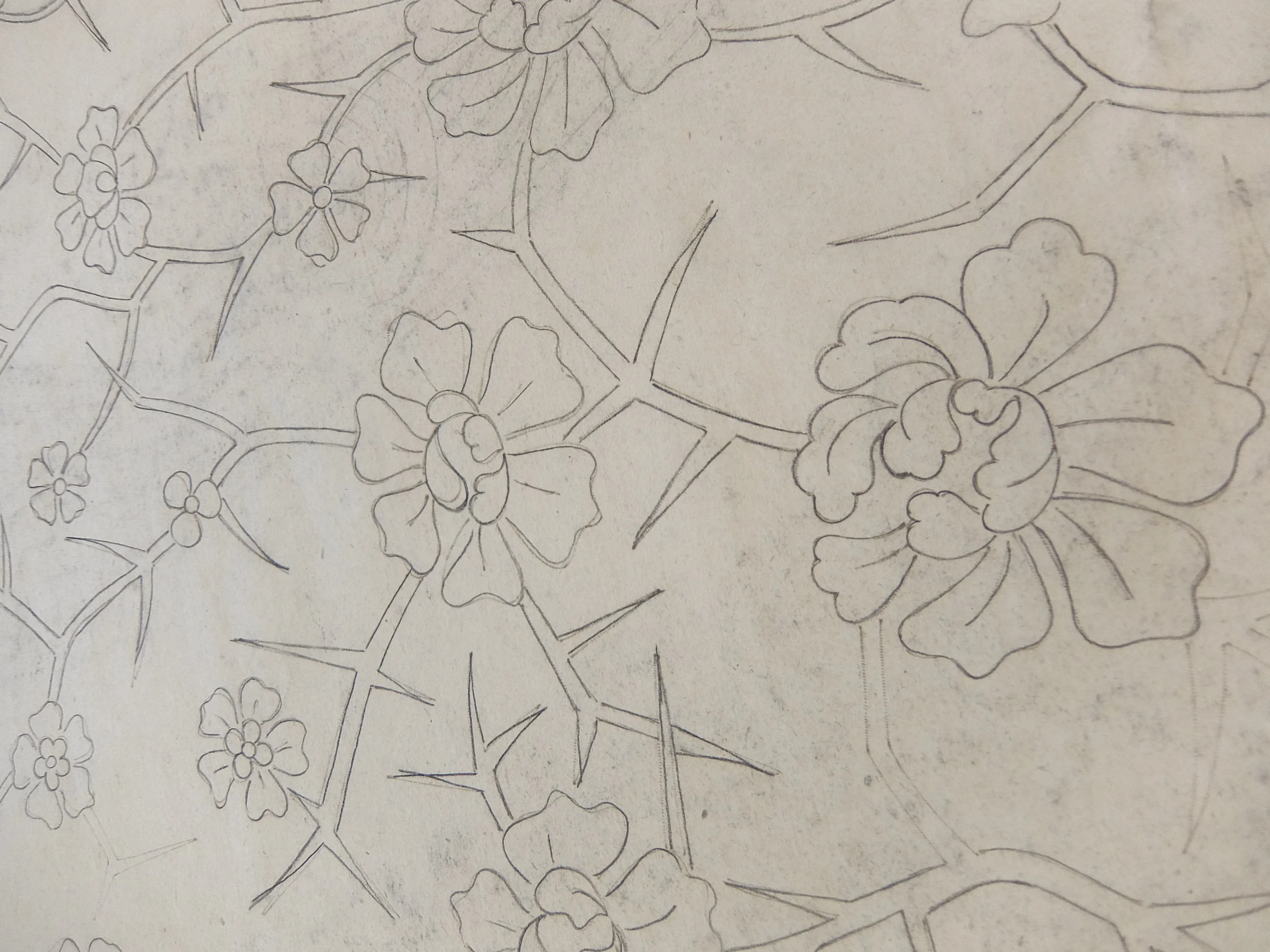
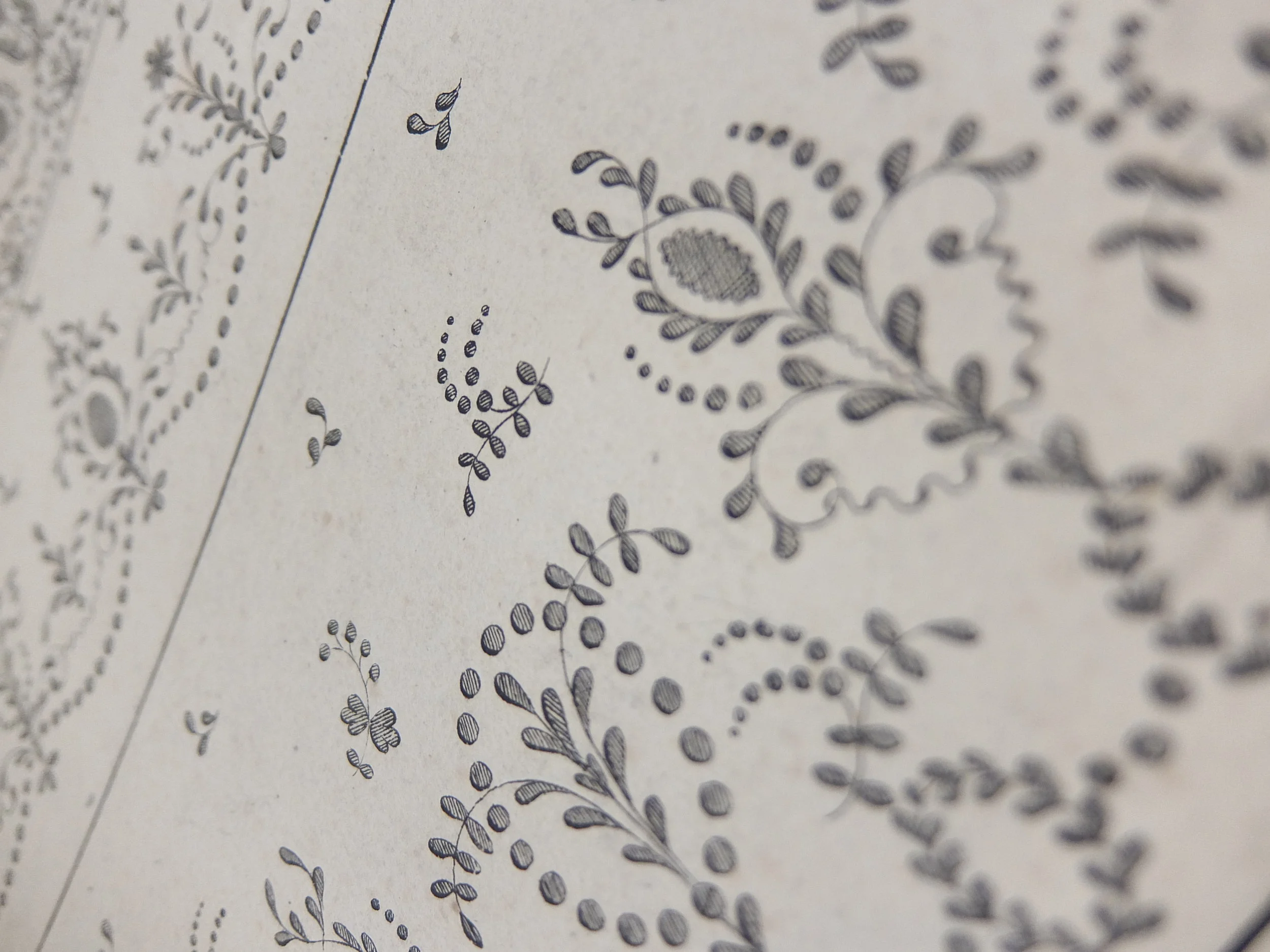
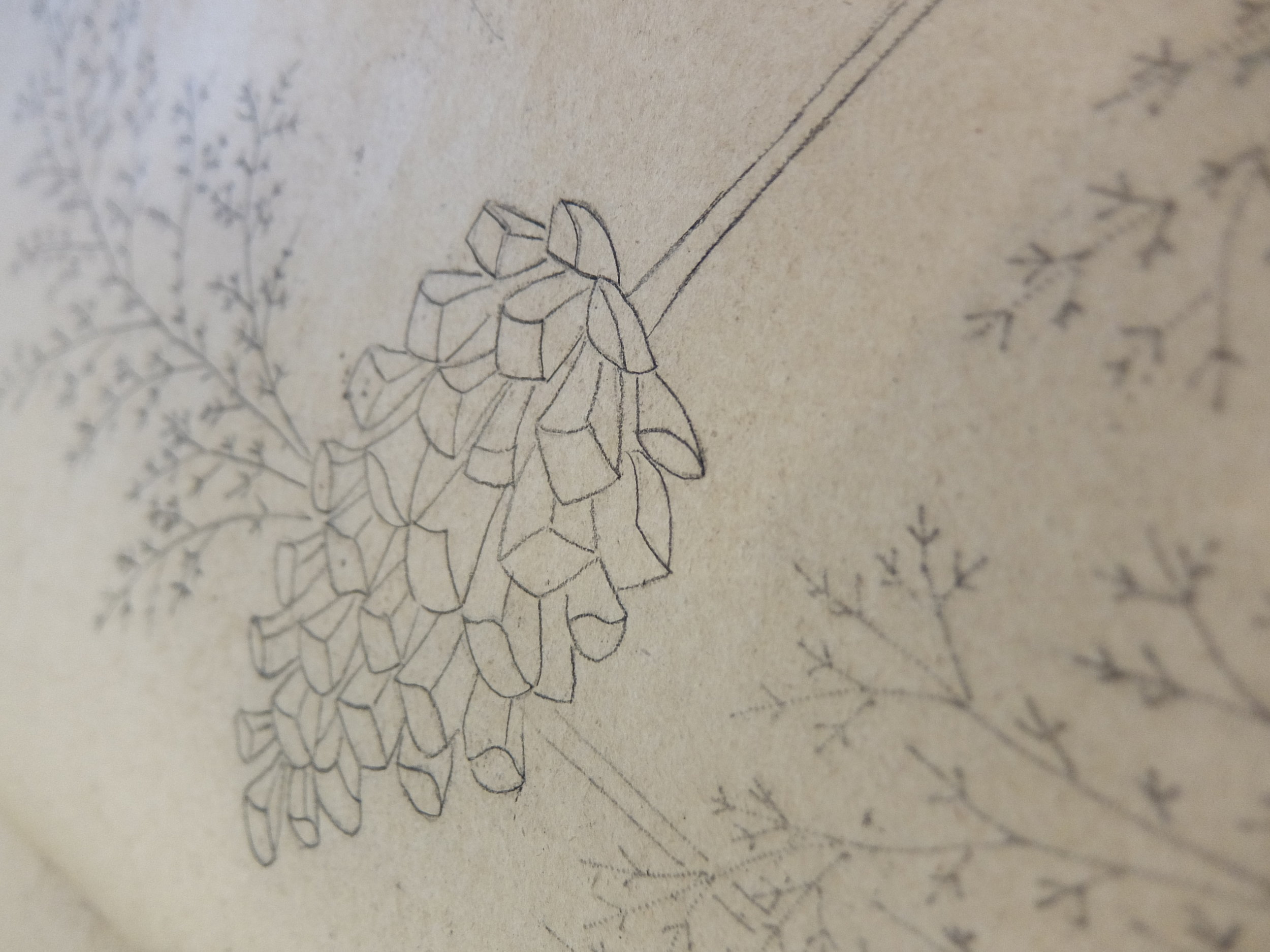
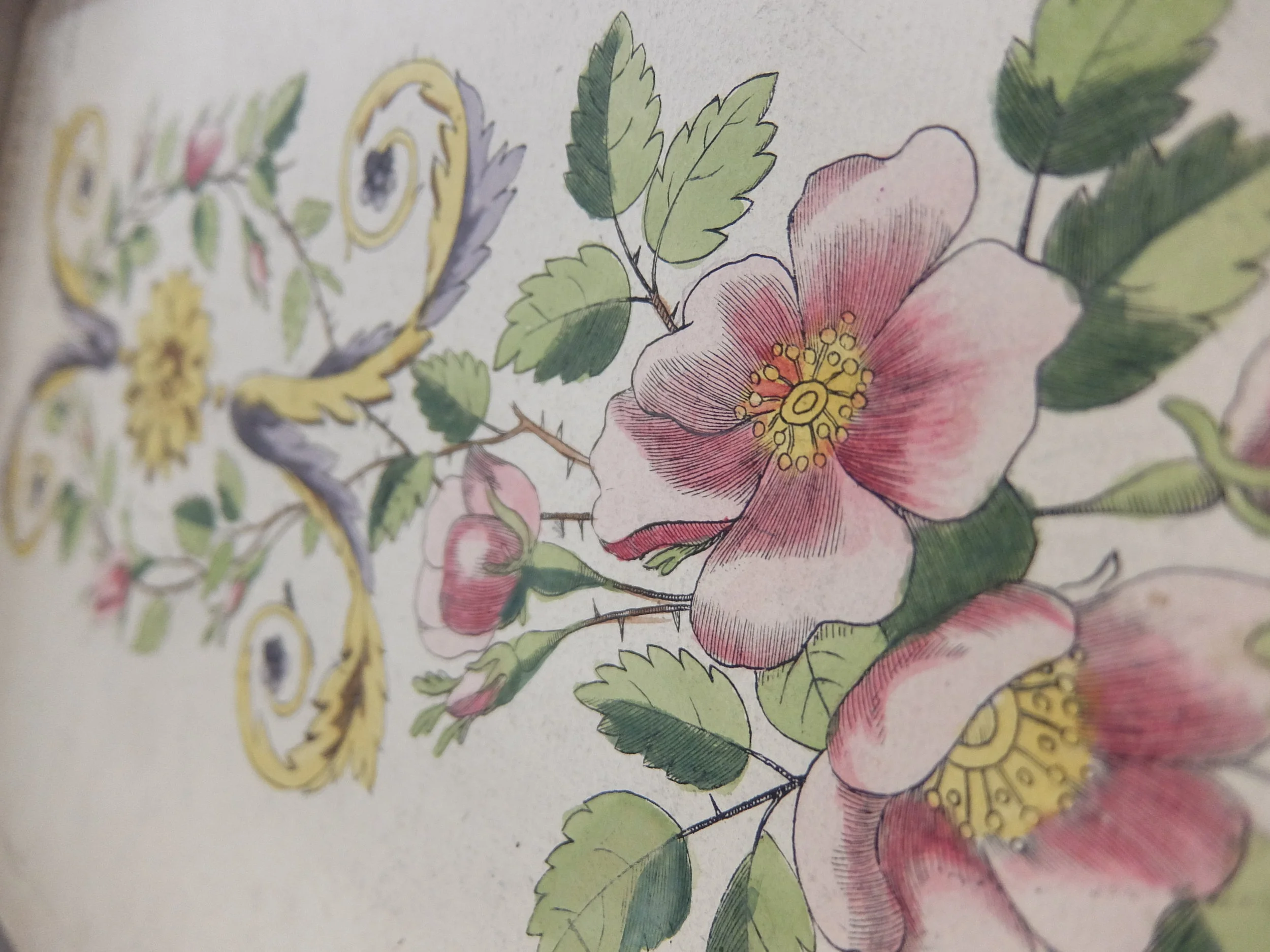
Embroidery designs from the Rusterholtz Atelier 

View fullsize DSCF5553.JPG
View fullsize DSCF5588.JPG
View fullsize DSCF5548.JPG
View fullsize DSCF5573.JPG
View fullsize DSCF5560.JPG
View fullsize DSCF5551.JPG
View fullsize DSCF5592.JPG
View fullsize DSCF5554.JPG
DSCF5627.JPG
DSCF5605.JPG
DSCF5619.JPG
DSCF5622.JPG
DSCF5620.JPG
DSCF5624.JPG

Needless to say, I filled out my membership form and was thrilled to hear that I could take out up to eight books for three weeks at a time. I found a spot between the shelves and began to research the history, techniques and designs of haute couture embroidery

20171005_153136.jpg

Textile Tours of Paris

Join Rebecca on a tour of Paris’ charming haberdasheries nestled deep in the winding streets of Le Sentier, the city’s historic textile and fashion district. Enjoy a Sunday morning with Rebecca on a Flea Market Tour as she guides you through the labyrinth alleys of Paris’ oldest marché-aux-puces to uncover hidden treasure troves filled with vintage lace, linen, passementerie, golden threads and gossamer lingerie. To find out more visit Textile Tours of Paris.
Sequinsational

November 26, 2017 Rebecca Devaney
Detail of Elsa Schiaparelli bolero embroidered by Maison Lesage, circa 1948

Detail of Elsa Schiaparelli bolero embroidered by Maison Lesage, circa 1948

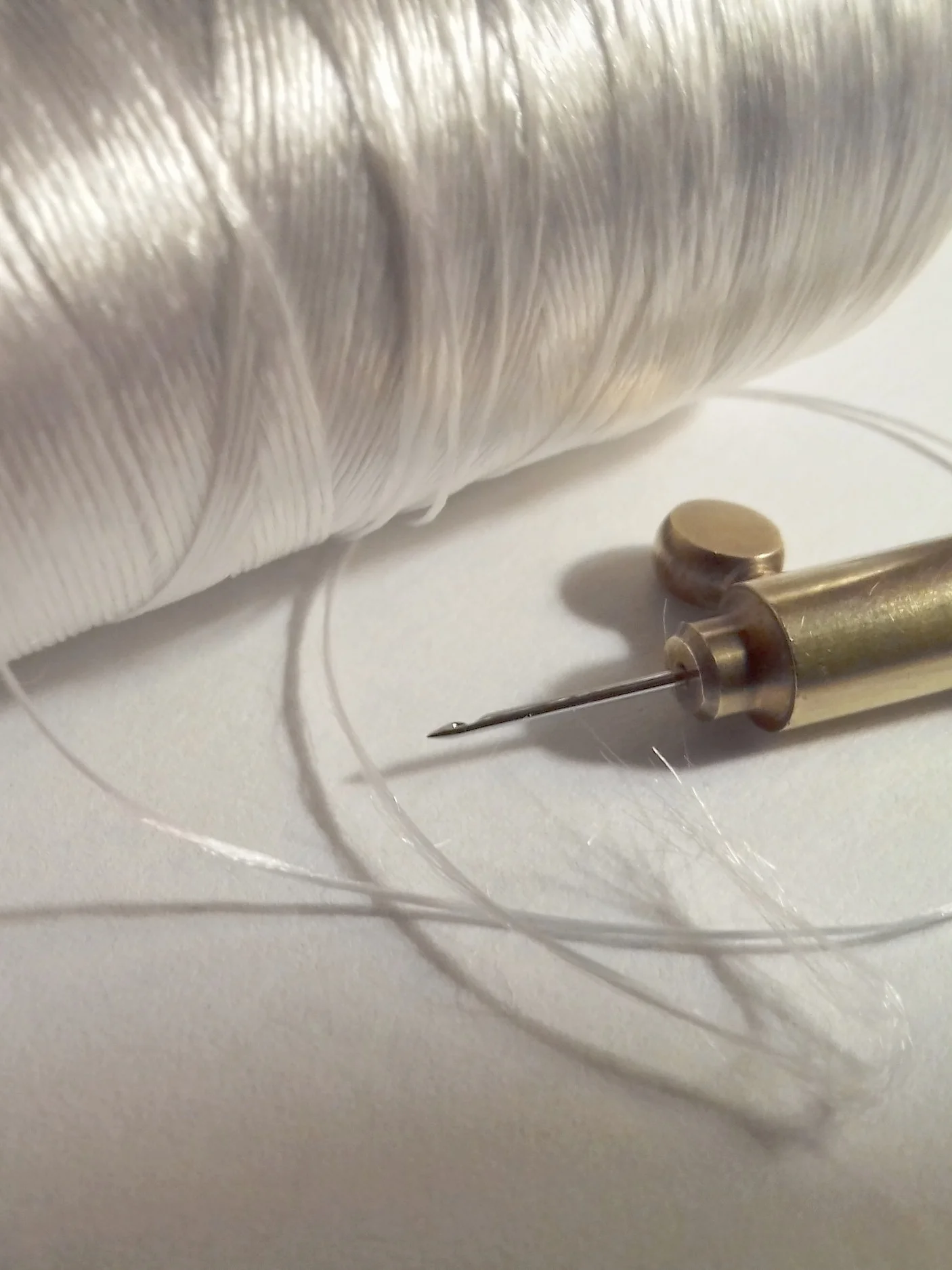
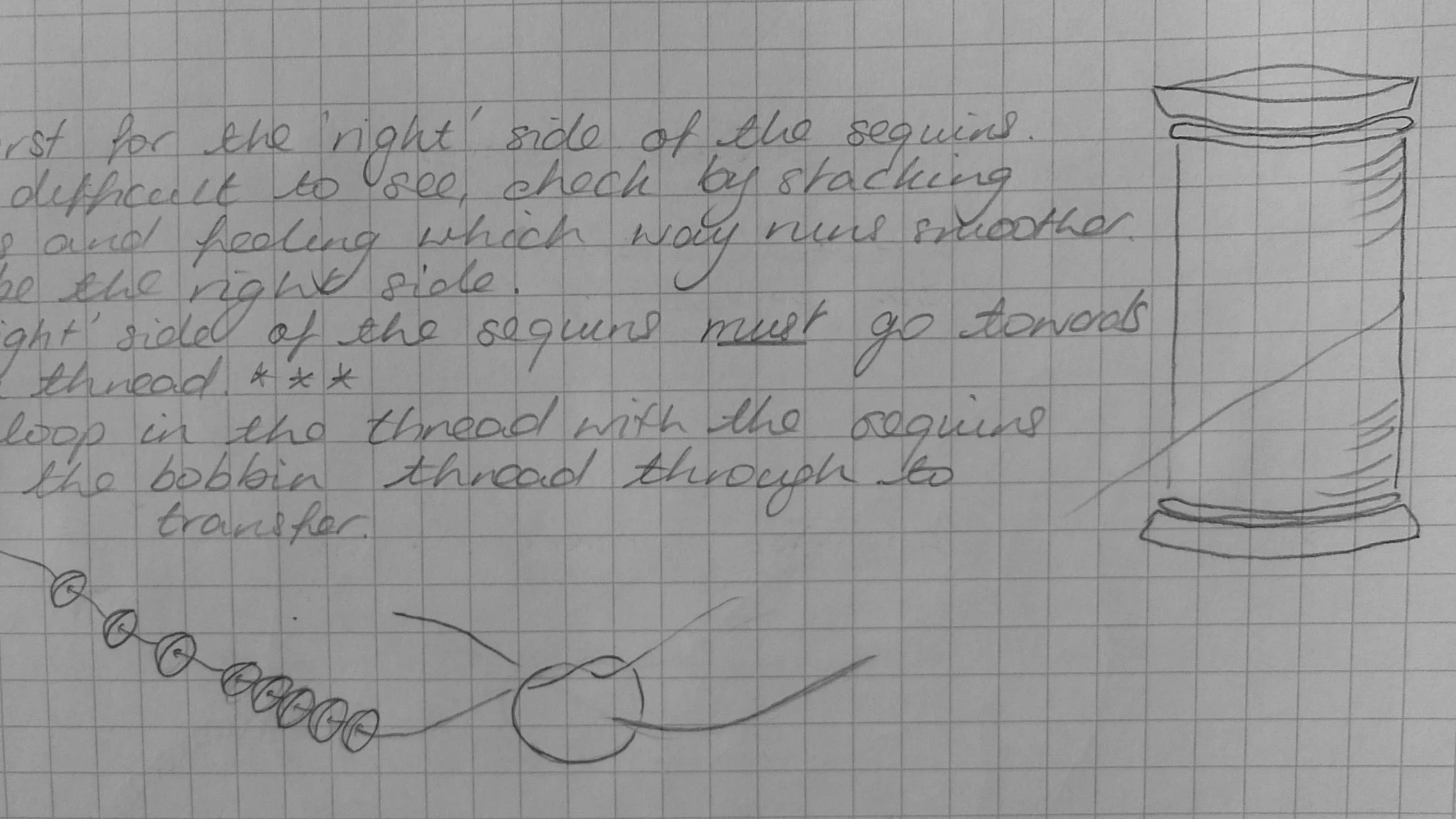
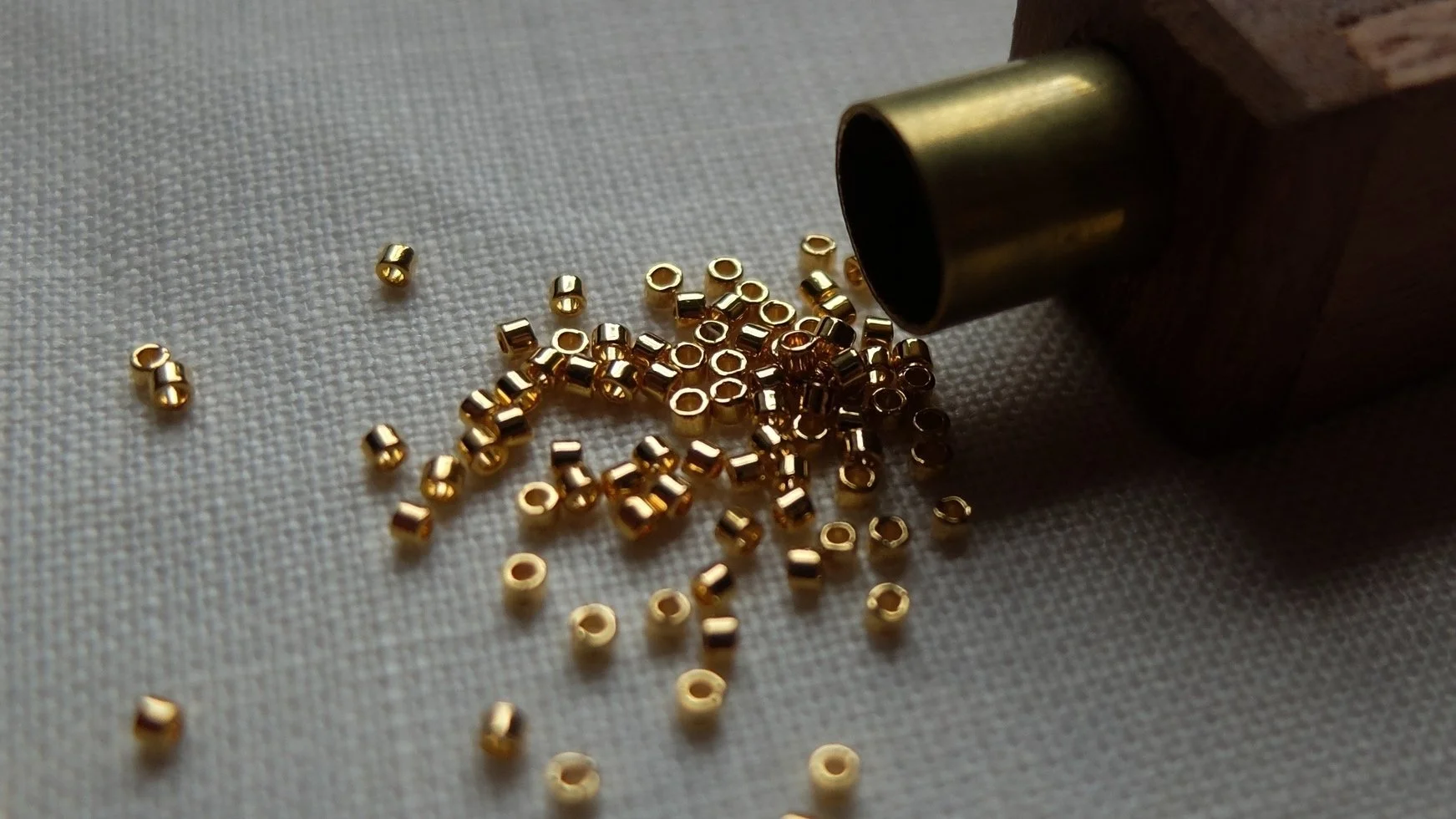
One of the first things you learn about sequins is that there is a right-side and a wrong-side.   Before threading them onto the bobbin thread you must find out which is which and there are a few tricks for this such as finding the minuscule lip on the wrong side that is created when the sequins are stamped out of sheets of plastic or metal, or feeling for a smooth and rough surface when the beads are stacked vertically or observing if they rest in a slanting slope or bumpy hill on your finger. I had to ask the teacher each time and then made sure to remember the trick for tying the loop in the string of sequins and then passing the bobbin thread through. 

Threading sequins

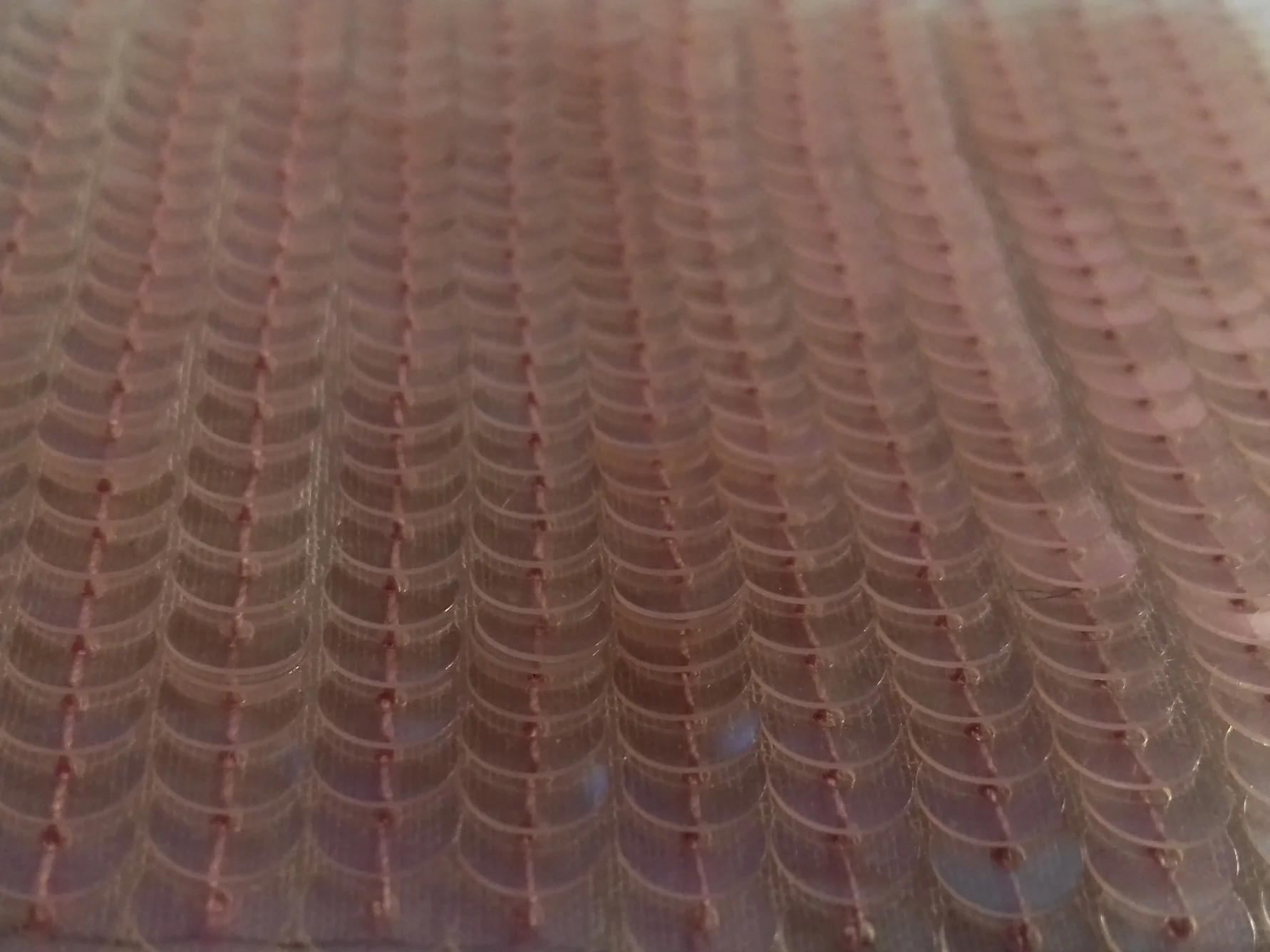
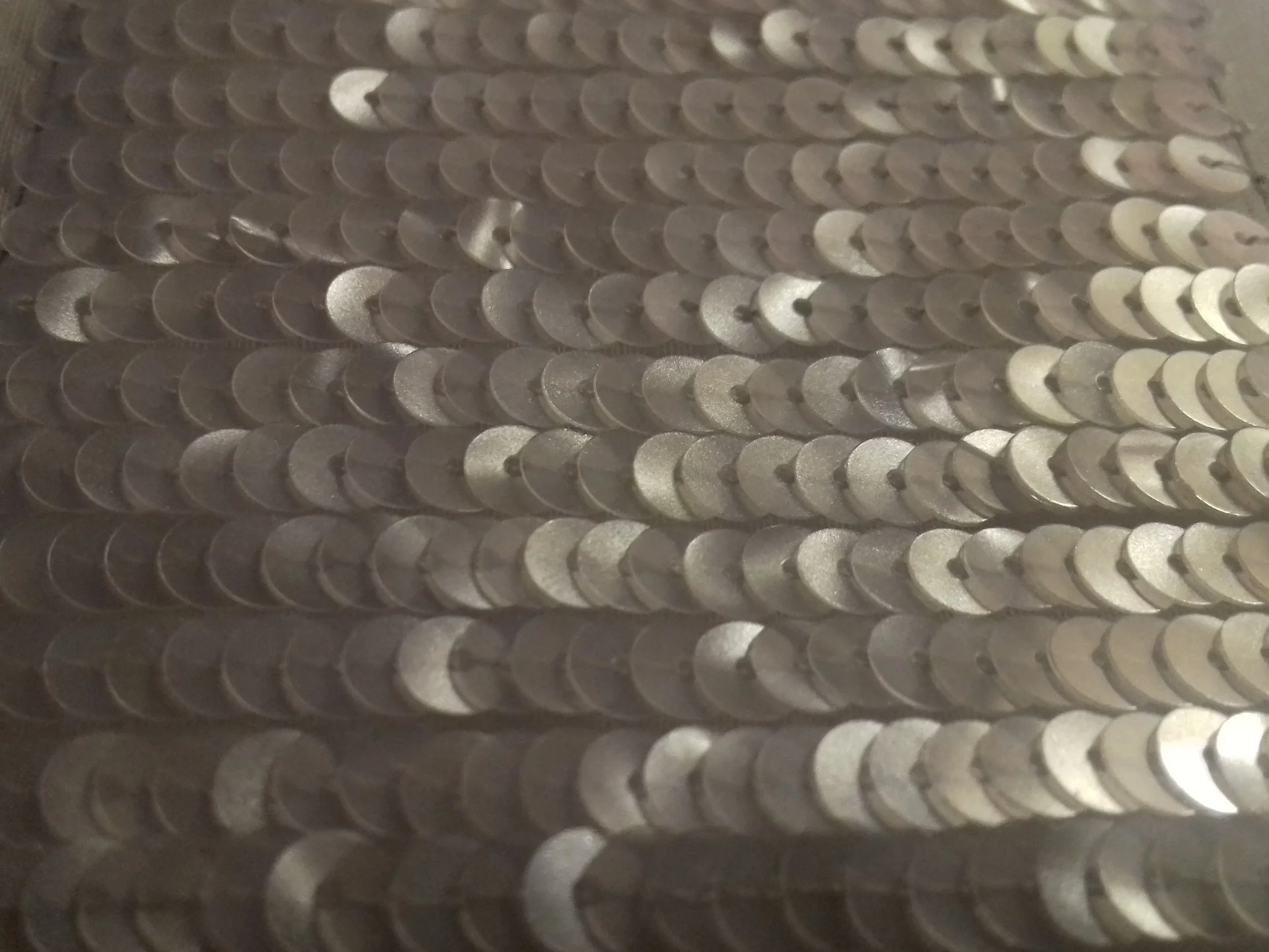
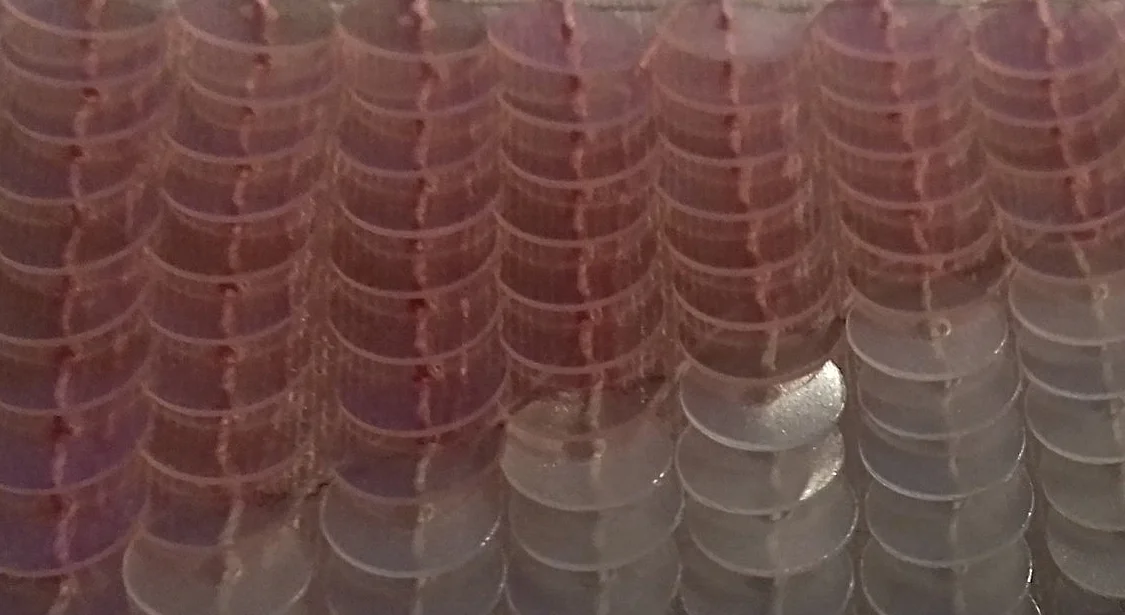
Applying sequins in a river 

20171126_111141_Richtone(HDR).jpg
20171126_111159_Richtone(HDR).jpg

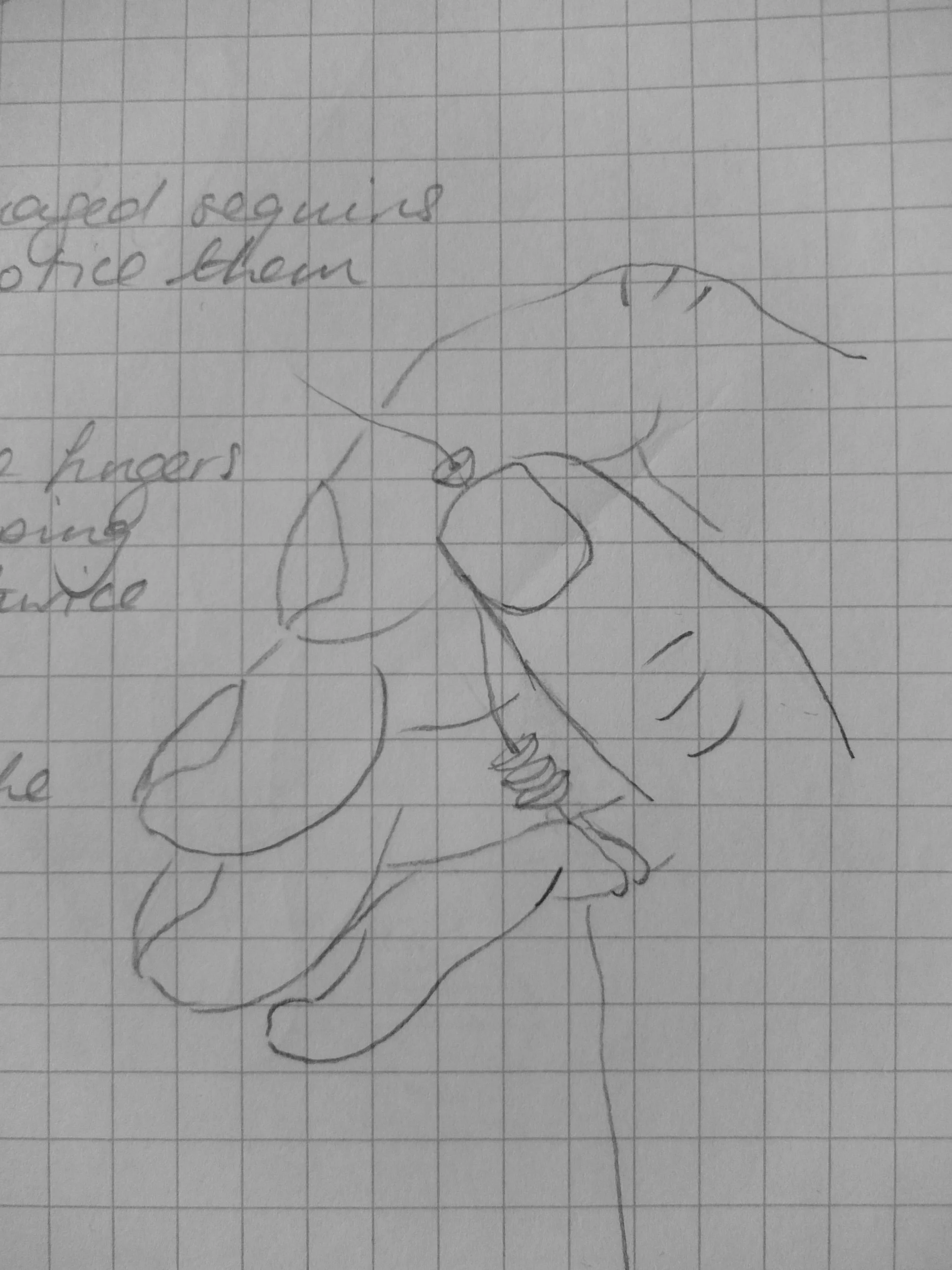
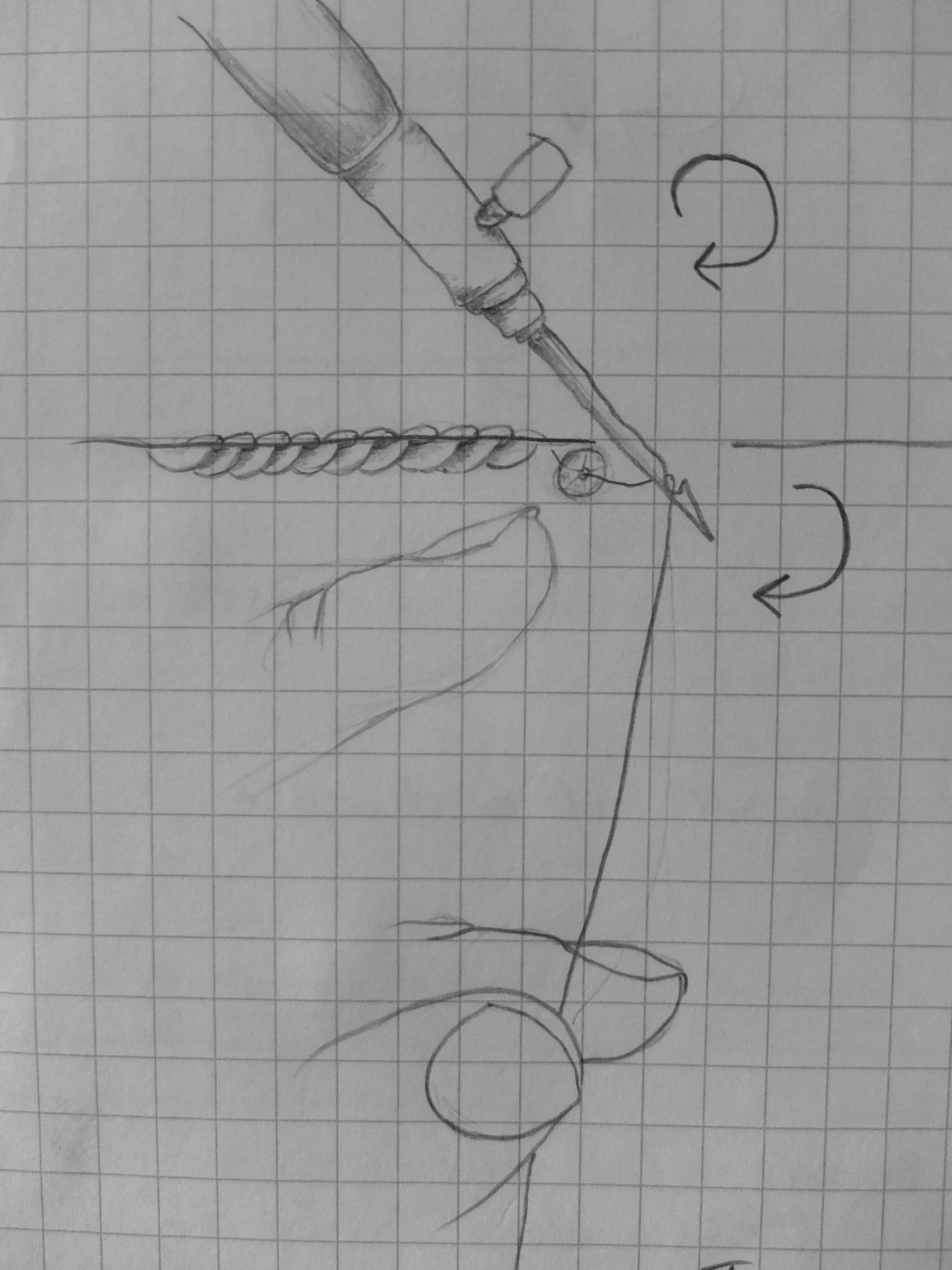
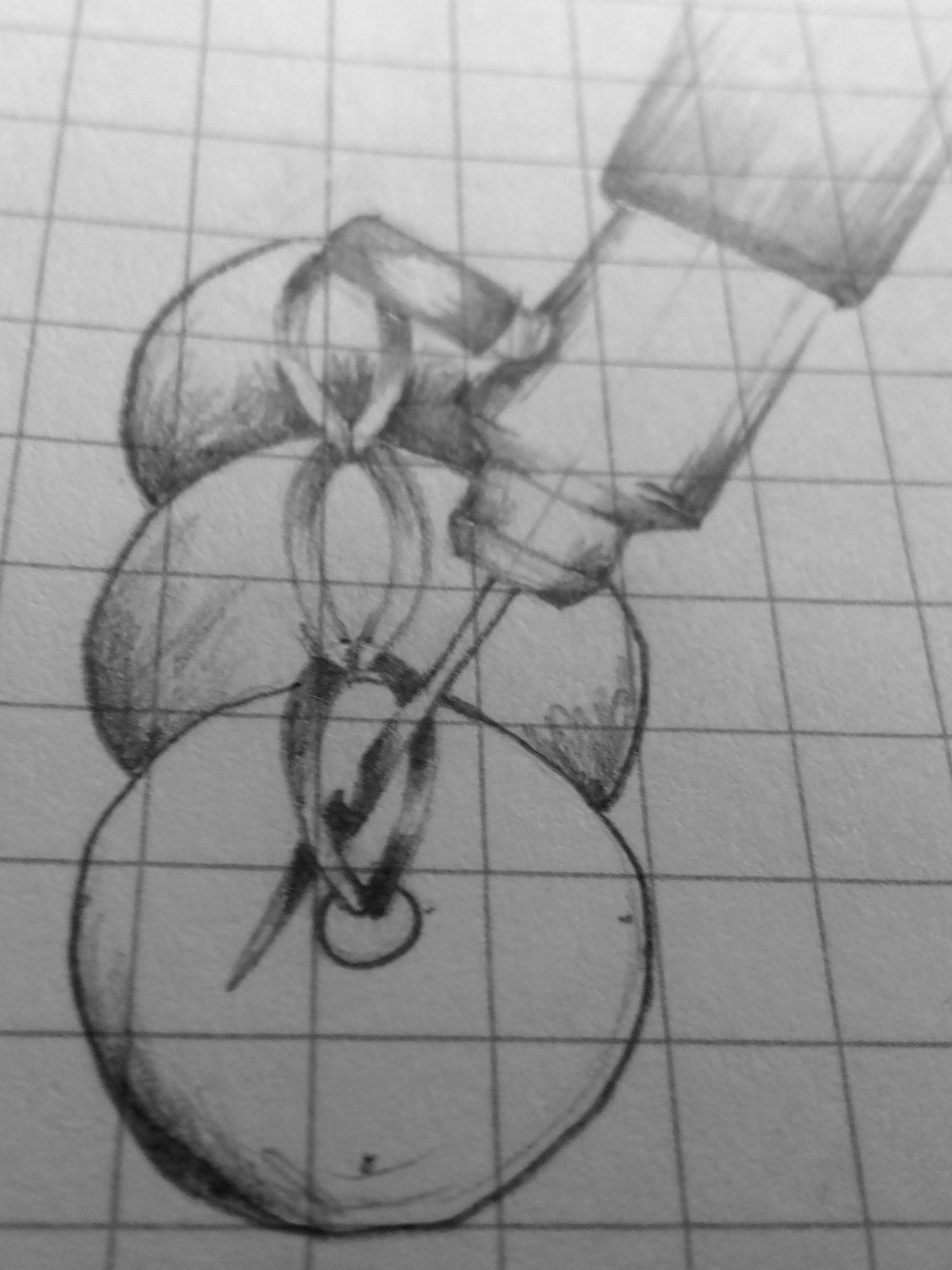
Gather some sequins from the bobbin and wrap the thread around the fingers on your left hand as for knitting. Separate and feed the sequins using your thumb and index finger.

Place the sequin behind the hook and then loop the thread around with your finger. The hook remains vertical and static, it is the left hand that moves. Once the thread is attached, rotate the hook and then pull to the surface. Remember to keep the tension by holding the bobbin thread vertical. 

It is very important with sequins that you respect the direction of the design which is usually marked with a little arrow. The direction that you apply the beads will determine how they overlap so it is worth remembering!

DSCF5648.JPG
DSCF5649.JPG

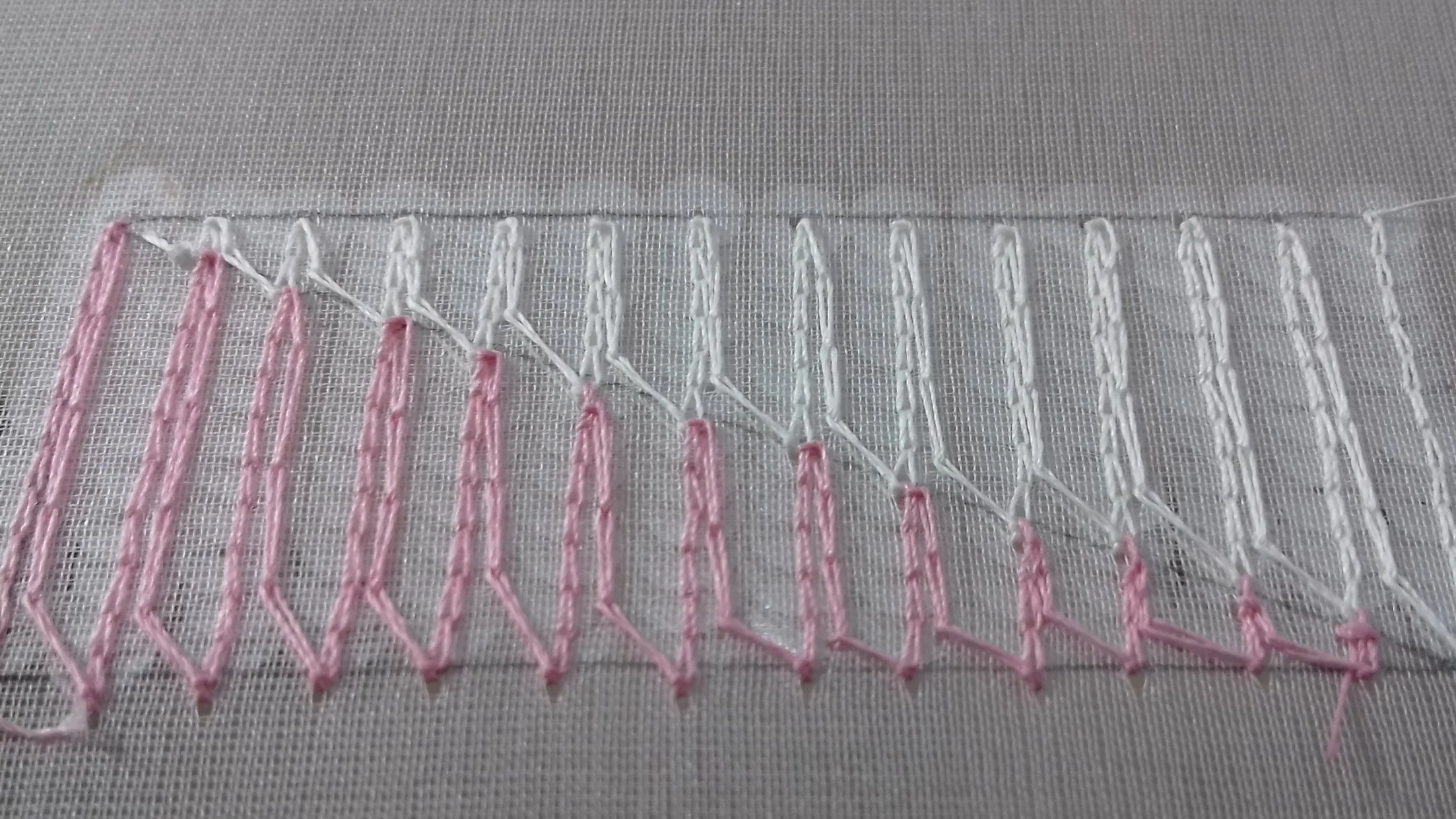
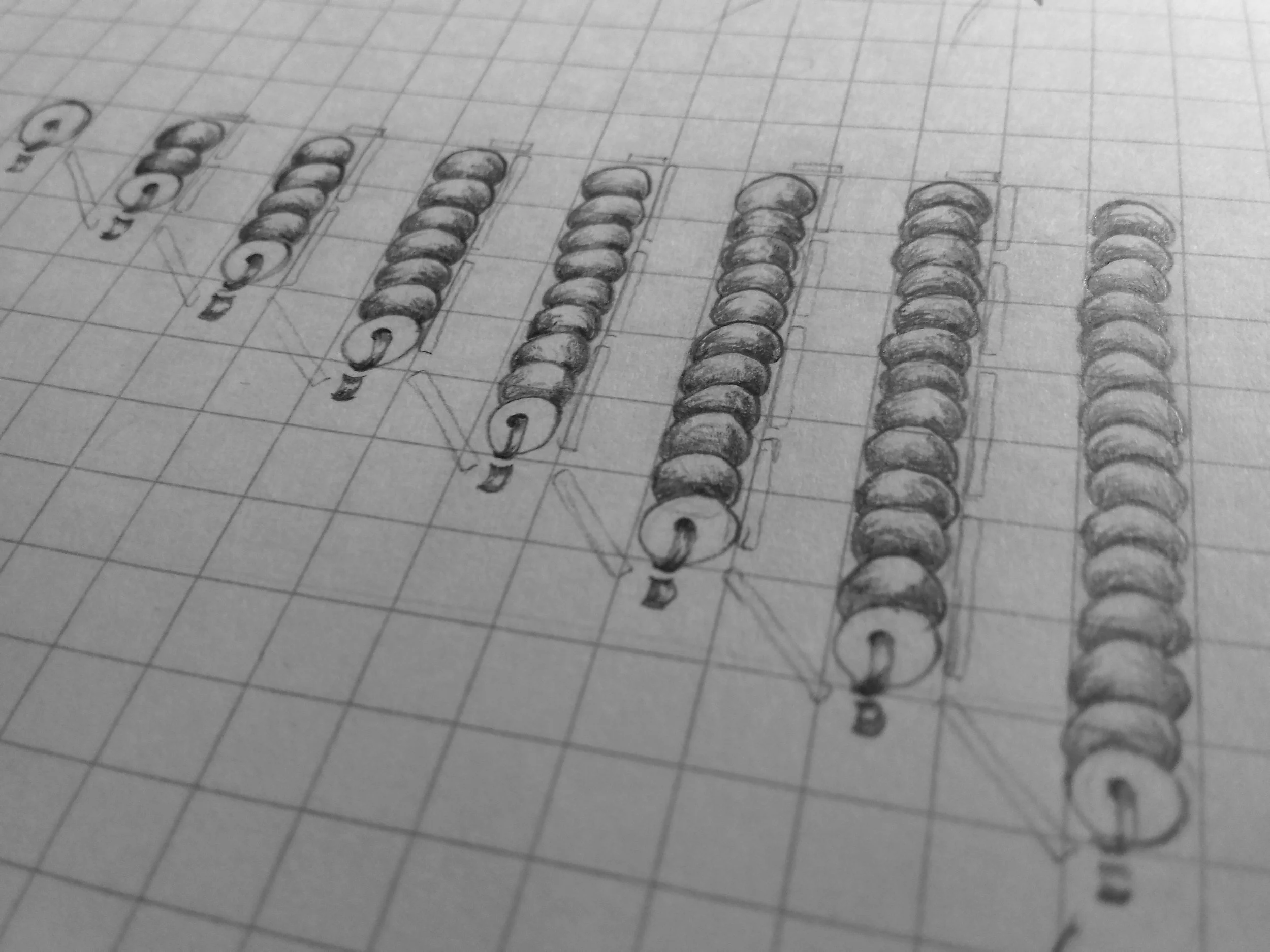
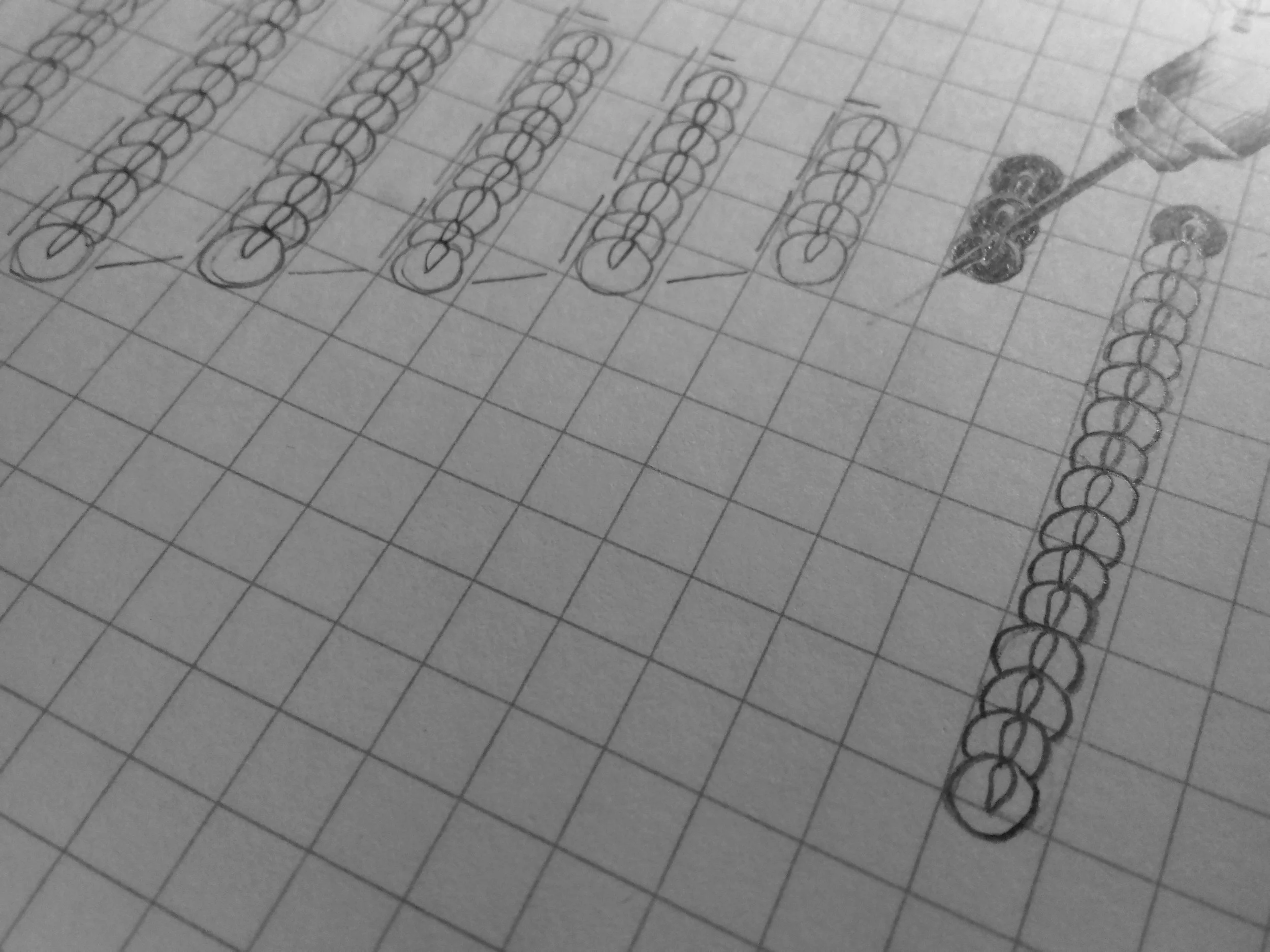
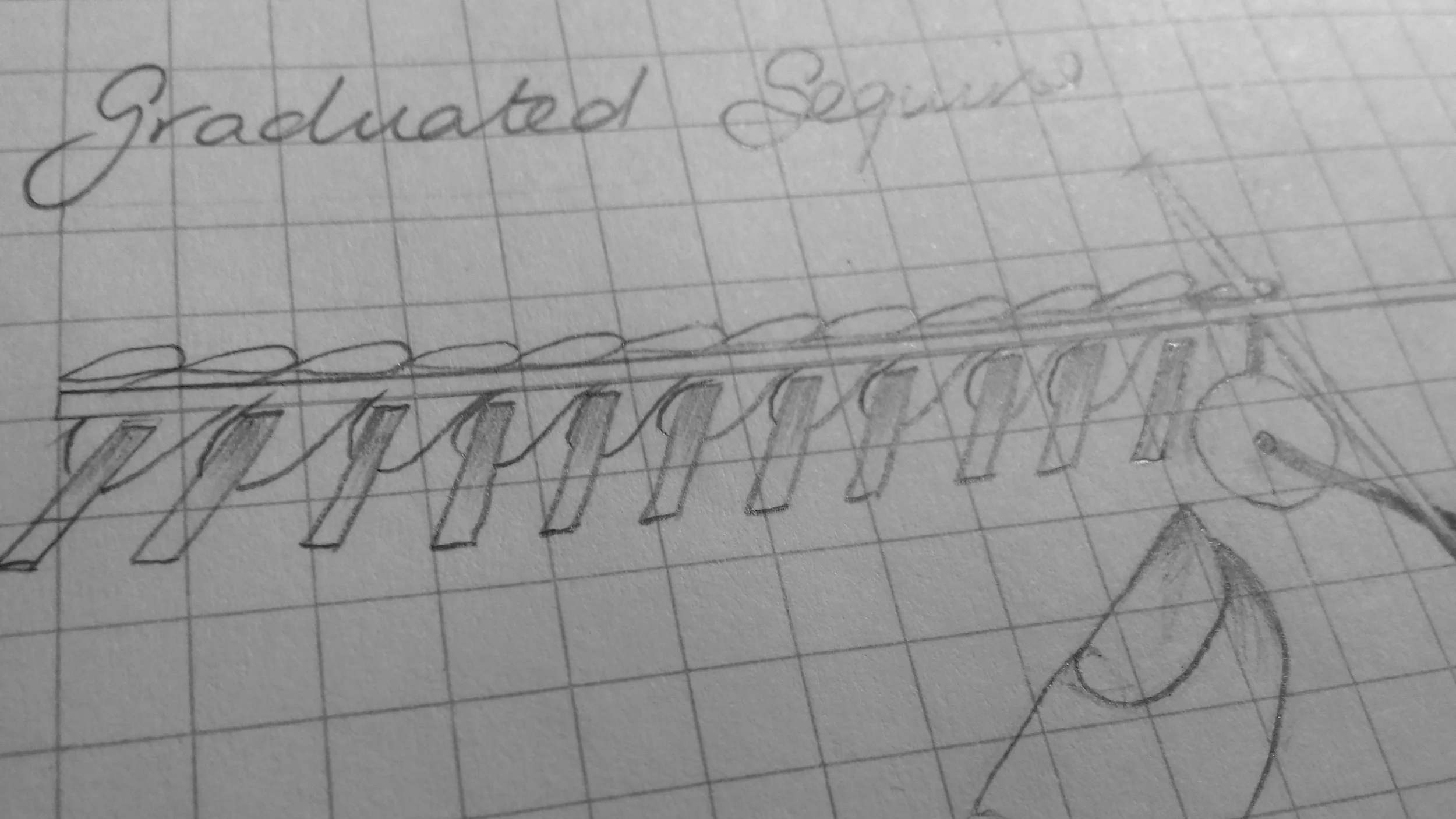
Graduated sequins

Graduated sequins
Graduated sequins.jpg

Apply sequins in a river and at the end of the row or column do a small stitch to hold the tension. Then do a diagonal stitch back towards the beginning of the next row and continue straight to the top. Change direction and apply the sequins in a river again until the design for the first colour is completed. Change the sequins on the bobbin thread or change the bobbin thread.

Bring the hook through the last chain stitch of the last sequin and continue applying the sequins in a row in the new colour. When the row is complete do a diagonal stitch back towards the next row and continue until the last sequin of the first colour.

Sampler55.jpg
20171126_131854_Richtone(HDR).jpg
20171126_131915_Richtone(HDR).jpg
graduated sequins.jpg

Textile Tours of Paris

Join Rebecca on a tour of Paris’ charming haberdasheries nestled deep in the winding streets of Le Sentier, the city’s historic textile and fashion district. Enjoy a Sunday morning with Rebecca on a Flea Market Tour as she guides you through the labyrinth alleys of Paris’ oldest marché-aux-puces to uncover hidden treasure troves filled with vintage lace, linen, passementerie, golden threads and gossamer lingerie. To find out more visit Textile Tours of Paris.
← Newer Posts Older Posts →
Featured
Les Petites Mains à Paris
Nov 25, 2019
Les Petites Mains à Paris
Nov 25, 2019
Nov 25, 2019
Fried Frères: A Cornucopia of Beads and Sequins
Sep 7, 2019
Fried Frères: A Cornucopia of Beads and Sequins
Sep 7, 2019
Sep 7, 2019
Mokuba: a Japanese Passementerie in Paris
Jul 28, 2019
Mokuba: a Japanese Passementerie in Paris
Jul 28, 2019
Jul 28, 2019
Au Ver à Soie: the Finest French Silk Threads
Jul 21, 2019
Au Ver à Soie: the Finest French Silk Threads
Jul 21, 2019
Jul 21, 2019
Maison Legeron: the Fanciest Feathers and Flowers
Jul 8, 2019
Maison Legeron: the Fanciest Feathers and Flowers
Jul 8, 2019
Jul 8, 2019
Ultramod: The Oldest Haberdashery in Paris
Jun 22, 2019
Ultramod: The Oldest Haberdashery in Paris
Jun 22, 2019
Jun 22, 2019
The Origins of Haute Couture: from Rue de la Paix to Le Sentier
Jun 15, 2019
The Origins of Haute Couture: from Rue de la Paix to Le Sentier
Jun 15, 2019
Jun 15, 2019
Au Revoir École Lesage!
Jun 3, 2019
Au Revoir École Lesage!
Jun 3, 2019
Jun 3, 2019
A 1950s Floral Confection
Jun 3, 2019
A 1950s Floral Confection
Jun 3, 2019
Jun 3, 2019
Les Midinettes
Jun 2, 2019
Les Midinettes
Jun 2, 2019
Jun 2, 2019
Paraffection
Mar 20, 2019
Paraffection
Mar 20, 2019
Mar 20, 2019
Et Voilà! La Pièce de Résistance...
Mar 15, 2019
Et Voilà! La Pièce de Résistance...
Mar 15, 2019
Mar 15, 2019
Arabesque Accents
Jul 7, 2018
Arabesque Accents
Jul 7, 2018
Jul 7, 2018
Flights of Fancy
Jul 6, 2018
Flights of Fancy
Jul 6, 2018
Jul 6, 2018
Golden Highlights
Jul 5, 2018
Golden Highlights
Jul 5, 2018
Jul 5, 2018
20180122_094804_Richtone(HDR).jpg
May 16, 2018
Silk Flowers and Strenuous Hours
May 16, 2018
May 16, 2018
Dancing Deer
Apr 22, 2018
Dancing Deer
Apr 22, 2018
Apr 22, 2018
Embroidered Scallops
Apr 15, 2018
Embroidered Scallops
Apr 15, 2018
Apr 15, 2018
Ornate Details
Apr 15, 2018
Ornate Details
Apr 15, 2018
Apr 15, 2018
Brilliant Blooms
Apr 8, 2018
Brilliant Blooms
Apr 8, 2018
Apr 8, 2018
Bon Marche
Mar 28, 2018
Les Grands Magasins
Mar 28, 2018
Mar 28, 2018
Adding a Dramatic Flourish
Mar 18, 2018
Adding a Dramatic Flourish
Mar 18, 2018
Mar 18, 2018
 C'est la Haute Couture
Mar 18, 2018
C'est la Haute Couture
Mar 18, 2018
Mar 18, 2018
The Timeless Allure of Maison Sajou
Mar 10, 2018
The Timeless Allure of Maison Sajou
Mar 10, 2018
Mar 10, 2018
First Things First
Mar 10, 2018
First Things First
Mar 10, 2018
Mar 10, 2018
On y va!
Mar 10, 2018
On y va!
Mar 10, 2018
Mar 10, 2018
20171016_123915.jpg
Dec 19, 2017
Saving the Best for Last
Dec 19, 2017
Dec 19, 2017
20171218_150236_Richtone(HDR).jpg
Dec 3, 2017
Pulling my hair out!
Dec 3, 2017
Dec 3, 2017
20171012_180611_Richtone(HDR).jpg
Dec 3, 2017
Bibliothèque Forney
Dec 3, 2017
Dec 3, 2017
Schiaparelli 1948.jpg
Nov 26, 2017
Sequinsational
Nov 26, 2017
Nov 26, 2017